

Key Takeaways
- Deception technology shifts incident response from reactive to proactive by detecting attackers early through decoys, honeytokens, and fake credentials.
- High-confidence alerts eliminate false positives, reducing alert fatigue and enabling faster, more precise response.
- It improves detection of identity-based attacks, lateral movement, and insider threats across hybrid environments.
- Automation and XDR integration accelerate containment, reduce dwell time, and streamline security operations.
- Platforms like Fidelis Elevate enhance visibility, support threat hunting, and generate actionable, organization-specific threat intelligence.
Cybersecurity has become unnecessarily complex. Modern threat actors have refined network infiltration techniques while many organizations continue operating with outdated response methodologies. Traditional security measures are proving insufficient against contemporary attack vectors, particularly advanced persistent threats that operate undetected for extended periods.
Security operations centers process thousands of daily alerts, with most representing false positives. During alert investigation periods, genuine attackers advance deeper into network infrastructure. This scenario resembles locating specific evidence within continuously expanding volumes of irrelevant data.
Deception technology provides a paradigm shift, enabling active adversary misdirection rather than purely defensive postures.
Limitations of Conventional Incident Response
Most organizations function reactively—alerts trigger investigations intended to minimize damage. Attackers often maintain undetected presence for extended periods. According to the Unit 42 Global Incident Response Report 20261, the fastest attacks now reach data exfiltration in as little as 72 minutes, a fourfold acceleration driven by AI-enabled attack automation.
Alert fatigue significantly impacts threat detection effectiveness. Analysts process excessive volumes of non-actionable notifications, creating conditions where legitimate threats escape notice. Traditional security measures struggle against sophisticated adversaries who deliberately exploit these operational limitations.
Signature-based detection dependencies allow sophisticated adversaries to develop evasion techniques that circumvent conventional security mechanisms. Advanced persistent threats particularly benefit from these detection gaps, maintaining persistence while avoiding traditional security measures designed for known attack patterns.
Efficacy of Deception Technologies
Deception strategies deploy fabricated resources—including counterfeit credentials, decoy systems, and breadcrumb files—designed to attract and capture adversarial interactions. When organizations deploy deception strategically, they create environments where any unauthorized access triggers immediate alerts.
Interactions with these contrived assets generate high-confidence alerts indicating definitive malicious activity. No legitimate operational requirements exist for accessing deceptive resources, making every interaction inherently suspicious. This approach delivers fewer false positives compared to traditional detection methods that struggle with legitimate user behavior patterns.
Modern deception platforms adapt in real time, adjusting breadcrumb placement and decoy exposure based on observed attacker behavior. Coverage now extends across network, endpoint, cloud, and Active Directory environments, addressing the multi-surface attack patterns that characterized 87% of intrusions investigated in 2025.
How Deception Technology Addresses Identity-Based Attacks
Identity-based attacks have become the dominant intrusion method, with identity weaknesses contributing to nearly 90% of investigated intrusions and 65% of initial access involving credential theft, MFA bypass, or misconfigured access controls. Attackers using valid credentials generate few anomalous signals, making them difficult for SIEMs and EDR tools to detect.
Deception technology closes this gap by seeding the environment with fabricated credentials, synthetic Active Directory accounts, and honeytoken files placed in locations that credential-harvesting tooling naturally reaches. Legitimate users have no operational reason to interact with these assets. Attackers performing reconnaissance almost certainly will. Any interaction triggers an immediate, high-confidence alert tied to a specific identity, source, and timestamp — giving incident response teams a precise starting point rather than a set of ambiguous signals to correlate.
This capability is particularly relevant for lateral movement detection. When an attacker uses a captured credential to probe adjacent systems, deceptive assets placed along likely traversal paths intercept that movement early, before critical infrastructure is reached.
- Reconnaissance and Lateral Movement Detection
- Provide SOC with Clear Visibility
- Extend Detection Across Hybrid Environments

Detecting Insider Threats with Deception
Insider threats present a detection challenge that conventional tools handle poorly, because insiders hold legitimate credentials and generate behavior that resembles normal activity. Deception technology applies the same detection logic regardless of whether the attacker is external or internal: no legitimate workflow requires accessing fabricated assets.
When an insider interacts with a honeytoken, a deceptive file share, or a synthetic privileged account, the platform generates the same high-confidence alert as any external intrusion, with identity context that can support both technical response and, where warranted, HR or legal escalation. The Mandiant M-Trends 2026 report specifically highlighted North Korean IT worker operations as a growing insider threat vector, with those cases carrying a median dwell time of 122 days; exactly the detection gap that deception-based tripwires are built to close.
Mitigation of False-Positive Burden
Alert fatigue represents one of cybersecurity’s most significant operational challenges. When analysts process thousands of daily alerts with most proving irrelevant, genuine threats inevitably escape detection within overwhelming noise. Traditional security measures generate excessive false positives that mask legitimate security incidents.
Deception technology addresses this fundamental problem by providing alerts with inherent confidence levels that conventional tools cannot match. Since legitimate users have no reason to access deceptive assets, any interaction definitively represents confirmed malicious activity. This approach yields fewer false positives than any traditional detection methodology.
This clarity transforms security team operations completely. Rather than spending hours investigating questionable alerts, analysts can respond confidently to deception alerts, knowing each represents genuine security incidents requiring immediate attention. Organizations implementing these approaches report dramatic reductions in false positives across their security operations.
Generation of Customized Threat Intelligence
Most organizations depend on external threat intelligence feeds that frequently lack context specific to their unique environments. Deception technology reverses this dynamic through internal threat intelligence creation, generating actionable insights through detailed analysis of how attackers interact with organizational deceptive assets.
When threat actors engage with deception layers, platforms capture comprehensive behavioral data including attack methodologies, tool preferences, and target selection patterns. This intelligence directly relates to specific attack surfaces and threat landscapes, making it significantly more actionable than generic external feeds.
Intelligence value compounds over time as systems build detailed profiles of threat actors targeting specific organizations. These profiles help security teams refine detection rules, enhance response procedures, and strengthen defenses against similar attack campaigns, particularly advanced persistent threats that require extended observation periods.
Quantifiable Organizational Benefits
Organizations implementing deception technology consistently report significant reductions in Mean Time to Detect (MTTD). The Mandiant M-Trends 2026 report2 puts the global median attacker dwell time at 14 days, while organizations that rely on internal detection reduced that figure to 9 days. Deception technology compresses detection further still by generating alerts the moment an attacker touches a fabricated asset, eliminating the dwell time that accumulates while analysts work through alert backlogs. These reductions translate directly into improved Mean Time to Respond (MTTR), reducing the window available for lateral movement, data staging, and exfiltration.
False positive reduction represents another critical success metric. Organizations report significant decreases in analyst workload due to high-confidence deception alerts, enabling security teams to focus expertise on genuine threats while reducing operational stress and fatigue. These implementations consistently deliver fewer false positives than any traditional security measures.
Internal threat intelligence creation through deception interactions proves more relevant and actionable than generic external feeds, driving improved security investment decisions and more effective threat prioritization.
Choosing Your Deception Strategy
Understanding available deception options helps organizations make informed decisions based on specific needs and operational constraints.
| Approach | Advantages | Disadvantages |
|---|---|---|
| Open Source Tools |
|
|
| Commercial Platforms |
|
|
The ultimate decision depends on organizational technical capabilities, budget constraints, and integration requirements. Organizations must evaluate whether to deploy deception through internal resources or commercial solutions.
How Fidelis Elevate Changes the Game with Integrated Deception
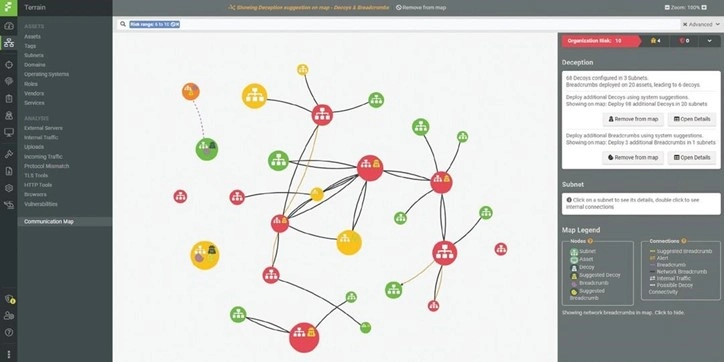
Fidelis Elevate integrates deception concepts within a comprehensive XDR platform, consolidating fragmented security tools into unified operational frameworks. Organizations gain centralized systems that continuously map cyber terrain while strategically positioning deceptive assets throughout infrastructure.
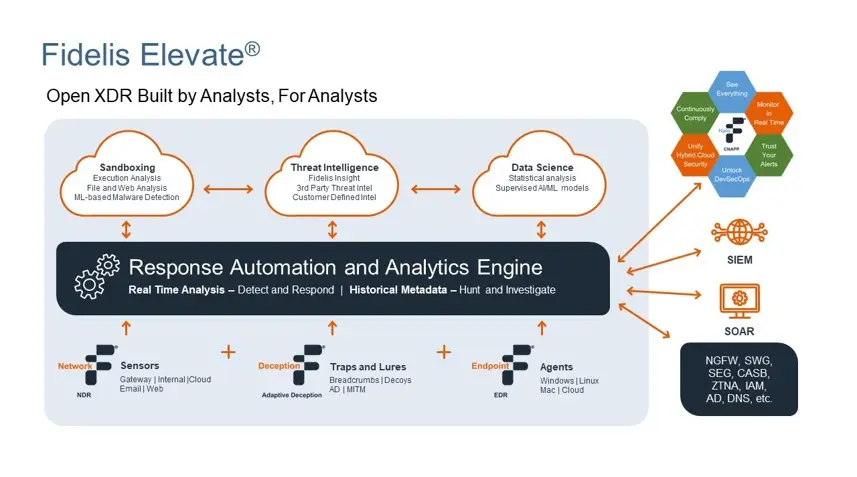
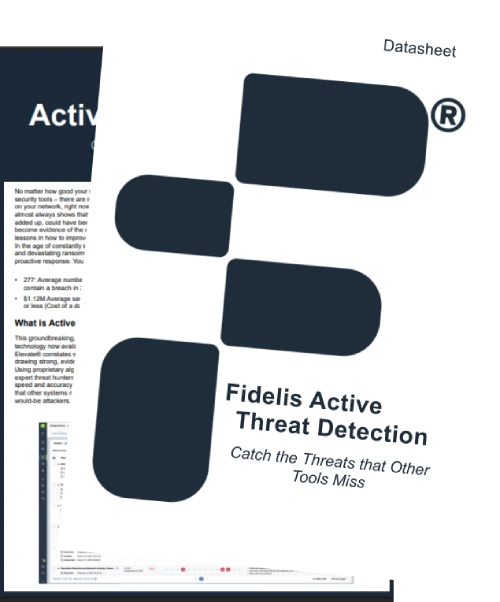
The platform’s Active Threat Detection capability correlates weak signals across multiple attack phases, generating high-confidence conclusions rather than overwhelming security teams with additional alerts. This approach significantly reduces false positives while providing actionable intelligence during genuine incidents.
Fidelis Elevate distinguishes itself through terrain-based methodologies, helping organizations understand attack surfaces from adversarial perspectives. This understanding proves essential for developing effective incident response procedures focused on areas where attackers typically concentrate efforts, particularly when dealing with advanced persistent threats.
- Detect and Correlate Weak Signals
- Active Threat Detection
- Evaluate Findings Against Known Attack Vectors
- Proactively Secure Systems
Automation in Incident Response
Deception-based detection eliminates traditional alert validation phases. When deception alerts activate, security teams can proceed with immediate confidence, knowing alerts represent legitimate malicious activity rather than requiring time-consuming verification procedures. This eliminates the false positives burden that traditionally overwhelms security operations.
This transformation enables entirely new incident response automation approaches. Teams can initiate containment and investigation protocols immediately rather than dedicating resources to alert validity determination.
Machine learning capabilities enhance efficiency through continuous attack pattern analysis and automatic deception deployment adjustments. Systems learn from each encounter, becoming increasingly sophisticated in trap placement and making deceptive assets more attractive when attackers engage with organizational infrastructure.
Integration capabilities represent significant advantages. Fidelis Elevate connects seamlessly with major security platforms including Splunk, IBM QRadar, and Palo Alto Cortex XDR. This connectivity means deception intelligence enhances existing workflows rather than requiring operational restructuring.
Strategic Deployment Methodologies
Effective approaches to deploy deception require thoughtful strategic planning rather than random asset distribution throughout network environments. Successful implementations embed fabricated credentials within memory locations, registry entries, and configuration files to intercept credential theft attempts at source points. Active Directory integration enables deployment of deceptive users and groups that trigger alerts during reconnaissance activities.
Cloud and IoT deception capabilities prove particularly valuable in contemporary hybrid environments. Traditional security measures often struggle with distributed infrastructures, but deceptive cloud services and fabricated IoT devices integrate seamlessly with legitimate assets while providing comprehensive threat visibility.
Success depends on making deceptive assets attractive when attackers engage while maintaining complete invisibility to legitimate users. Advanced platforms accomplish this through intelligent naming conventions, strategic vulnerability placement, and automated breadcrumb deployment that effectively guides attackers toward prepared traps.
Precision Threat Hunting and Platform Integration
Traditional threat hunting often resembles searching without clear direction. Deception technology transforms this process into targeted engagement by focusing hunting activities specifically on areas where deceptive assets have been strategically deployed.
Fidelis Elevate’s terrain mapping capabilities enable precision threat hunting by identifying high-risk areas where attackers typically focus efforts. Security teams can deploy additional deceptive resources in these locations, creating early warning systems specifically designed to detect advanced persistent threats before they reach critical assets.
Integration with threat intelligence feeds enhances hunting capabilities by correlating deception interactions with known attack patterns and indicators of compromise. This provides valuable context for hunting activities while enabling more effective investigation prioritization, particularly against sophisticated advanced persistent threats.
Ensuring Seamless Technological Integration
One of implementing new security technologies’ most significant challenges involves achieving compatibility with existing infrastructure. Traditional security measures often create integration complexity that deception platforms must address. Fidelis Elevate’s open architecture supports seamless integration with leading security platforms without requiring complete workflow redesigns.
The platform’s comprehensive API framework enables custom integrations for organizations with unique operational requirements. Integration with SOAR platforms enables automated response actions when deception alert thresholds are exceeded, significantly reducing mean time to response across security operations.
Future-Proofing Cyber Defense
Attackers are now using AI to automate reconnaissance, generate phishing lures at scale, and compress the time between initial access and data exfiltration. Attack speeds quadrupled year-over-year in 2025, with threat actors routinely using AI across reconnaissance, scripting, and lateral movement phases. Deception technology provides inherent resilience against unknown threats because deceptive assets should never be accessed by legitimate users, regardless of the attack methodology being used.
This characteristic enables deception technology detect capabilities particularly valuable for identifying zero-day exploits, novel malware variants, and previously unknown attack techniques that might evade signature-based detection systems. Organizations can maintain effective incident response capabilities even against completely novel threats through strategic approaches to deploy deception across their infrastructure.
Strategic Investment in Proactive Defense
Building effective incident response capabilities in today’s threat landscape requires moving beyond reactive security models toward proactive threat engagement strategies. Traditional security measures prove inadequate against sophisticated adversaries who understand conventional detection limitations.
Deception technology, particularly when integrated with comprehensive XDR platforms like Fidelis Elevate, provides the foundation for this critical transformation. Organizations implementing deception-enhanced incident response consistently report significant improvements across multiple operational metrics: faster threat detection, reduced analyst workload, and enhanced threat intelligence quality.
These benefits compound over time, creating increasingly effective security operations that maintain competitive advantages against evolving threats. The integration of deception with extended detection and response capabilities represents the next evolution in cybersecurity operations, offering proven pathways toward more effective threat management and improved organizational resilience against sophisticated adversaries and advanced persistent threats.
Our customers detect post-breach attacks over 9x Faster
- Detect Advanced Threats Before Damage Escalates Trusted
- Cybersecurity Leader for 20+ Years
- See why security teams choose us over other solutions
Key technical terms mentioned in this article are linked below for further exploration: