

Key Takeaways
- Modern security teams struggle with high alert volumes and delayed breach detection, often taking over 240 days to respond effectively.
- Active threat detection correlates multi-layer telemetry in real time, enabling faster identification of coordinated attack activity.
- Fidelis Elevate® uses Deep Session Inspection to analyze full traffic context, including encrypted and complex data structures.
- Correlation algorithms map signals to MITRE ATT&CK, improving detection accuracy and reducing false positives.
- Integrated evidence collection and scoring accelerate investigations, enabling faster, more confident incident response.
Modern security teams face a dual challenge: they’re bombarded with alerts while still missing the critical signals that indicate real threats. According to IBM’s 2025 Cost of a Data Breach Report, organizations took an average of 241 days to identify and contain a breach in the most recent study period, the fastest response time in nine years. Organizations that extensively deployed AI and automation identified and contained breaches significantly faster than those that did not, cutting the breach lifecycle by roughly 80 days.
Fidelis Active Threat Detection™ closes this gap: it correlates weak signals across multiple phases of an attack, works as a proactive threat detection engine, and hands analysts the context they need for a fast, active threat response. Here’s how the underlying active threat detection system works inside the Fidelis Elevate® platform, and what to look for if you’re comparing options.
What is an active threat detection system?
An active threat detection system continuously correlates network, endpoint, deception, identity, and cloud telemetry to detect threat actor activity in real time, rather than waiting for isolated alerts or signature matches. It’s a core layer of active cyber defense, built to surface active threats with enough evidence for an analyst to act on immediately.
Security teams now contend with increasingly automated intrusion campaigns that compress reconnaissance, credential abuse, and lateral movement into minutes rather than days, making continuous signal correlation more important than ever.
The Technical Foundation of Active Threat Detection
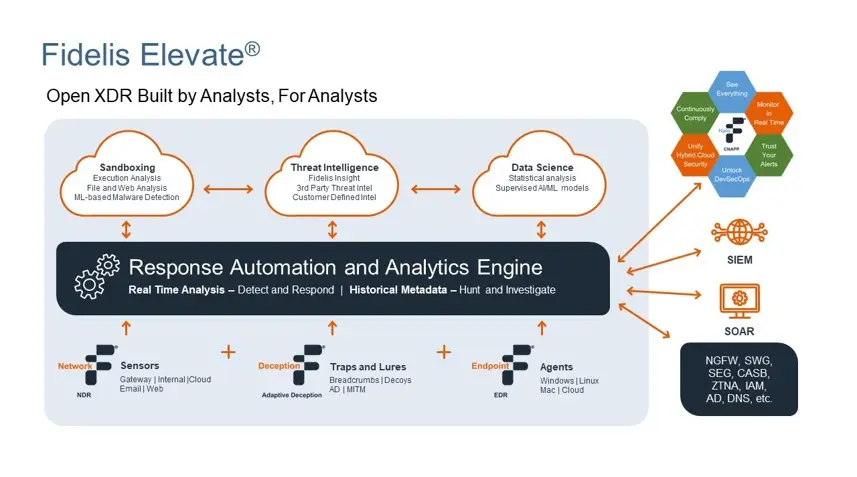
Fidelis Active Threat Detection™ operates as an integral component of the Fidelis Elevate® XDR framework. Rather than functioning as a standalone solution, it leverages multiple data streams from across the security infrastructure to build comprehensive threat intelligence.
Deep Session Inspection: The Core Detection Engine
At the foundation of Fidelis Elevate®‘s active threat detection system is its patented Deep Session Inspection® technology. Unlike conventional traffic monitoring systems that evaluate only headers or basic packet data, this technology:
- Processes traffic at speeds up to 20 GB through specialized 1U sensors
- Inspects content across all network ports and protocols
- Reconstructs and analyzes complete sessions rather than isolated packets
- Detects threats concealed within nested files and complex data structures
- Seamlessly integrates with third-party decryption technologies to examine encrypted traffic both in-line and out-of-band
- Monitors ephemeral and containerized workloads that frequently escape detection
- Content Inspection
- Content Identification
- Full Session Reassembly
- Protocol and Application Decoding
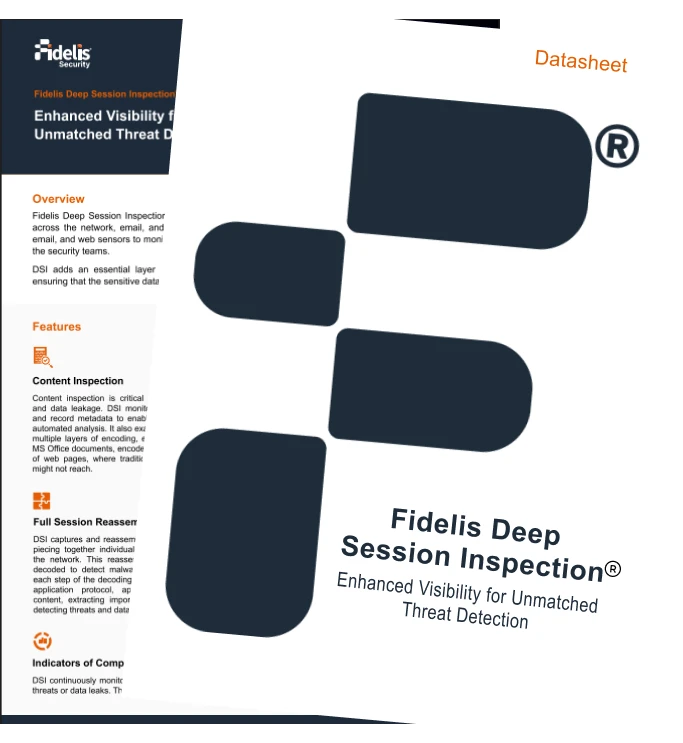
This deep inspection creates the raw signal data that feeds into the threat detection correlation system.
Continuous Terrain Mapping and Risk Assessment
For accurate threat detection, Fidelis Elevate® first establishes comprehensive visibility through:
- Real-time inventory collection across on-premises and cloud environments
- Asset classification and risk profiling
- Network traffic pattern analysis
- Data flow monitoring
- Configuration assessment
This environmental awareness creates the contextual backdrop against which potential threat signals are evaluated.
The Signal Correlation Mechanism
The actual mechanics of Active Threat Detection involve several distinct technical processes:
Signal Aggregation from Multiple Sources
Fidelis Elevate® aggregates data from multiple detection vectors:
- Network traffic analysis alerts from Fidelis Network®
- Deception environment triggers from Fidelis Deception®
- Endpoint detections from Fidelis Endpoint® or third-party EDR solutions
- Sandbox execution results for suspicious files
Proprietary Correlation Algorithms
These signals then undergo analysis using proprietary algorithms that:
- Identify potentially related events across different security layers
- Apply temporal correlation to establish potential attack sequences
- Evaluate indicators against baseline behavioral patterns
- Filter out noise and false positives using contextual intelligence
- Identify connections based on threat actor profiles and TTPs
MITRE ATT&CK Framework Mapping
A crucial technical element is the automatic mapping to the MITRE ATT&CK framework, which:
- Categorizes observed techniques according to established attack patterns
- Supplements proprietary detection with industry-standard classification
- Enables defenders to understand the attack stage and potential next steps
- Provides a common language for threat analysis and response
How the Active Threat Detection System Works
In practice, Active Threat Detection follows a defined technical process flow that moves from raw signal to a confirmed conclusion once threat activity is detected:
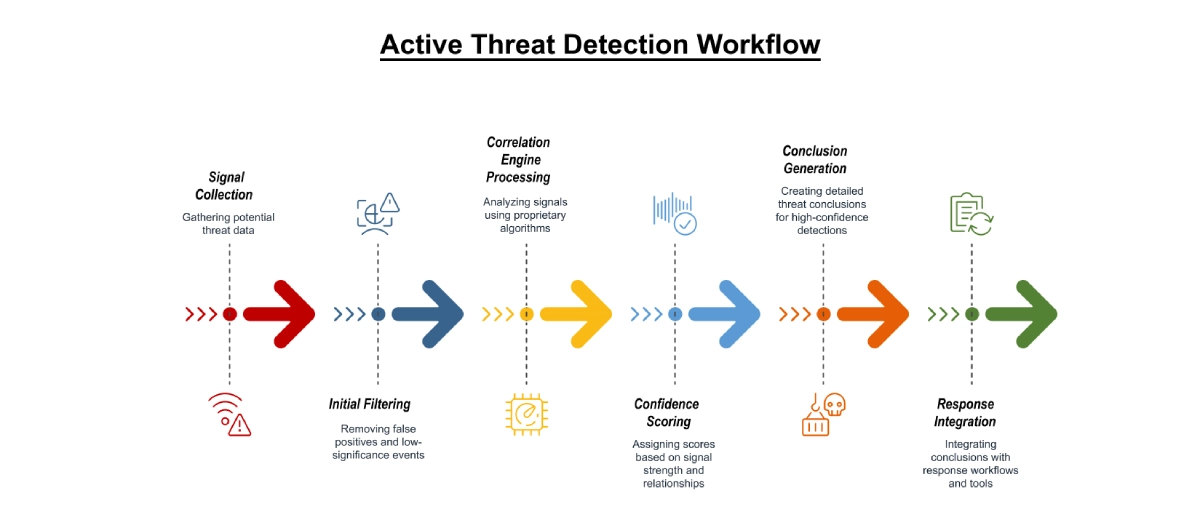
- Signal Collection: The system continuously gathers indicators from across the security environment, generating a stream of potential threat data.
- Initial Filtering: Basic noise reduction removes obvious false positives and low-significance events.
- Correlation Engine Processing: The remaining signals undergo correlation analysis using the proprietary algorithms described above.
- Confidence Scoring: Each potential threat pattern receives a confidence score based on the strength, number, and relationships between correlated signals.
- Conclusion Generation: Once the system can detect threat actor activity with high confidence, it generates an "Active Threat" conclusion containing detailed evidence and attack context.
- Response Integration: These conclusions integrate with automated response workflows and analyst investigation tools.
Technical Integration with the Security Stack
As an open XDR platform, Fidelis Elevate®‘s Active Threat Detection integrates with existing security infrastructure via:
- REST APIs for bidirectional data exchange
- Out-of-the-box connectors for common security platforms
- Custom integration options through the Fidelis API
- Webhook-based alert forwarding
This integration ensures that Active Threat Detection enhances rather than duplicates existing security investments.
Real-World Technical Implementation
In practical deployment, Active Threat Detection demonstrates several key technical capabilities. Organizations building a proactive threat hunting program should also understand how XDR supports continuous threat investigations.
Threat Pattern Recognition
The system recognizes complex threat patterns, including:
- Multi-stage attack sequences spanning days or weeks
- Living-off-the-land techniques using legitimate tools
- Supply chain compromise indicators
- Command-and-control communications hidden in legitimate traffic
Real-Time Processing Architecture
The underlying architecture enables:
- Parallel processing of multiple threat signals
- Near real-time correlation of disparate events
- Dynamic updating of threat conclusions as new evidence emerges
- Continuous recalibration of detection algorithms based on new intelligence
Forensic Evidence Collection
For each Active Threat detection, the system automatically preserves:
- Relevant network traffic captures
- Process execution logs
- File access records
- Authentication events
- Configuration changes
This evidence collection happens automatically as threats are detected, creating a comprehensive record for investigation.
Technical Benefits of the Approach
The technical design of Active Threat Detection offers several distinct advantages:
Reduced False Positives
By correlating multiple signals before generating alerts, the system dramatically reduces false positives compared to traditional point solutions.
Increased Detection Confidence
The confidence scoring mechanism ensures analysts receive high-quality alerts with sufficient supporting evidence for immediate action.
Enhanced Investigation Efficiency
Detailed contextual information and evidence preservation streamline the investigation process, reducing time-to-remediation.
Continuous Security Improvement
The system’s intelligence grows over time through:
- Machine learning algorithms that refine detection patterns
- New correlation rules based on emerging threats
- Automatic incorporation of threat intelligence
- Feedback loops from analyst investigations
Our customers detect post-breach attacks over 9x Faster
- Detect Advanced Threats Before Damage Escalates Trusted
- Cybersecurity Leader for 20+ Years
- See why security teams choose us over other solutions
Conclusion
Fidelis Active Threat Detection™ is a practical foundation for active cyber defense. By correlating weak signals across multiple security layers, mapping findings to known attack patterns, and providing rich contextual intelligence, it gives security teams active threat protection that goes beyond static alerting, and a clear path to active threat response when it matters most.
Paired with the broader Fidelis Elevate® platform, it covers the full attack lifecycle, from initial detection through investigation and response, so your team spends less time chasing noise and more time closing real gaps.