
Security leaders are under constant pressure to prove value. The kind that shows up in reduced dwell time, fewer wasted analyst hours, faster detection, better response, and lower business risk. Cyber Deception ROI is also a similar conversation.
For years, deception was treated like an interesting security tactic. Drop a few decoys, catch attackers, and call it clever. But modern cyber deception technology has become a practical active defense layer, especially when it is deployed intelligently across hybrid environments, identity paths, cloud workloads, and high-value assets.
If you are looking at top deception solutions, Fidelis Deception is one of them.
It is not just about creating a few fake systems and hoping an attacker touches them. It uses realistic decoys, breadcrumbs, fake accounts, and fake data to lure adversaries into revealing themselves earlier in the attack lifecycle. Fidelis proactively exposes attackers before they can cause damage, giving security teams a stronger position to act quickly and confidently.
Thus, with Fidelis Deception, ROI in security is not just about money saved but also about risk reduced.
If deception deployment helps your team detect lateral movement sooner, validate threats faster, reduce alert noise, and protect critical assets more effectively, that is ROI your CISO, SOC leader, and board can understand.
Why Cyber Deception ROI is Different from Traditional Security ROI
Most security tools ask analysts to interpret suspicious behavior. Cyber deception is the opposite.
If an attacker touches a decoy server, uses a fake credential, opens a deceptive file, or follows a breadcrumb toward a fake asset, there is very little legitimate explanation. That interaction carries intent.
This is why active cyber deception is so valuable. It does not simply wait for known malware signatures or generic anomalies. It creates a controlled environment where attackers expose themselves.
Fidelis Deception takes this further by helping defenders reshape the attack surface. Its deception approach is designed to understand attack paths to deploy defenses, hinder lateral movement, distract attackers with convincing decoys and breadcrumbs, and trap them at the deception layer before they reach real assets.
That gives security leaders a cleaner way to measure impact. Instead of asking, “How many alerts did this tool generate?” the better question becomes:
How much faster did we detect real attacker behavior, and how much risk did we remove?
The Deception ROI Formula Security Teams Can Use
A simple deception ROI formula can help security leaders connect deception outcomes to business value.
Use this as a practical starting point:
Cyber Deception ROI = Value of Risk Reduction + Operational Savings – Deception Investment / Deception Investment
In plain English:
You calculate what deception helped the business avoid or improve, subtract what it cost to deploy and operate, and compare that value against the investment.
The “value” side can include:
- Analyst hours saved through fewer false positives
- Faster investigation and response
- Reduced dwell time
- Earlier detection of lateral movement
- Better protection for high-value assets
- Lower incident response cost
- Reduced probability of major breach impact
- Better use of existing SOC, SIEM, XDR, and endpoint investments
- Deception is Much More Than a Honey Pot
- Practical Applications for Deception Technology
- Prevent Post-Breach Damage
The “investment” side can include:
- Platform cost
- Deployment effort
- Tuning and management time
- Integration work
- Training and operational overhead
The important thing is not to reduce cyber deception ROI to one financial number too early. Security value is often operational before it becomes financial. If Fidelis Deception helps your team catch credential misuse before attackers reach domain infrastructure, that is a measurable value even before you assign a dollar figure to it.
Metrics to Measure Cyber Deception ROI
Metric 1: Mean Time to Detect
Mean Time to Detect, or MTTD, is one of the strongest ROI metrics for cyber deception.
Why? Because attackers are most dangerous when they are active but invisible.
Traditional tools may detect malware execution or suspicious traffic. But deception is built to catch the behavior that attackers often perform after initial access: reconnaissance, lateral movement, credential testing, privilege escalation, and discovery of sensitive systems.
A strong deception deployment should help answer:
- How quickly do we detect suspicious internal movement?
- Are we catching attackers before they reach critical assets?
- Has detection time improved in high-risk network segments?
- Are deception alerts surfacing threats missed by other tools?
If the answer is yes, cyber deception ROI becomes much easier to defend.
Metric 2: False Positive Reduction
Every SOC knows the pain of noisy alerts. False positives drain analyst time, slow down response, and create alert fatigue. When analysts are buried in low-confidence alerts, even real threats can blend into the background.
Cyber deception technology helps reduce this problem because deception alerts are usually based on interaction with something that should not be touched.
To measure this ROI, track:
- False positive rate for deception alerts
- Analyst hours spent validating deception alerts
- Percentage of deception alerts escalated to incidents
- Reduction in time wasted on low-value investigations
- Alert-to-incident conversion rate
If your deception alerts are consistently more meaningful than generic alerts, that is a direct productivity gain.
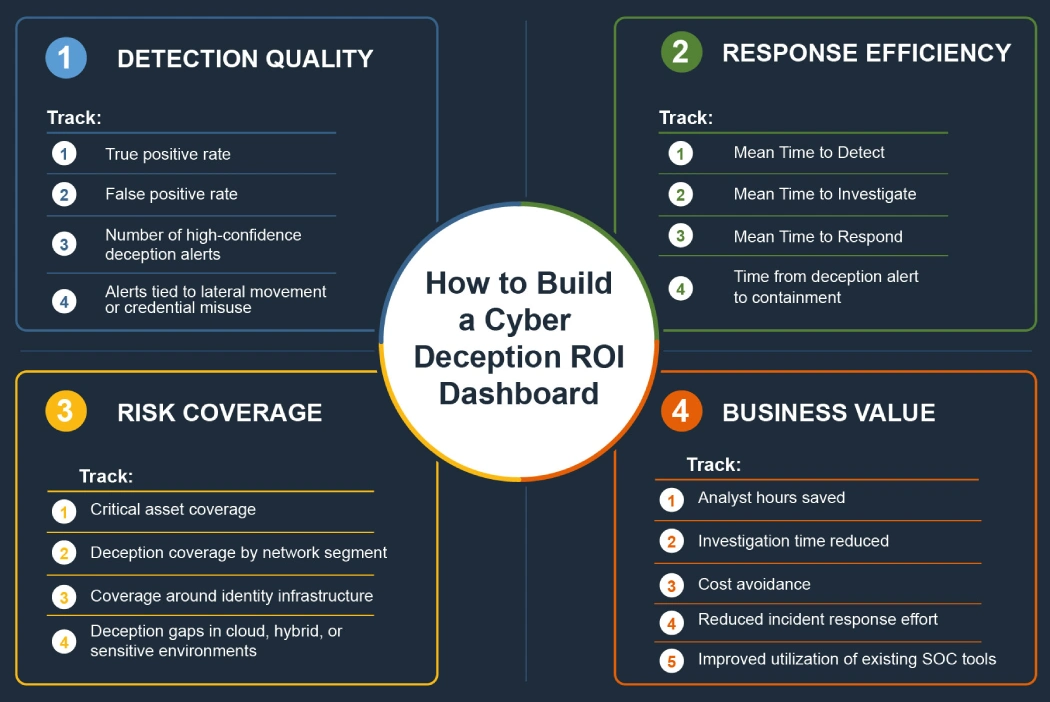
Metric 3: Mean Time to Investigate
Detection is only the first step. Once an alert fires, analysts still need to understand what happened, who was involved, what systems were touched, and whether the activity is part of a broader attack.
This is where deception gives the SOC a major advantage.
A deception alert already carries context. It tells the analyst that someone interacted with an asset that was intentionally placed to detect unauthorized behavior. That shortens the investigation path.
For example, instead of starting with, “Is this unusual login actually malicious?” the analyst can start with, “Why did this source system use a deceptive credential that no legitimate user should have?”
That is a very different investigation.
Fidelis Deception is especially valuable here because it does not treat deception as an isolated trap. Fidelis integrates deception with broader visibility and threat detection through Fidelis Elevate, giving teams a stronger view of attacker behavior across the environment.
To measure this metric, track:
- Average investigation time for deception alerts
- Number of analyst steps required to validate an alert
- Time from alert review to incident classification
- Reduction in manual triage effort
- Quality of context available at the start of the investigation
When analysts can move from suspicion to confidence faster, deception ROI becomes operationally obvious.
Metric 4: Mean Time to Respond
Mean Time to Respond, or MTTR, is where detection value becomes business value. The faster your team contains an active threat, the less time attackers have to move, steal, encrypt, manipulate, or destroy.
Cyber deception active defense gives responders confidence because deception alerts are high-intent by design. If an attacker touches a fake asset or uses a deceptive credential, responders can act with less hesitation.
Measure:
- Time from deception alert to containment
- Time from validation to response action
- Number of incidents where deception triggered the first response
- Reduction in attacker dwell time
- Response speed for lateral movement and credential misuse
Metric 5: Lateral Movement Visibility
Most serious breaches do not stop at initial access. Attackers land somewhere and then move. They enumerate systems. They test credentials. They look for file shares. They search for privileged accounts. They try to understand where the valuable assets live.
This is why lateral movement visibility is one of the best ways to measure cyber deception ROI.
A good deception deployment should show when attackers are moving through the environment, not just when malware first executes.
Track:
- Attempts to access decoy systems
- Use of deceptive credentials
- Connections to fake services
- Interaction with fake shares or files
- Reconnaissance against deceptive assets
- Source systems involved in suspicious movement
Metric 6: Credential Misuse Detection
Credentials are still one of the fastest ways attackers move. Once they obtain usernames, passwords, hashes, tokens, or keys, attackers can often look like legitimate users. That makes credential misuse difficult to detect with traditional controls alone.
Deception changes this math. Fake credentials are planted where attackers are likely to find them, and when those credentials are used, the signal is extremely strong.
Measure:
- Attempts to use fake credentials
- Source hosts using deceptive accounts
- Authentication attempts against decoy systems
- Credential misuse tied to lateral movement
- Time from fake credential use to containment
This is one of the most practical areas for active cyber deception because the alert is easy to explain. No legitimate workflow should use a credential that was created only for deception.
For executives, this is also easy to understand: deception helps detect credential abuse before attackers use real access to reach real assets.
Metric 7: Coverage Around High-Value Assets
Cyber deception ROI depends heavily on where deception is deployed. A random deception deployment may produce some value, but a strategic deception deployment produces much more.
Security teams should place deception around:
- Identity infrastructure
- Domain controllers
- Privileged access paths
- Sensitive databases
- File repositories
- Cloud workloads
- OT and IoT environments
- Business-critical applications
- Executive or finance systems
The goal is not to cover everything equally. The goal is to make the attacker’s path risky, confusing, and observable.
Fidelis Deception is useful here because it is designed to support risk-aligned deception. Fidelis maps the relationship between users, systems and data to analyze the attack paths and then automates deployments. It also continuously alters the attack surface to mislead the attackers by updating the decoys.
Track:
- Percentage of critical assets protected by deception
- Deception coverage by business unit or environment
- Decoy-to-real asset ratio in high-risk segments
- Coverage of identity and privileged access paths
- Deception gaps around crown-jewel systems
This metric helps security leaders show that deception deployment is not random. It is aligned to business risk.
Metric 8: Analyst Productivity
Security teams have limited resources, which makes analyst productivity one of the most important cyber deception ROI metrics. If a deception solution helps analysts spend less time chasing noise and more time responding to real threats, that is a meaningful return.
Track:
- Analyst hours saved per month
- Reduction in repetitive triage
- Faster alert validation
- Increase in high-confidence incidents
- Fewer escalations caused by vague or low-context alerts
Every hour analysts do not spend investigating noise is an hour they can spend threat hunting, improving detections, strengthening response playbooks, or working on higher-risk cases.
Metric 9: Attacker Engagement Intelligence
Some security tools tell you that something happened. Deception can show you how the attacker behaves.
When adversaries engage with deceptive assets, they may reveal tools, commands, techniques, objectives, and movement patterns. That intelligence can improve detection engineering, threat hunting, incident response, and security architecture.
Track:
- Tools and commands observed in deception environments
- Techniques used against decoys
- Time spent interacting with deceptive assets
- Paths attackers attempted to follow
- New detections created from deception intelligence
Metric 10: Cost Avoidance
Eventually, cyber deception ROI needs to connect to money. Cost avoidance does not mean claiming that every deception alert prevented a multimillion-dollar breach. That is too broad and usually not credible.
A better approach is to calculate specific, defensible savings.
For example:
- If deception reduces false positives, calculate analyst hours saved.
- If deception reduces investigation time, calculate SOC labor savings.
- If deception detects lateral movement earlier, estimate avoided response escalation.
- If deception protects critical assets, estimate reduced breach impact exposure.
- If deception improves existing XDR or SIEM performance, include improved value from current tools.
A simple cost-avoidance model may look like this:
Monthly Savings = Analyst Hours Saved x Average Hourly Security Labor Cost + Avoided Incident Response Effort
Then compare that against the cost of the deception deployment.
This gives security leaders a practical way to measure the ROI of cyber deception without making exaggerated claims.
Why Fidelis Deception Makes the ROI Case Stronger
There are plenty of deception tools in the market. But the ROI case becomes stronger when deception is not treated like a standalone gimmick.
Fidelis Deception is compelling because it connects deception to broader security operations.
It helps defenders:
- Deploy realistic decoys and breadcrumbs
- Detect lateral movement earlier
- Identify credential misuse
- Reduce low-value alert noise
- Gain attacker behavior intelligence
- Improve response confidence
- Align deception with high-risk assets
- Integrate deception into a larger detection and response strategy
Security teams do not need another isolated console. They need controls that strengthen the SOC’s ability to detect, investigate, and respond. Fidelis Deception is built for that kind of operational value.
It gives attackers something believable to chase and gives defenders the signal they need to act.
That is the real value of cyber deception active defense.
For executive reporting, keep it focused on risk, speed, and cost. For SOC reporting, go deeper into alert quality, attacker behavior, and response actions.
- Trust High-Fidelity Alerts
- Study an Attacker’s Every Move
- Maintain Cyber Resiliency
Final Thoughts: Cyber Deception ROI is About Control
Attackers usually have the advantage of surprise. Cyber deception takes some of that advantage away.
With the right deception deployment, security teams can make attackers question what is real, expose themselves earlier, and waste time on assets that cannot help them. That is not just clever. It is measurable.
The best way to measure cyber deception ROI is to focus on outcomes:
- Did we detect threats faster?
- Did we reduce false positives?
- Did analysts investigate faster?
- Did we catch lateral movement earlier?
- Did we improve coverage around critical assets?
- Did we reduce operational cost and business risk?
With Fidelis Deception, the answer can be yes across all of those areas.
For security leaders looking to move from passive monitoring to active cyber deception, the ROI story is clear: earlier detection, better signal, faster response, and stronger control over the attacker’s path.
Frequently Asked Questions
What is cyber deception ROI?
Cyber deception ROI measures the value an organization gains from using deception technology compared with the cost of deploying and operating it. It includes faster detection, fewer false positives, reduced investigation time, improved lateral movement visibility, and lower incident response effort.
What is a simple deception ROI formula?
A practical deception ROI formula is:
Cyber Deception ROI = Value of Risk Reduction + Operational Savings – Deception Investment / Deception Investment
Security teams can calculate value through analyst hours saved, faster response, lower false positive rates, reduced dwell time, and better protection of critical assets.
How do you measure the ROI of cyber deception?
To measure ROI of cyber deception, track operational metrics such as Mean Time to Detect, Mean Time to Investigate, Mean Time to Respond, false positive reduction, lateral movement detection, credential misuse detection, and analyst productivity. Then connect those improvements to cost savings and risk reduction.
Why is Fidelis Deception useful for active cyber deception?
Fidelis Deception supports active cyber deception by using realistic decoys, breadcrumbs, fake accounts, and fake data to lure attackers into revealing themselves. It helps defenders detect suspicious behavior earlier, especially around lateral movement, credential misuse, and high-value assets.
What makes cyber deception technology different from traditional detection tools?
Traditional detection tools often analyze normal activity and look for suspicious patterns. Cyber deception technology creates deceptive assets that legitimate users should not touch. When an attacker interacts with a decoy, fake credential, or breadcrumb, the alert usually has stronger intent and higher investigative value.