

Key Takeaways
- Signature-based tools are blind to living-off-the-land attacks, fileless malware, and credential abuse. Endpoint traffic analysis picks these up by watching communication behavior rather than scanning for known file signatures.
- The telemetry covers network connections, DNS queries, application traffic, file transfers, authentication events, and cloud API calls across every managed device.
- Behavioral baselines let the system flag things like unexpected PowerShell execution, unusual outbound connections, or large off-hours data transfers without needing a signature match.
- Teams with traffic analysis in place typically move from hours or days to minutes when spotting a potential compromise.
- For compliance, the continuous monitoring logs and investigation records produced by endpoint traffic analysis map directly onto requirements in NIST, PCI DSS, and ISO frameworks.
Every few months there’s another report about a major breach at an organization that had, by all accounts, a reasonable security stack. Antivirus, next-gen firewalls, endpoint agents, they work. And yet. The gap between ‘we have tools’ and ‘we detected the attack’ keeps showing up in post-incident writeups, and the reason is usually the same: the tools were looking for things the attacker wasn’t doing.
Modern intrusions don’t start with a malicious executable dropped to disk. They start with a stolen credential used to log in quietly, or a PowerShell script run through a process that IT uses legitimately every day, or a C2 channel tunneled over HTTPS to infrastructure that looks like any other cloud provider. Signature scanners have nothing to match against, and thus the attack proceeds.
Endpoint traffic analysis works differently. Instead of comparing files to a database of known bad things, it watches how endpoints behave and flags communication patterns that fall outside what’s usually normal for that specific device and user. It’s not a silver bullet, but it covers a meaningful portion of the attack surface that signature tools genuinely can’t reach. This piece explains how it works and where it fits in a real security program.
What is Endpoint Traffic Analysis?
Put simply: endpoint traffic analysis takes network communication data and ties it back to the specific device, process, and user that generated it. That sounds like a minor distinction from regular network monitoring, but in practice it changes what you can actually do with the information.
A generic network alert might tell you that traffic went from somewhere in the 10.x.x.x space to an unusual external destination. Endpoint traffic analysis tells you it was svchost.exe on FINANCE-WKS-047, running under the account of a user who left for vacation yesterday, at 1:47am, connecting to an IP range associated with Eastern European hosting infrastructure the organization has never touched before. Same event. Entirely different investigative starting point.
It’s also distinct from endpoint monitoring in a way that trips people up. Endpoint monitoring is about the status of the device online, whether patches are current, and whether the AV agent is running. Useful, but it’s a health check, not a threat detection capability. Endpoint traffic analysis is behavioral. It’s asking what this device is doing, not whether it’s configured correctly.
The data sources involved include outbound and internal network connections, DNS queries and resolution patterns, application-level traffic, file transfer and upload activity, authentication and credential events, and cloud service and API access. Any one of those individually gives you a limited signal. The value is in the correlation across all of them together because real attacks almost never stay confined to a single data type.
| Endpoint Monitoring | Endpoint Traffic Analysis |
|---|---|
| Tracks endpoint status | Examines communication behavior |
| Focuses on device health | Focuses on threat detection |
| Checks patch and AV status | Analyzes processes, connections, and data flows |
| Basic visibility | Deep behavioral insights |
Why Traditional Endpoint Security is No Longer Enough
Signature-based detection isn’t a failed technology. For the class of threats it was designed for, commodity malware with stable, identifiable characteristics, it works reliably and doesn’t cost much to run. The problem is that the class of threat is a much smaller share of what organizations are dealing with today.
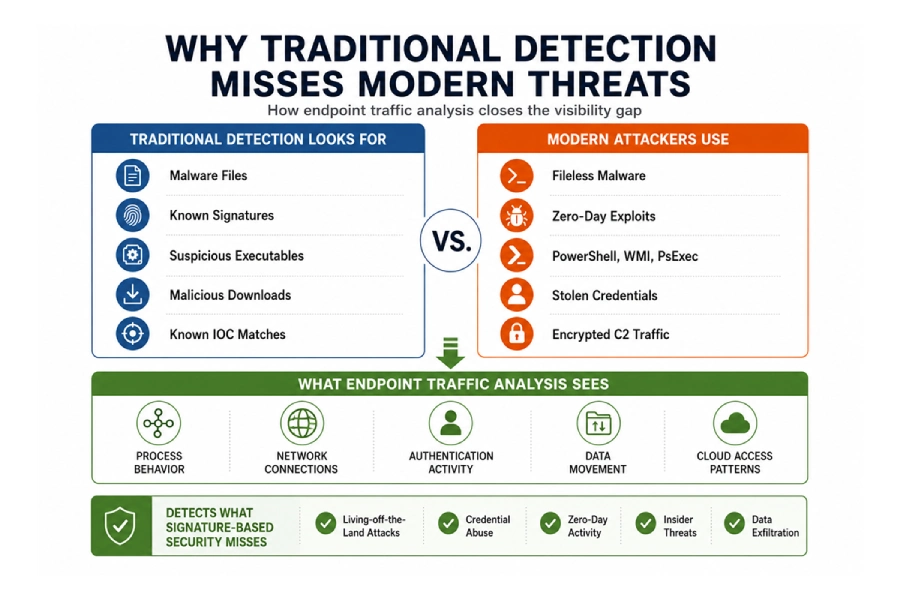
The core limitation is simple: a signature tool can only catch what it’s already seen. Novel malware variants slip through. Polymorphic payloads that rewrite their own signature on each execution slip through. Custom implants built for a single target by a capable threat actor? Those will almost certainly slip through too because they’ve never been catalogued. More critically, a lot of modern intrusions don’t involve dropping a file at all, which means there’s nothing for a scanner to examine regardless of how good its signatures are.
Living-off-the-land is the cleanest example of why. PowerShell, WMI, certutil, mshta, PsExec: these are all built into Windows and used by IT administrators for legitimate work every day. An attacker who runs their attack through PowerShell isn’t introducing anything foreign to the endpoint. The binary is signed by Microsoft, and the process is fully trusted. From a signature scanner’s perspective, nothing unusual is happening.
Credential attacks are similar. Once someone has a valid set of credentials, whether phished out of an employee or purchased on a criminal forum, they authenticate the way the legitimate user would. The login looks normal because technically it is a valid authentication. No payload, no file, and no signature to match.
Fileless malware executes entirely in memory. C2 traffic routes over HTTPS to cloud infrastructure, often through providers the organization uses legitimately for other things. The telltale signs that signature detection relies on simply aren’t present.
None of this means you pull signature-based tools from the stack. They’re cost-effective for commodity threats and worth keeping. But they can’t be the load-bearing detection layer when a large share of attacks are specifically engineered to avoid everything a signature scanner looks for.
How Endpoint Traffic Analysis Detects Threats Earlier
The practical value of endpoint traffic analysis comes down to one thing: it catches behavioral anomalies that have no signature match. What does that actually look like across the most common attack patterns?
Command-and-Control Communications
C2 communications first because they’re often where detection opportunities are most consistent. After getting a foothold, the attacker needs to talk to the infrastructure they control. That communication has to go somewhere external. Even when it’s encrypted, the pattern of how it happens is detectable. Beaconing, where the implant checks in at regular intervals, produces a rhythm of outbound connections to the same destination that legitimate software just doesn’t generate.
DNS-based C2 using domain generation algorithms (DGA) produces a pattern of failed or unusual DNS queries that stands out clearly against baseline. Connections to IP ranges associated with bulletproof hosting in atypical geographies, or on non-standard ports, are additional signals. None of this requires knowing the specific C2 domain beforehand.
Lateral Movement
The initial compromise almost never lands on anything valuable. Attackers need to pivot, which means generating traffic between systems that don’t normally communicate. SMB connections between workstations with no history of talking to each other. RDP or WinRM access from accounts that have never used those protocols. Rapid sequential authentication events across multiple systems from a single user account in a timeframe that doesn’t match human working patterns. Each of these is a deviation from the established baseline, and none requires a signature.
Data Exfiltration
Exfiltration is, in some ways, the hardest to hide. Data has to leave. Bulk file access in the hours leading up to an unusual outbound transfer is an early signal. Large uploads to cloud storage destinations the organization doesn’t normally use. Data movement concentrated at 3am. And here’s the thing about encryption: it hides the content, not the metadata. A device that normally moves a few hundred megabytes a day suddenly pushing 40 gigabytes to an unfamiliar cloud endpoint is detectable without reading a single byte of the payload.
Insider Threats
Insider threats work the same way. The detection mechanism doesn’t care about intent; it cares about deviation from pattern. An employee accessing file shares they’ve never touched, downloading volumes of data outside their normal scope, routing files through a personal cloud account from a corporate device: all of these registers as anomalous against that user’s behavioral baseline, the same way an external attacker’s activity would.
The Role of Endpoint Behavior Analysis in Threat Detection
It’s worth being concrete about what behavioral detection is actually doing, because the marketing version often sounds vaguer than the technical reality.
During an initial observation period, the system builds a statistical model for each endpoint. What processes it runs, what external destinations it communicates with, what protocols it uses, what user accounts it operates under, what time patterns its activity follows, how all of those things relate to each other. This isn’t a static list of allowed behaviors. It’s a continuously updated profile that adapts as the endpoint’s legitimate usage evolves.
When current behavior deviates significantly from that model, an anomaly score increases. If the deviation is large enough, or if it coincides with other anomalous signals from the same device or user, it gets surfaced for analyst review. The output isn’t ‘this matched a known bad signature.’ It’s ‘this endpoint is doing things outside its normal behavioral range in the following specific ways.’ That’s a more actionable starting point than a generic signature hit, especially when the alternative is no alert at all.
Prioritization is handled by risk scoring layered on top. A workstation that connects to a domain it’s never seen before: mildly anomalous, low priority on its own. That same workstation connecting to a new domain immediately after spawning an encoded PowerShell child process from an Office application parent? The combination pushes the risk score substantially higher, and the alert priority reflects that. Tuning this scoring accurately is genuinely difficult and one of the ongoing challenges of running behavior-based detection well.
Here’s a concrete example that illustrates why these matters. A marketing laptop starts executing PowerShell at 2am. The parent process is mshta.exe, which is not something Office or any marketing application typically spawns. The PowerShell process immediately initiates a connection to an IP address in a residential hosting block in Eastern Europe. No file was dropped to disk. No signature was triggered. But none of that behavior combination has appeared once in six months of baseline data for that device. A behavior-based system flags it immediately. A signature-only deployment sees nothing.
Endpoint Traffic Analysis and Advanced Endpoint Investigations
Detection gets most of the attention, but honestly, investigation capability is where endpoint traffic analysis tends to deliver more return in real-world operations. You notice this most when you’ve worked an incident on a team that didn’t have it.
When an alert fires, the next question is always: what happened? With correlated endpoint traffic data, that reconstruction starts from actual evidence. Without it, you’re working backward from whatever logs happened to get written and retained, filling gaps with inference, and regularly discovering you can’t answer basic scope questions.
The workflow with traffic analysis in place runs roughly like this: alert fires on a behavioral anomaly or known indicator; associated traffic data gets pulled and reviewed; the responsible process gets traced back through its execution chain; user activity from the same window gets correlated; the threat is confirmed or ruled out against the complete evidence picture; and response kicks off based on established scope. Each step depends on the previous one having solid data underneath it.
Root cause analysis, answering specifically how the attacker got initial access, requires historical data about what the endpoint was doing before the alert. That data needs to be granular and process-attributed, not just high-level event logs. Timeline reconstruction for multi-stage attacks requires timestamped records across all the systems involved. Threat hunting, where analysts are proactively looking for indicators of compromise rather than responding to automated alerts, only works if there’s enough historical telemetry to query against meaningful hypotheses.
Without the underlying data, investigations stall. Teams spend the first several hours trying to piece together what happened from whatever they can find. That’s slow, it’s often incomplete, and it’s happening during the exact window when the attacker may still be active and dwell time is still accumulating.
How Endpoint Traffic Analysis Improves Incident Response Times
Mean time to detect and mean time to respond: two metrics the security industry talks about constantly, and endpoint traffic analysis genuinely moves both. But the how is worth understanding because it is not the same mechanism for each.
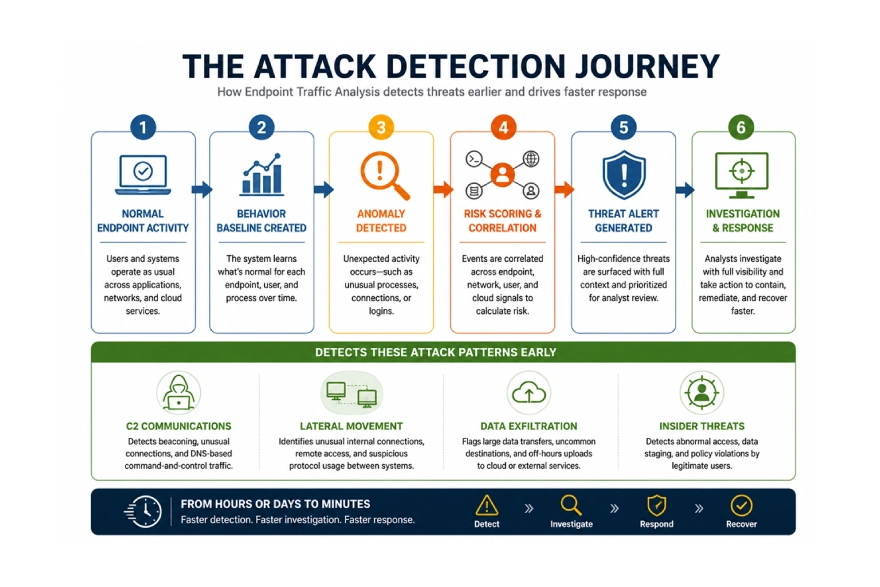
On detection, behavioral anomaly detection surfaces threats that signature tools miss, and it does so without requiring the threat to have been catalogued first. The signature detection model has an inherent lag: discover the malware, analyze it, write a signature, distribute, and update. For novel attacks, that lag can be days or weeks. Behavioral detection doesn’t have that lag built in.
| Without Endpoint Traffic Analysis | With Endpoint Traffic Analysis |
|---|---|
| Hours or days to identify a compromise | Minutes to surface suspicious activity |
| Manual log review across multiple sources | Correlated traffic data in a single view |
| Unclear scope of what was accessed | Clear visibility into which systems were involved |
| Slow triage due to missing context | Evidence-based decisions from the first alert |
Response time is where the gains are often larger than expected, though. When evidence is already correlated, an analyst opening an alert can understand scope immediately. They’re not spending the first three hours logging into five different systems, pulling logs with different schemas, manually correlating timestamps, and working out whether the suspicious activity is on one device or spread across twenty. The context is already assembled. They can act on it.
Automation matters here too, particularly for off-hours coverage. An endpoint actively beaconing to C2 infrastructure at 3am shouldn’t sit in a queue until someone clocks in at 9am. Automated workflows can isolate the device, populate an incident ticket with context, and notify whoever’s on call, all before a human has reviewed anything. The analyst’s job shifts from assembling information to validating and directing a response that’s already started.
Can Endpoint Analysis Detect Zero-Day Threats?
Short answer: better than signatures, but not a complete solution.
The structural problem with signature-based zero-day detection is that there’s literally nothing to match against. The vulnerability isn’t known yet, so no signature exists. By the time a zero-day is discovered, analyzed, and a signature is written and distributed to endpoints, the attack has typically been running for days or weeks. That lag is baked into the detection model and can’t be tuned away.
Behavioral detection sidesteps this. A zero-day exploit still has to do the same things after getting in that any other attack does. Establish C2 communications. Move laterally. Escalate privileges. Stage and exfiltrate data. Those post-exploitation behaviors generate anomalies against the endpoint’s baseline whether the initial exploit has a CVE assigned to it. The detection triggers on what happens after the attacker is inside, not on recognizing the entry technique.
| Detection Method | Known Threats | Zero-Day Threats |
|---|---|---|
| Signature Detection | Strong | Weak |
| Behavioral Analysis | Strong | Strong |
| Endpoint Traffic Analysis | Strong | Strong |
In practice, this means suspicious post-exploitation activity often surfaces within minutes of its beginning, frequently well before any external intelligence about the underlying vulnerability exists. A device that starts beaconing to unfamiliar infrastructure gets flagged based on the behavioral pattern, regardless of what technique was used to compromise it.
The honest caveat: sophisticated, patient attackers who’ve done serious reconnaissance on a target’s environment can sometimes operate below behavioral detection thresholds for extended periods. Nation-state actors with deep target intelligence are specifically trying to avoid triggering these systems, and they’re sometimes good at it. Behavioral detection raises the floor substantially. It doesn’t make detection impossible to evade for a sufficiently capable and motivated adversary.
Endpoint Traffic Analysis in Remote and Hybrid Work Environments
Remote work didn’t fundamentally change how attacks work. What it changed was the environment in which defenses must operate, and several of the assumptions that traditional endpoint security programs were built on stopped holding.
The corporate network perimeter gave security teams a consistent monitoring point. Traffic came in and out through a defined set of chokepoints where inspection tools were deployed. That’s substantially less useful when a significant portion of the workforce is connecting from home broadband, hotel networks, and shared office spaces, where the organization has no visibility into or control over the underlying infrastructure.
Where Remote Environments Create Gaps
Endpoint traffic analysis adapts better to this environment than perimeter-based tools do, because the telemetry and the behavioral baseline travel with the device. They don’t depend on the endpoint being inside a controlled network perimeter. The analysis is present whether the employee is in the office or connecting from a coffee shop.
Making It Work
Home networks bring specific problems. Other devices on the same subnet, personal phones, smart TVs, family computers, may be compromised and could be used to probe or pivot to the corporate endpoint. Home routers often run outdated firmware with unpatched vulnerabilities. BYOD devices used for work may be missing standard endpoint security tooling or running old OS versions. Cloud application usage that routes directly to SaaS providers, outside any corporate infrastructure, creates blind spots in monitoring that’s anchored to the network rather than the device.
Making this work requires a few things: cloud-based deployment of the analysis platform so visibility doesn’t depend on VPN connection; baselines built to include the actual variety of remote work patterns rather than just office behavior; risk-based alerting that distinguishes between a login from a known home IP and a login from an unfamiliar country; and automated containment for high-confidence detections, because the response delay in a fully manual process is much longer when the relevant team members aren’t immediately reachable.
Can Endpoint Analysis Support Compliance Reporting?
Most compliance frameworks are ultimately asking two things: do you know what’s happening on your systems, and would you detect a problem in time to do something about it? Endpoint traffic analysis provides evidence for both.
NIST, PCI DSS, and ISO 27001 all have requirements around continuous monitoring, incident detection capability, and audit trail preservation. The telemetry endpoint traffic analysis generates maps directly onto those requirements.
Continuous monitoring records: yes.
Documented incident detection with timestamps and investigation records: yes.
Access tracking showing who accessed which system and when: yes.
Preserved logs usable as an audit trail: yes.
The practical difference between organizations that have this in place and those that don’t is most obvious during actual audits and incident response scenarios, which is unfortunately when it’s too late to address the gap. Answering an auditor’s question about a specific system access event is a quick lookup when the telemetry is centralized and searchable. The same question, answered by pulling logs from multiple disconnected systems and correlating them manually, hoping everything was retained, takes orders of magnitude longer and often comes back with gaps. Those gaps are what generate findings.
Best Practices for Effective Endpoint Traffic Analysis
Establish Behavioral Baselines Before Tuning for Anomalies
Anomaly detection quality is entirely a function of baseline quality, which sounds obvious but gets underweighted in practice. A baseline built over two weeks will generate more noise than one built over three months. It also needs to cover the actual range of legitimate behavior: different user roles, different device types, different working patterns across shifts and time zones. Teams that rush the baseline phase and then find themselves drowning in false positives are almost always cutting that corner.
Treat Endpoint and Network Data as Two Sides of the Same Evidence
Endpoint telemetry and network telemetry are not redundant. They’re complementary. Endpoint data tells you what process initiated a connection and what user account it ran under. Network data tells you what happened on the wire. You need both to move from ‘something looks suspicious’ to ‘here is exactly what happened and how far it got.’ Organizations running endpoint analysis without correlating network session data regularly end up unable to confirm or dismiss alerts because half the evidence isn’t there.
Add Deep File Analysis to Cover Initial Access Vectors
File ingestion is a detection surface that traffic analysis alone doesn’t cover. Malicious payloads arrive through email attachments, browser downloads, compromised software packages, USB drives: delivery channels that don’t necessarily generate anomalous network traffic until after the payload executes. Deep file analysis inspects content and behavior at ingestion, before execution, which is the only window where that particular attack path can be blocked rather than just detected after the fact.
Automate Enrichment and Containment for High-Confidence Alerts
Alert fatigue is a real operational failure mode. When analysts receive more alerts than they can review, they raise thresholds, and real threats start getting buried. Automation changes the math: enrichment workflows that automatically pull context and correlate related events cut the time per alert, and automated containment for high-confidence detections removes the need for a human in the loop before a compromised device is isolated. The analyst still owns the decision; they’re just reviewing an already-enriched picture rather than starting from scratch.
Tune Continuously, Not Once
Finally: environments change, and baselines drift. New tools get deployed; teams reorganize, and work patterns shift. Detection rules that accurately represent normal behavior at deployment will progressively generate more noise as the environment evolves. Tuning is maintenance, not a one-time setup activity.
How Fidelis Security Enhances Endpoint Traffic Analysis
Running endpoint, network, and cloud security as separate tools creates a coordination failure that shows up most clearly during incidents. The endpoint agent fires an anomaly. The network monitor fires a separate alert on traffic from the same device around the same time. The cloud access logs have unusual API calls in the same window. Three tools, three alert queues, no automatic connection between them. The analyst who eventually pieces it together has typically lost a significant amount of time to that coordination gap, time during which the attacker is still active.
Fidelis Elevate is built around the premise that endpoint traffic analysis only reaches its ceiling when endpoint telemetry, network session data, and cloud activity are correlated in a single platform, rather than leaving that correlation work to manual analyst effort.
Deep session inspection paired with endpoint telemetry: When Fidelis Elevate detects anomalous activity on an endpoint, it doesn’t stop at the device-level alert. It immediately cross-references outbound network sessions from that device. If it’s reaching out to a domain it’s never contacted, using an unusual port, or connecting to an IP range with no prior history in the environment, those signals merge into a single enriched alert rather than two separate low-priority events that might get handled independently or get lost in the queue backlog.
Cloud telemetry integration: This matters because compromised endpoints are increasingly used as the launchpad for cloud-based attack activity. A workstation used to call cloud storage APIs, spin up compute instances in the victim’s cloud environment, or exfiltrate data through a legitimate file-sharing service generates events that are completely invisible to endpoint-only tools. Fidelis Elevate ingests cloud access logs, API call records, and configuration change events, tying each back to the initiating endpoint. The full scope of post-compromise cloud activity shows up in the same investigation interface as endpoint and network events.
Behavior-based detection with per-device baselines: Fidelis Elevate builds and continuously updates a behavioral profile for each managed endpoint, tracking normal network destinations, process execution patterns, authentication timing, and communication volumes. Deviations from those profiles trigger detections regardless of signature availability. A finance workstation that’s never run PowerShell executing an encoded command at 11pm surfaces as an anomaly before anyone needs to know what the payload actually does.
Tactical provenance analysis: When Fidelis Elevate fires a detection, it reconstructs the full execution chain around it. Parent-child process relationships, file system changes, registry modifications, the sequence of outbound connection attempts before and after the suspicious activity. Root cause analysis that would otherwise take hours of manual reconstruction becomes something an analyst can work through in the first few minutes.
Automated orchestration and containment: Fidelis Elevate can isolate a compromised endpoint, update network access controls, generate a populated incident ticket, and queue remediation tasks in the ITSM system automatically when risk thresholds are crossed. The detection-to-containment gap, which in fully manual workflows is measured in hours, shrinks to minutes.
Continuous vulnerability scanning with live threat intelligence: no scheduled scan windows. Endpoint and cloud asset telemetry are continuously checked against current CVE data and threat intelligence feeds. When a critical vulnerability drops for a widely deployed application, the platform immediately checks which managed endpoints are running the affected version. Prioritization uses CVSS score, asset criticality, and active exploit availability, so teams aren’t treating every vulnerability finding with the same urgency regardless of actual risk.
Closing Thoughts
The case for endpoint traffic analysis isn’t that it’s theoretically superior to signature detection. It’s that the attack techniques organizations are dealing with, credential abuse, living-off-the-land execution, fileless malware, C2 over encrypted channels, were built specifically to stay below the signature detection threshold. Attackers did the research. They know what traditional tools miss, and they’ve oriented their techniques around those gaps.
Behavioral detection shifts the detection surface to post-exploitation behavior, which attackers can’t avoid the way they can avoid dropping a file. The C2 channel must exist. The lateral movement generates traffic. The data must be staged before it leaves. Those activities show up in endpoint traffic data against a behavioral baseline, regardless of how sophisticated the initial exploitation was.
The shift to remote work and cloud infrastructure doesn’t weaken this argument, it strengthens it. A detection approach that follows the device rather than depending on network perimeter controls is better suited to the environment most security teams are managing. The perimeter assumptions that underpin a lot of traditional tools have been deteriorating for years. Endpoint traffic analysis doesn’t rely on them.
Frequently Asked Questions
How can I perform endpoint analysis to detect malware on a corporate network?
Deploy agents that collect telemetry from managed endpoints across network connections, process activity, authentication events, and file transfers. Let behavioral baselines develop across device types and user roles before tuning anomaly detection thresholds. When something flags, trace the responsible process through its execution chain, correlate it with user activity from the same timeframe, and work through an investigation workflow before escalating. The investigation quality is directly tied to how much historical telemetry is available to reconstruct what happened before the alert fired.
Can endpoint analysis help with compliance reporting in IT environments?
Yes. The continuous monitoring records, timestamped alert logs, access tracking, and investigation documentation cover most of what NIST, PCI DSS, and ISO frameworks require. Beyond the checkbox coverage, the bigger practical benefit is usually the centralized, searchable telemetry. Answering auditor questions is a lot faster when you’re doing a lookup rather than piecing together evidence from disconnected systems after the fact.
What are the best practices for endpoint analysis in remote work environments?
Cloud-based deployment is the prerequisite, so visibility doesn’t require corporate network access. Build baselines from actual remote work patterns, not just office behavior. Use risk-based alerting that treats a login from an unfamiliar country differently than a login from a known home IP. Automate containment for high-confidence detections because the response delay in a fully manual process is substantially longer when team members aren’t immediately available.
How quickly can endpoint analysis detect zero-day threats?
Usually within minutes of post-exploitation activity starting. The detection isn’t looking for the vulnerability; it’s looking for the behavioral anomalies that follow from exploitation: C2 beaconing, lateral movement traffic, data staging. Those behaviors generate anomalies against the baseline whether the underlying vulnerability has a CVE number yet.
How can endpoint analysis improve incident response times?
Mainly by eliminating the evidence assembly phase. Instead of logging into multiple systems to pull and correlate logs, analysts have a correlated view showing which endpoints were involved, what they did, and when. Automated enrichment and containment workflows compress the timeline further. High-confidence detections can trigger isolation and ticket creation before a human has reviewed anything, which matters most during off-hours when manual response delays are longest.
Key technical terms mentioned in this article are linked below for further exploration: