

Key Takeaways
- NDR monitors network traffic and surfaces suspicious behavior; cyber deception confirms malicious intent through decoy interactions. They solve different parts of the detection problem.
- NDR provides broad visibility into network activity and helps security teams identify suspicious behavior for further investigation.
- Cyber deception generates high-confidence alerts because any interaction with a decoy asset is considered unauthorized by definition.
- Combining NDR with deception compresses time-to-response, reduces false positive burden, and strengthens lateral movement detection.
- The integrated approach delivers the most value in environments facing ransomware, APT activity, insider threats, or sustained alert fatigue.
Most security teams aren’t struggling because they lack tools. They’re struggling because the tools they have can’t tell them, with any real confidence, whether what they’re looking at is a genuine threat or just noise.
That’s the problem sitting at the center of the deception vs NDR conversation. An anomaly fires. The analyst looks at it. Maybe it’s a misconfigured application. Maybe it’s an admin doing something unusual. Maybe it’s an attacker who’s been inside the network for three days. Without a confirmation mechanism, those three scenarios look similar enough that triage takes time, and time is exactly what attackers are counting on.
NDR and cyber deception both get deployed to solve this problem. But they don’t solve the same part of it. NDR watches the network and flags what looks suspicious. Cyber deception confirms whether what looks suspicious actually is. That distinction is the whole argument for running both.
What is Network Detection and Response (NDR)?
NDR platforms sit on the network and watch everything, internal east-west traffic, perimeter north-south traffic, encrypted sessions, and lateral connections. They build behavioral baselines and flag deviations: an account suddenly accessing file shares it’s never touched, a device beaconing outbound at regular intervals, data moving in volumes that don’t match any known workflow.
What NDR gives you is coverage. Broad, continuous, network-wide coverage. It catches the behavioral fingerprints of threats that have already bypassed perimeter controls and are operating inside the environment. For anything that moves across the network, NDR will likely see it.
The challenge, which any NDR user will tell you, is that seeing something suspicious and knowing it’s malicious aren’t the same thing. That’s not a flaw in the technology. It’s just the nature of behavioral analytics.
What is Cyber Deception?
Cyber deception takes a completely different approach. Instead of watching all traffic and flagging anomalies, it builds a layer of fake assets throughout the environment, honeytokens, deceptive credentials, decoy servers, and lure documents sitting on endpoints. None of these assets serve any legitimate purpose. No real system would ever call them and no real user would ever access them. So when something does interact with them, there’s no investigation needed. The interaction is the answer.
That’s the operational advantage deception brings that behavioral analytics can’t replicate. There’s no baseline to tune, no threshold to adjust, and no false positive rate to manage. If a deception asset gets touched, something unauthorized is happening. The confidence level on that alert is categorically different from an NDR anomaly flag.
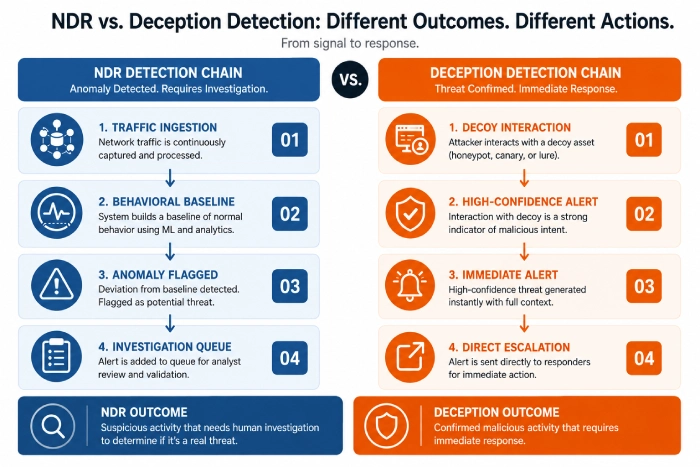
Deception vs NDR: Key Differences
| Capability | NDR | Cyber Deception |
|---|---|---|
| Visibility scope | Network-wide traffic analysis | Decoy and trap interactions |
| Detection method | Behavioral analytics, ML models | Trap-based direct interaction |
| False positive rate | Moderate - anomalies need validation | Very low - any interaction is suspicious |
| Threat validation | Indirect - based on pattern deviation | Direct - attacker touches a fake asset |
| Coverage strength | Broad monitoring across all traffic | High-confidence confirmation of intent |
| Best use case | Detecting suspicious network behavior | Validating malicious activity, lateral movement |
| SOC workflow role | Surface and prioritize suspicious events | Confirm and escalate confirmed threats |
They operate on different detection stages and produce different types of intelligence. They aren’t equally competing tools, rather they are complementary ones.
Where NDR Alone Can Fall Short
None of this is a criticism of NDR. It’s an observation about what happens when any single tool becomes the entire detection strategy.
Alert volume is where it usually starts. A well-tuned NDR platform in a complex enterprise environment generates a lot of anomaly flags. Most of them aren’t threats. Some of them are. Figuring out which is which takes analyst time, and analyst time is finite. As the queue grows, the high-priority items get slower attention. The window an attacker has to operate quietly gets longer.
Sophisticated actors make this worse on purpose. They’ve studied how behavioral analytics work. They move slowly, use approved toolings like PowerShell, WMI, legitimate admin protocols, and deliberately stay inside traffic patterns NDR systems are calibrated to tolerate. They look like normal operations because they’re trying to. And they’re often succeeding.
The structural problem is that NDR was built to surface suspicious behavior, not confirm malicious intent. Those are related but different things. An anomaly is a signal that something might be wrong. A confirmed threat is a signal that something is wrong and warrants immediate response. Getting from the first to the second requires either investigation time or a different class of detection tool entirely.
Lateral movement is the sharpest edge of this problem. NDR can surface that lateral movement appears to be happening. Whether that movement is opportunistic, deliberate, or using stolen credentials, the context that determines how fast you respond, NDR often can’t tell you.
Enhancing Detection, Response, and Visibility Through NDR-Centric Security Integrations
- NDR and EDR
- NDR and CNAPP
- NDR and DLP
Where Cyber Deception Alone Can Fall Short
High-confidence signals are genuinely valuable. They’re also incomplete on their own.
Deception only generates telemetry when an attacker interacts with a decoy asset. That’s the mechanism. Which means an attacker who navigates the environment without touching anything deceptive, by luck, by prior intelligence, or simply by moving straight toward high-value targets without much reconnaissance, produces no deception alerts at all. Zero visibility into what they’re doing.
Coverage is an operational reality too. Maintaining decoy assets at useful density across a modern hybrid environment, on-premise servers, cloud workloads, remote endpoints takes sustained attention. Gaps in coverage are gaps in detection. Deception works where it’s deployed; it’s blind where it isn’t.
And a SOC running purely on deception-triggered alerts would have strong confidence in what it sees but very little ability to hunt proactively, investigate forensically, or understand the broader behavioral context around confirmed incidents. The telemetry layer that NDR provides isn’t a nice-to-have. It’s fundamental.
How Deception and NDR Work Together
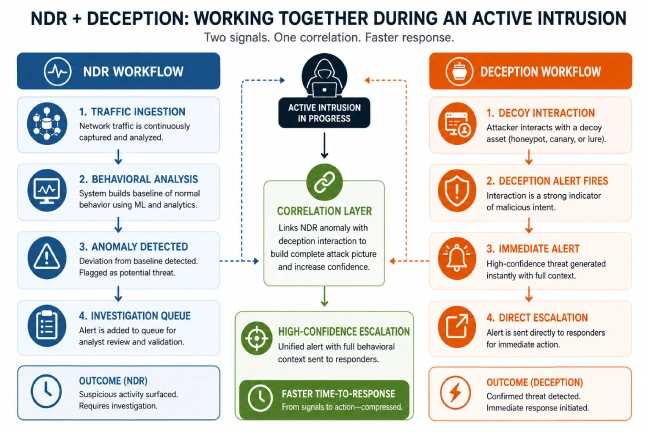
The operational shift when NDR and deception work together is significant. Each technology compensates for what the other can’t do. The detection-to-response workflow looks different, faster, with less time in the uncertainty zone between anomaly and confirmed threat.
Lateral movement and credential theft in practice
An attacker gets in through phishing and starts moving internally. NDR picks up SMB (Server Message Block) activity that doesn’t fit the baseline, an account accessing systems it’s never touched. The alert goes in the queue. Investigation starts, but the analyst can’t tell yet whether this is malicious or a legitimate admin doing something unusual.
Then the attacker finds a deceptive credential on a compromised endpoint and tries to use it. Deception alert fires. Now the SOC has two correlated signals: the NDR behavioral flag and direct confirmation that the anomaly is tied to active malicious activity. The investigation question is already answered. Response is immediate.
Ransomware precursor detection
Ransomware operators don’t rush. They spend days or weeks doing reconnaissance, escalating privileges, and mapping the environment before any payload deploys. NDR surfaces the behavioral indicators of that phase: unusual scanning, abnormal file share access, elevated account activity.
During that same window, deceptive file shares and honeytokened credentials distributed through the environment are waiting. The moment the attacker touches one during their sweep, a high-confidence alert correlates with the NDR signals already in the queue. Security teams get the chance to respond before anything deploys. That window between reconnaissance and payload is the only window that matters in ransomware defense.
Insider threat validation
NDR flags unusual data access from an internal user. Volumes and destinations that don’t match their role. Behavioral analytics raise it, but the activity could still be legitimate. Context the system doesn’t have might explain it.
A deceptive asset accessible to that user’s clearance level is the tiebreaker. If they access the decoy during the anomalous activity, escalation is confirmed. If they don’t, the analyst investigates without treating it as an active threat. Either way, the decision is grounded in something more than pattern matching.
Benefits of Combining Cyber Deception With NDR
-
Faster confirmation
NDR surfaces suspicious behavior. Deception confirms intent. The gap between detection and confident escalation gets shorter when both signals are available and correlated. -
Lower false positive burden
NDR alerts require investigation before action. Deception alerts don't, because the interaction itself is the evidence. Running both means fewer uninvestigated anomalies consuming analyst time before anyone can act. -
Lateral movement you can actually confirm
NDR identifies behavioral indicators. Deception catches the attacker touching something they shouldn't. Together they close the gap that deliberate attackers specifically exploit. -
Alert prioritization that reflects reality
In environments where alert fatigue is a daily operational problem, having a class of alerts that can be escalated immediately without investigation changes how analyst time gets allocated. That matters for morale as much as metrics. -
Faster incident response
When behavioral context from NDR and intent confirmation from deception arrive together, responders start with richer information. Containment decisions are faster and better grounded.
How Fidelis Puts This Into Practice
Fidelis Security’s detection architecture treats network visibility and deception-driven validation as parts of the same system, not separate tools that happen to be deployed in the same environment.
Fidelis’ NDR Platform continuously analyzes network communications using Deep Session Inspection, providing visibility across ports, protocols, and encrypted traffic metadata. Combined with Cyber Terrain Mapping, it automatically discovers assets, maps communication patterns, and builds context around network behavior, helping SOC teams identify low-and-slow intrusions, lateral movement, and attacker reconnaissance that often blend into legitimate activity.
Fidelis Deception extends that visibility by planting realistic decoy systems, credentials, service accounts, and Active Directory objects throughout the environment. These deceptive assets are designed to appear legitimate to attackers while remaining invisible to normal users.
If an adversary enumerates a decoy AD account, requests a Kerberos ticket for a decoy service account, or interacts with a planted credential, Fidelis generates an immediate high-confidence alert. Correlating these interactions with network telemetry from Fidelis Network, gives analysts clear evidence of attacker intent, richer forensic context, and faster validation of suspicious activity.
For SOC teams managing real workloads, the practical result is fewer alerts sitting uninvestigated, faster escalation on confirmed threats, and better starting data for incident responders.
- Understanding Government and Federal Requirements
- Understanding Enterprise and Commercial Needs
- Bridging the Gap - Unified Deception Across Environments
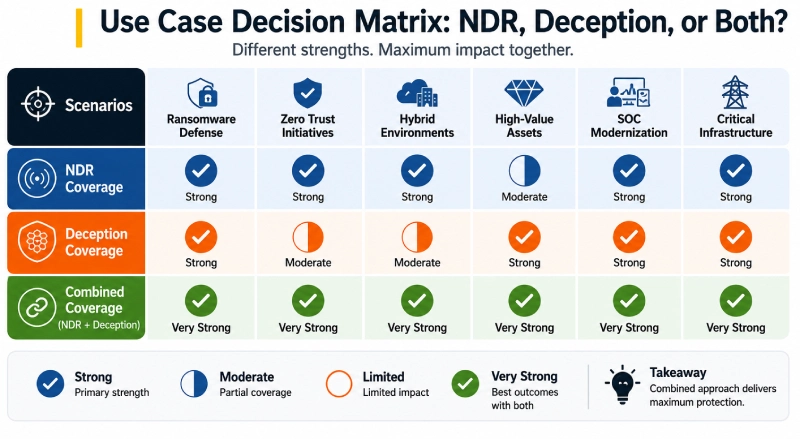
When Organizations Should Use Both Technologies
The case gets strongest in environments where advanced threats are a realistic concern and where SOC efficiency directly affects the ability to detect and contain intrusions before damage occurs.
-
Ransomware defense
The pre-deployment window is the intervention window. NDR detects the behavioral signs. Deception provides the tripwires that confirm active malicious intent before anything deploys. -
Zero trust initiatives
Lateral movement detection is a core capability requirement, not an optional enhancement. NDR and deception together provide the behavioral monitoring and confirmation layer that give zero trust architecture operational meaning. -
Hybrid and multi-cloud environments
Complex attack surfaces with traffic across multiple infrastructure tiers benefit from NDR's broad coverage combined with deception's distributed validation points. -
High-value asset environments
Critical systems like financial infrastructure, intellectual property, operational technology, warrant detection that minimizes both dwell time and false escalations. Running both achieves that more reliably than either alone. -
SOC modernization
Reducing uninvestigated noise while increasing confidence in escalated alerts is a direct quality-of-work improvement for analysts dealing with sustained alert fatigue.
Closing Thoughts
The deception vs NDR framing makes for a clean vendor comparison slide. It doesn’t reflect how these technologies actually function in a production security environment.
NDR answers one question: what suspicious behavior is happening on the network?
Deception answers a different one: is the behavior we’re seeing actually malicious? Both questions matter. Neither one is sufficient on its own.
Security teams that run only NDR are detecting anomalies and spending analyst time confirming what most of them already know, that the majority of flags require investigation before action is justified. Teams that run only deception are acting with high confidence on the threats they catch while potentially missing everything that doesn’t interact with a decoy.
The combined architecture changes the operational reality. Less time in the uncertainty zone between anomaly and confirmed threat. Faster responses when it matters. Less burnout from sustained investigation of alerts that don’t go anywhere. And a meaningfully shorter window for attackers who are counting on dwell time to do their work.
Frequently Asked Questions
What is the difference between cyber deception and NDR?
NDR monitors network traffic and flags behavioral anomalies for investigation. Cyber deception plants fake assets that confirm malicious intent the moment an attacker interacts with them. They operate at different stages of the detection chain and are most effective when used together.
Does cyber deception replace NDR?
No. Deception only generates alerts when an attacker touches a decoy asset, providing no visibility into broader network traffic or behavior. NDR provides the continuous visibility layer that deception cannot replicate.
Why do NDR platforms generate false positives?
NDR flags deviations from behavioral baselines, and in complex environments, legitimate activity often looks unusual. Deception alerts bypass this problem entirely since decoy assets have no legitimate purpose, any interaction is suspicious by definition.
How does combining deception with NDR improve lateral movement detection?
NDR surfaces behavioral indicators of lateral movement. Deception confirms it by catching attackers interacting with decoy assets placed along likely movement paths. Together they move from “something looks like lateral movement” to confirmed threat much faster.
What threat scenarios benefit most from running both?
Ransomware pre-deployment activity, APT intrusions using low-velocity techniques, insider threats, and compromised account misuse, scenarios where behavioral anomalies need intent confirmation before response decisions can be made confidently.
Key technical terms mentioned in this article are linked below for further exploration: