

Key Takeaways
- Gain deep visibility into encrypted traffic with Fidelis Network® without sacrificing performance or compliance
- Use Deep Session Inspection to analyze over 300 session attributes without full decryption
- Combine metadata analysis with selective SSL decryption for scalable and controlled inspection
- Detect C2 beaconing, malware delivery, and data exfiltration hidden inside TLS traffic
- Eliminate blind spots across perimeter, internal east-west, and cloud environments
- Consolidate NDR, DLP, sandboxing, and threat intelligence into a single Fidelis platform
- Validate security posture with auditable and retrospective session analysis
How Does Fidelis Help Enterprises Inspect Encrypted Traffic?
Encrypted traffic inspection is the process of decrypting or analyzing TLS/SSL sessions to detect threats, enforce security policies, and prevent data exfiltration hidden inside encrypted network traffic.
Fidelis Network® inspects encrypted traffic through two mechanisms running in parallel:
- Deep Session Inspection (DSI): Collects over 300 metadata attributes of protocols and files to provide deeper visibility and threat detection than NetFlow deployments, including TLS traffic profiling.
- Network Detection and Response: Provides sandboxing, network forensics, DLP, threat intelligence, and automated security rules in one unified solution, with sensors covering internal and cloud network traffic, email, and web traffic.
Together, these cover north-south perimeter flows and east-west internal sessions, across on-premises, cloud, and hybrid environments.
Fidelis Network® scans traffic bidirectionally, east-west and north-south, using patented Deep Session Inspection technology and supervised and unsupervised machine learning to uncover threats that traditional detection methods miss.
The Result: Deep visibility and threat detection across network, email, web, and cloud traffic, with response time reduced from hours to seconds.
Why Are Enterprises Exposed to Encrypted Traffic Threats?
Before going deeper, here is the core challenge in brief:
- TLS encrypts nearly all enterprise traffic, making payload content invisible to firewalls, intrusion prevention systems, and SIEMs without active encrypted traffic analysis by dedicated security tools
- TLS 1.3 (RFC 8446) enforces forward secrecy via ephemeral key exchange, eliminating retroactive passive decryption entirely
- NIST SP 1800-37 (September 2025) confirms this directly conflicts with passive monitoring techniques enterprises have historically relied on
- ENISA's 2025 Threat Landscape (4,900+ verified incidents) documents adversaries consistently routing C2 traffic and data exfiltration through encrypted channels
- Content Inspection
- Content Identification
- Full Session Reassembly
- Protocol and Application Decoding
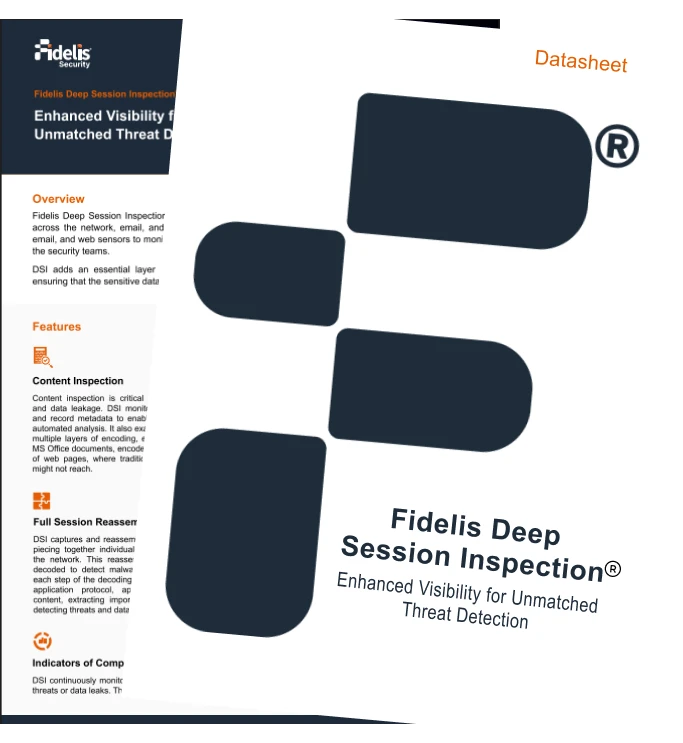
The business consequence: undetected C2 beacons extend dwell time, uninspected outbound sessions let exfiltration complete undetected, and encrypted lateral movement generates zero alerts.
What Threats Hide Inside Encrypted Traffic?
Attackers are not hiding in obscure protocols. They are hiding in port 443, using the same TLS sessions your users generate every day.
C2 beaconing over HTTPS. Malware implants call home through TLS, making beacon traffic indistinguishable from normal web sessions. Without session-level behavioral profiling, there is nothing for perimeter tools to flag.
Data exfiltration through approved encrypted channels. Attackers exploit these channels, putting confidential data inside encrypted sessions routed through cloud storage, SaaS platforms, and approved business tools, all logging as normal outbound activity. Perimeter DLP that cannot inspect decrypted traffic never fires.
Malware staged inside valid TLS sessions. Phishing delivers malicious content over HTTPS using legitimate certificates. Standard security tools log a clean connection. The payload transits undetected.
Lateral movement through internal encrypted sessions. Zero-trust environments encrypt east-west traffic by design. Post-breach, attackers pivot between internal segments using sessions that look identical to legitimate service communication. Perimeter tools never see this traffic at all.
Business impact: Every day of uninspected encrypted traffic is a live window for attackers to establish persistence, move laterally, and exfiltrate data without triggering a single actionable alert.
Why Are Next-generation Firewalls Not Enough for Encrypted Traffic Inspection?
SSL/TLS inspection on NGFWs refers to the process of decrypting and re-encrypting encrypted sessions inline at a firewall. While supported in principle, it consistently fails at enterprise scale due to CPU limitations, protocol gaps, and structural coverage blind spots.
Most enterprises list SSL/TLS inspection as their primary defense against cyber threats. In production, it rarely delivers full coverage. Here is why.
Performance degrades fast under real load. SSL decryption saturates firewall CPUs quickly. Teams build bypass lists to protect throughput. Those lists grow until a large share of encrypted network traffic flows through uninspected. This is the most common failure pattern in enterprise SSL inspection deployments.
TLS 1.3 breaks legacy decryption. RFC 8446 eliminated static RSA key exchange. Appliances that predate TLS 1.3 support either drop connections or silently pass encrypted sessions without inspection. Logs often do not distinguish between the two.
Perimeter only coverage leaves east-west traffic in the dark. NGFWs watch boundary traffic. Lateral movement between internal systems, where most post-breach attacker activity happens, is completely invisible.
Decryption without correlation is not detection. A device that decrypts packets but has no behavioral baselines or threat intel correlation catches commodity threats and misses everything operating over time.
Blanket decryption creates compliance exposure. Healthcare records, legal communications, and financial data are subject to regulatory restrictions on interception. Without per-category decryption policies, the choice is binary: decrypt everything, risking compromising security posture and compliance, or bypass sensitive categories and accept the coverage gap.
The bottom line: NGFWs were not built to handle TLS visibility at enterprise depth and scale. They cover a narrow slice. Everything else is unexamined.
Why Choose Fidelis Over NGFW for Encrypted Traffic Inspection?
The differences between traditional NGFW approaches and Fidelis Network® become clearer when comparing how each handles visibility, deployment, and encrypted traffic inspection.
| Capability | NGFW (Next-Generation Firewall) | Fidelis Network® |
|---|---|---|
| Deployment Model | Commonly deployed at network perimeter (north-south traffic) | Can be deployed at perimeter and internal network segments (north-south and east-west) |
| Internal (East-West) Visibility | Limited, depending on deployment architecture | Supported through internal sensor deployment |
| Encrypted Traffic (No Decryption) | Limited inspection without SSL/TLS decryption | Analysis of session metadata without requiring decryption |
| Encrypted Traffic (With Decryption) | Inspection possible when SSL/TLS decryption is enabled, may introduce performance and policy considerations | Full inspection capabilities applied when traffic is decrypted inline and permitted by policy |
| Inspection Approach | Typically signature and policy-based inspection | Deep Session Inspection (DSI) with extensive metadata analysis |
| Inspection Depth | Varies by implementation | Collects 300+ metadata attributes across protocols, applications, and data per session |
| Additional Analysis Capabilities | Varies by vendor and configuration | Real-time and retrospective analysis, sandboxing, DLP, and machine learning-based detection |
| Traffic Coverage | Primarily network traffic at inspection point | Network, email, web, and cloud traffic via multiple sensor types |
What Is the Difference Between Inline and Passive SSL Inspection?
These are general network security concepts relevant to any buyer evaluating encrypted traffic inspection:
Passive SSL inspection analyzes session metadata visible in the TLS handshake without decrypting payload content. It is lightweight and does not require terminating the TLS session. Its limitation: it cannot detect threats embedded in the payload that leave no handshake-level signal.
Inline SSL inspection actively intercepts and decrypts the TLS session for full content analysis, then re-encrypts and forwards. It provides full content visibility but is computationally expensive at scale and requires careful policy management to avoid breaking certificate-pinned applications and conflicting with privacy regulations.
Fidelis Network®‘s patented Deep Session Inspection technology provides contextual metadata analysis across all ports and protocols, including TLS traffic profiling, at wire speed and enterprise scale. For full content inspection, Fidelis also integrates with the ICAP protocol for web traffic. The documentation does not specify the precise inline decryption mechanism, and buyers should confirm the exact SSL inspection workflow with Fidelis directly for their specific deployment.
How Does Deep Session Inspection Detect Threats in Encrypted Traffic?
DSI collects over 300 metadata attributes of protocols and files per session, providing significantly more content and context than NetFlow solutions. It looks deep into nested files, performs full session reassembly, and applies protocol and application decoding in real time.
What this means for encrypted traffic: DSI does not stop at packet headers. It profiles TLS encrypted traffic, extracting session-level metadata across all ports and protocols at wire speed. This metadata is what Fidelis uses to detect threats inside sessions that are never fully decrypted.
Fidelis Insight™ applies continuously updated threat intelligence rules and policies against this metadata in real time. New threat intelligence is automatically applied to retrospective metadata already in the Collector, meaning a newly published indicator can identify threats that entered the network weeks before it was publicly known.
The Result: threat detection across encrypted sessions without requiring full decryption of every flow, which is the architectural reason Fidelis sustains coverage at scale where NGFW-based inspection collapses under load.
How Does Fidelis Perform Inline SSL/TLS Decryption at Scale?
For traffic where policy permits allowing decrypted data to be sent for full inspection, Fidelis performs active inline analysis: sessions are analyzed after TLS decryption, then re-encrypted and forwarded. Neither endpoint is aware of the inspection process.
The full detection stack runs simultaneously on decrypted content:
- Signature matching against STIX/TAXII, YARA, and Suricata threat intel feeds
- Behavioral analytics on decrypted session content
- Machine learning anomaly detection across session patterns
- Cloud sandbox detonation of suspicious files and URLs from decrypted payloads
- DLP policy enforcement scanning outbound encrypted sessions for sensitive data
For web traffic, the Fidelis Web Sensor integrates with enterprise HTTP/HTTPS proxies via ICAP. The proxy handles TLS decryption using corporate certificates and passes cleartext content to Fidelis through that ICAP integration. This distributes decryption load across existing proxy infrastructure rather than concentrating it at a single point, sustaining throughput at enterprise session volumes.
How Does Fidelis Inspect East-West Encrypted Traffic?
East-west encrypted traffic inspection refers to the analysis of TLS sessions between internal network segments, as opposed to north-south inspection at the network perimeter. Most NGFWs and legacy tools only inspect boundary traffic, leaving internal lateral movement invisible.
This is where Fidelis diverges structurally from perimeter-focused tools, and it is the coverage gap that matters most after a breach.
North-south: Sensors at perimeter ingress and egress points inspect inbound traffic carrying encrypted malware delivery attempts and outbound sessions for exfiltration attempts.
East-west: Internal Sensors between network segments cover lateral movement through internal encrypted sessions, the exact post-breach activity space that boundary tools leave completely dark.
Email: The Fidelis Mail Sensor integrates at the SMTP Message Transfer stage for bidirectional inspection, including attachment analysis, pre-click URL checking, and bidirectional quarantine.
Cloud: Fidelis Network® supports cloud deployment, either customer-managed or Fidelis-managed, extending sensor coverage to cloud environments without requiring all traffic to be routed through on-premises infrastructure.
All sensor data consolidates into the CommandPost interface. Session metadata is stored in the Fidelis Collector for long-term retention. When new threat indicators are published, they run as retrospective queries against stored historical metadata. Threats that entered the network before public disclosure become detectable after the fact.
How Does Fidelis Turn Encrypted Traffic Detections Into Actionable Intelligence?
Every detection maps automatically to MITRE ATT&CK. Analysts immediately see which technique is active, where it sits in the attack chain, and what response actions apply. That context closes investigations in hours instead of weeks.
Machine learning operates across both inspection layers:
- Supervised models catch known patterns through indicator and signature correlation
- Unsupervised statistical analysis surfaces behavioral anomalies outside established session baselines, the primary mechanism for detecting emerging threats without published signatures
Network DLP enforcement covers all traffic flows. Pre-built policy sets address regulatory compliance requirements across network, email, and web sensor coverage points. Outbound encrypted sessions matching sensitive data patterns trigger enforcement before exfiltration completes.
How Does Encrypted Traffic Inspection Work in Real Enterprise Environment?
The scenario: A large financial services organization. Hybrid infrastructure across two on-premises data centers, AWS, and Azure. Compliance audit requirement to demonstrate encrypted outbound traffic inspection for data exfiltration controls.
The problem: Their NGFWs inspected a slice of perimeter SSL traffic. Throughput limits forced bypass lists for high-volume SaaS categories. East-west encrypted sessions between application tiers were completely uninspected. When the audit arrived, there was no inspection evidence for bypassed traffic. Controls looked functional in documentation. In the network, they were not.
After deploying Fidelis Network®:
DSI captured session metadata from all TLS flows immediately, including sessions outside the full decryption policy. Behavioral baselines were established across the environment within two weeks. The Collector built a retrospective metadata store covering all sessions.
The compliance team gained a complete, auditable evidence trail. DLP results with full session context for decrypted traffic. DSI metadata findings for session-analysis-only traffic. Both approaches documented and distinguishable by category. Audit requirements satisfied.
The threat hunting team received a new JA3 fingerprint linked to a banking trojan. They queried 90 days of stored metadata. Three sessions matched from one workstation, connecting to unflagged external IPs with timing intervals consistent with C2 beaconing. Incident scoped and contained before escalation.
A DLP alert fired on an outbound encrypted session carrying a structured data export matching a sensitive data pattern. Session terminated inline. Metadata and decrypted payload preserved for the incident record. Exfiltration prevented.
Outcomes at a glance:
| Area | Before Fidelis | After Fidelis |
|---|---|---|
| Encrypted traffic visibility | Partial perimeter only | Full perimeter + east-west + cloud |
| East-west inspection | None | Internal Sensors across all segments |
| Compliance evidence | Gap for bypassed traffic | Auditable trail for all sessions |
| Threat detection | Signature-only on decrypted slice | DSI + ML + behavioral analytics across all TLS |
| Retrospective analysis | Not available | 90+ days of queryable session metadata |
What is the Best Way to Inspect TLS Traffic at Enterprise Scale?
When evaluating encrypted traffic inspection solutions, these are the capabilities that separate production-ready platforms from proof-of-concept tools that break under real load.
Dual-layer inspection architecture. Session metadata analysis across all encrypted flows, plus inline decryption for policy-specified categories, under one framework. Single-layer platforms create systematic coverage gaps.
TLS session metadata depth beyond NetFlow. JA3 fingerprints, cipher suite proposals, certificate chain analysis, handshake timing. Without these, sessions that bypass full decryption become completely invisible to threat detection.
Policy-based selective SSL decryption. Granular control by destination category, domain, application type, and user group. Blanket decryption is neither practical at scale nor compliant with data privacy regulations for sensitive traffic categories.
East-west internal sensor coverage. Perimeter-only inspection misses lateral movement entirely. Internal coverage is a structural requirement, not an optional upgrade.
Retrospective metadata analysis. New indicators should run against stored historical sessions, not just future traffic. Long-term retention turns threat intel into a tool for finding past compromises.
Integrated DLP inside the inspection pipeline. DLP enforcement needs to operate on the same decrypted session data the inspection engine sees. Separate tools against separate data sources create encrypted outbound coverage gaps.
MITRE ATT&CK mapping on every detection. Technique and tactic context on every alert reduces investigation time and gives analysts immediate situational awareness.
Performance validated under real production load. Test SSL decryption throughput under actual concurrent session volumes. Lab numbers do not accurately predict production behavior.
How to Check if Your Encrypted Traffic is Actually Being Inspected?
Most enterprises cannot answer that question with confidence. The gap accumulates through bypass rules, perimeter-only architectures, aging appliances that predate TLS 1.3, and tools that were not designed for proxy SSL inspection or deep traffic analysis at enterprise depth.
NIST SP 1800-37 provides the framework for maintaining TLS visibility without breaking forward secrecy. MITRE M1020 marks SSL/TLS inspection as a foundational network defense control. Regulators in finance, healthcare, and government are increasingly treating demonstrable inspection controls as audit requirements, not recommendations.
The cost of the gap is concrete: C2 beacons extending dwell time, undetected exfiltration occurring through uninspected outbound sessions, lateral movement through east-west encrypted traffic generating no alerts.
Fidelis Network® closes that gap with:
- Patented Deep Session Inspection across all TLS flows
- Selective inline decryption under policy-based controls
- Bidirectional sensor coverage from perimeter to internal segments to cloud
- Integrated DLP enforcement on decrypted outbound sessions
- Retrospective analysis against a long-term metadata store
- Full MITRE ATT&CK mapping through a single CommandPost interface
The question to put to your security team: What is your actual encrypted traffic inspection coverage, and what evidence supports that answer for an auditor?
If the honest answer involves significant bypass lists, perimeter-only sensors, or uncertainty about east-west encrypted sessions, that gap needs to close before it is documented in an incident report.
Assess your TLS visibility and encrypted data coverage with Fidelis Security
Contact UsFrequently Asked Questions
Can Encrypted Traffic Inspection Violate Data Privacy Regulations?
Yes, if implemented without category-based policy controls.
Indiscriminate decryption of all encrypted traffic, including healthcare portals, personal banking sessions, and legal communications, can conflict with HIPAA, GDPR, and applicable financial privacy regulations.
MITRE M1020 explicitly advises against decrypting sensitive or privacy-related traffic to maintain compliance. The solution is selective decryption policies that distinguish inspectable business traffic from regulated sensitive categories.
Fidelis applies DSI session metadata analysis to regulated traffic instead of full decryption. Metadata analysis delivers meaningful threat detection through TLS handshake signals, JA3 fingerprints, and behavioral patterns, without exposing protected content. Security coverage and regulatory compliance coexist under the same policy framework.
Does SSL/TLS Inspection Impact Network Performance at Enterprise Scale?
It can, significantly, if the architecture relies solely on inline decryption across all traffic.
SSL decryption is computationally intensive. At enterprise session volumes, inspection devices not purpose-built for cryptographic workloads saturate quickly. The typical outcome: bypass lists expand until the tool inspects a fraction of actual traffic.
The architectural mitigation is a dual-layer approach. Fidelis DSI handles behavioral detection across all sessions without decryption overhead. Inline decryption activates only for policy-specified categories. The workload is distributed, throughput is sustained, and inspection coverage does not collapse under load.
How Does TLS 1.3 Forward Secrecy Affect Enterprise Traffic Monitoring?
Forward secrecy in TLS 1.3 means each session generates ephemeral encryption keys that are discarded immediately after the session ends. No long-term key can retroactively decrypt captured traffic, making passive post-capture inspection permanently impossible.
This eliminates offline decryption as a monitoring fallback.
NIST SP 1800-37 identifies this as a visibility challenge requiring active inline inspection infrastructure. For enterprises, this means monitoring tools must be positioned inline or receiving live mirrored traffic with active TLS interception capability. Organizations running monitoring architectures designed for TLS 1.2 have inspection gaps they may be unaware of, and those gaps widen as TLS 1.3 adoption grows.
Citations:
- ^MITRE ATT&CK. SSL/TLS Inspection, Mitigation M1020.
- ^MITRE ATT&CK. Encrypted Channel, Technique T1573.
- ^NIST NCCoE. SP 1800-37: Addressing Visibility Challenges with TLS 1.3 within the Enterprise. September 2025.
- ^NIST NCCoE. Addressing Visibility Challenges with TLS 1.3 Project Page.
- ^IETF. RFC 8446: The Transport Layer Security (TLS) Protocol Version 1.3.
- ^ENISA. Threat Landscape 2025. October 2025.
- ^ENISA. Threat Landscape 2025 Booklet (PDF).
- ^NIST. SP 800-81 Rev. 3: Secure Domain Name System (DNS) Deployment Guide. March 2026.