
Key Takeaways
- Global network security has moved past perimeter defense. Zero trust, AI detection, and deception technology are doing the heavy lifting now.
- Ten trends are reshaping how multinational enterprises protect their networks, and most are navigating several at once.
- Scaling network security and scaling application security in global enterprises are two different problems. Treating them as one creates gaps.
- Deception technology, decoys, breadcrumbs, credential traps, is one of the highest-confidence detection methods available today.
- The right approach unifies network, endpoint, cloud, and deception in one platform rather than managing them in silos.
A decade ago, securing a corporate network meant defending a perimeter. One headquarters, a few data centers, maybe a branch office or two. You knew where the edge was, so you built a wall around it.
That doesn’t really describe anyone anymore. Most enterprises we talk to run operations across a dozen countries, several cloud providers, and a workforce logging in from home, co-working spaces, airport lounges. There’s no single edge left to defend, which means security itself has to stop thinking in terms of walls.
This piece looks at where global network security stands right now. What’s changing, what’s driving it, and where platforms like Fidelis Elevate® fit into the picture.
What is Global Network Security?
Strip away the formal definition and it’s basically this: the strategies and tools a company uses to protect its networks, data, and people once those things stop living in one place. Different countries. Different cloud regions. Business units that don’t always run by the same playbook. It builds on what network security has always meant, firewalls, access controls, intrusion detection, just stretched far enough to hold up when nothing sits still anymore.
The old assumption was simple. One network, one rulebook. Add variable connectivity, data laws that change by country, several cloud vendors, and people working across a dozen time zones, and that assumption doesn’t survive contact with reality. Wider scope. Higher stakes. A lot less room to be inconsistent about any of it.
Global network security vulnerabilities tend to multiply faster than teams can inventory them, especially at companies expanding across regions quickly. Building a global enterprise-grade network security solution means accounting for that reality from the start, not retrofitting controls after something breaks.
Latest Trends Shaping Global Network Security
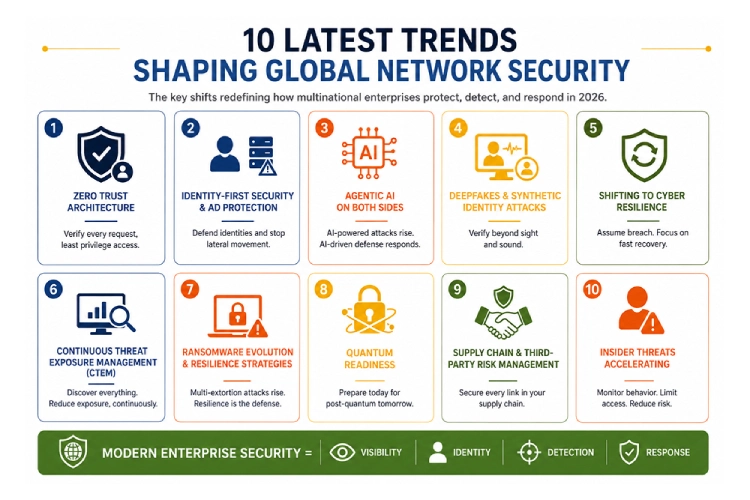
What’s actually shifting in global network security right now? More than most teams have bandwidth to deal with, honestly. Some of it is new threat behavior, some of it is the infrastructure changing underneath security programs that were built for a different era. Here are the ten trends that keep coming up in every serious conversation about where this is heading.
1. Zero Trust Architecture
Nobody’s debating zero trust anymore. The question most security teams are actually sitting with is why it keeps breaking in the middle of rollout, usually somewhere between the legacy VPN that nobody wants to touch and the cloud environment that went live six months ago. Least-privilege access and continuous verification sound clean on a whiteboard. Enforcing them consistently across infrastructure that wasn’t built with any of this in mind is a different problem entirely.
2. Identity-First Security and Active Directory Protection
AD is where attackers go first. Not because it’s the easiest target, but because whoever owns it owns the keys to almost everything else in the environment. The perimeter used to be the network edge. Now it’s an employee’s login credentials on a personal laptop in a coffee shop. Real-time risk signals, device health, behavioral patterns, these are replacing the static rulebooks that haven’t been meaningfully updated since the last compliance audit. If an identity gets compromised, there should be nowhere useful for the attacker to go. Sessions cut off the moment something looks wrong.
3. Agentic AI on Both Sides of the Fight
Somewhere along the way, AI stopped being a tool that needed a human to point it at something. Attackers figured that out early. Reconnaissance, vulnerability probing, lateral movement, it’s happening autonomously now, no keyboard operator required.
The WEF’s Global Cybersecurity Outlook 2026 put a number on it: 87% of respondents called AI-related vulnerabilities the fastest-growing cyber risk they’d seen over the past year. SOCs are deploying the same autonomous capability on defense because they don’t really have a choice anymore. The attack doesn’t wait for a human to notice it, so the response can’t either.
4. Deepfakes and Synthetic Identity Attacks
Video and audio can no longer be treated as reliable verification. Attackers are using real-time deepfakes to impersonate CFOs on Zoom calls, fool HR departments during remote onboarding, and authorize fraudulent transactions. Organizations are responding with out-of-band verification requirements, daily changing verbal code words for sensitive decisions, and biometric liveness detection that checks for pulse patterns rather than just facial recognition. If you get an urgent payment request from a known colleague on a call, the new standard is to verify through a separately confirmed number before acting.
5. Shifting from Breach Prevention to Cyber Resilience
The industry has largely accepted that a determined attacker will get in eventually. Budgets are moving away from building higher walls and toward surviving the breach. The metric that matters now is time to remediate, not just time to detect. Boards are approving funds for backup redundancy and offline system recovery before signing off on new perimeter upgrades, which tells you something about where the industry’s head is at.
6. Continuous Threat Exposure Management (CTEM)
Periodic scanning and annual patch cycles aren’t cutting it anymore. Gartner research says companies that adopt continuous threat exposure management are three times less likely to suffer a breach. Good exposure management means maintaining real-time inventory across shadow IT, cloud workspaces, forgotten subdomains, APIs, expired certificates, and every third-party connection, continuously, not quarterly.
Attack surface management is being integrated into CTEM programs to provide constantly updated views of external exposures, with dark web monitoring layered in for early warning.
7. Ransomware Evolution and Resilience Strategies
The encrypt-and-ransom playbook is old news. What’s hitting organizations now is messier: data gets stolen before encryption even starts, then the threat is public exposure, not just locked files. Add pressure on business partners, operational disruption, and a countdown timer, and you’ve got four simultaneous levers being pulled at once. Paying doesn’t necessarily stop any of them.
The response has had to evolve accordingly, offline backups that can’t be touched remotely, segmentation that limits how far an attacker can move before someone notices, endpoint visibility, and threat intelligence that connects dots across systems rather than treating each alert like it appeared out of nowhere.
8. Quantum Readiness
Quantum computers can’t break current encryption today, but some adversaries are already running a “harvest now, decrypt later” strategy, stealing encrypted data now to decrypt once the technology matures. Financial and healthcare regulators are already requiring organizations to inventory where they use public-key encryption and produce transition timelines for moving to post-quantum cryptographic standards. The window to prepare is open, but it won’t stay open indefinitely.
9. Supply Chain and Third-Party Risk Management
A single attack on a small vendor can today have major ramifications for a large multinational firm. Attackers target the weakest link in a company’s software development chain, open-source libraries, managed service providers, embedded dependencies, rather than breaching the main target directly. New regulations in 2026 require companies to audit the security practices of all vendors and partners, not just internal code. Contracts now include clauses that allow immediate audits of supplier systems and penalties for failure to disclose incidents.
10. Insider Threats Accelerating with Remote Work
Remote work didn’t create insider threats. It just made them a lot harder to see coming. Someone connecting from a home network on a personal laptop sits completely outside the visibility that traditional perimeter tools were built around. And it’s rarely the dramatic scenario people imagine, a disgruntled employee walking out with files. More often it’s someone pasting customer data into an AI tool they found online, or clicking through a phishing email that a monitored office environment would have caught before it landed.
Behavioral analytics and session monitoring are picking up some of that slack, along with access policies tight enough that even a compromised account can’t reach much worth taking.
Where Fidelis Fits into Changing Global Network Security
Most security platforms are built around keeping attackers out. Fidelis is built around what happens when that doesn’t work, and at this point, assuming breach isn’t pessimism, it’s just accurate.
Several of the trends above map directly to what Fidelis Elevate® is designed to address. The shift from prevention to resilience, the rise of identity-based attacks, insider threats accelerating with remote work, and the need for high-confidence post-breach detection aren’t things Fidelis had to retrofit for. They’re what the platform was built around.
Fidelis Elevate® is the only XDR platform that brings together Fidelis Network®, Fidelis Endpoint®, Fidelis Deception®, and Active Directory Intercept™ in a single platform. That matters because most XDR deployments stitch together products that weren’t designed to work together, which creates correlation gaps and slows response. With Fidelis Elevate®, a deception alert gets immediately enriched with network metadata, endpoint telemetry, and sandbox analysis without manual handoffs between tools.
The network layer runs on Fidelis Network®, which uses patented Deep Session Inspection™ to analyze traffic across all ports and protocols, decoding nested files and reassembling sessions to find threats hiding inside legitimate-looking traffic. It collects forensic metadata across 300+ attributes and maps the cyber terrain continuously, giving teams the visibility needed to detect lateral movement and behavioral anomalies as they happen. A top five global bank used this to cut incident response time from ten days to five hours, which tells you something about what that metadata depth means when things go wrong.
On the identity and insider threat front, Active Directory Intercept™ addresses exactly what the zero trust and identity-first security trend is pushing organizations toward. It monitors for privilege escalation, unauthorized AD changes, and suspicious reconnaissance while deploying AD-aware deception assets specifically designed to trap credential harvesting attempts. For multinational enterprises where AD spans multiple domains and regions, that dedicated coverage fills a gap that general-purpose tools typically miss.
Fidelis Deception® is where it gets genuinely different. It profiles assets, maps the cyber terrain, and deploys a tailored layer of decoys, breadcrumbs, fake AD credentials, and poisoned data across the environment. When an attacker touches a deceptive asset, the alert isn’t an anomaly score to investigate, it’s a confirmed intrusion with behavioral context already attached. Decoy AD objects catch reconnaissance and credential harvesting. Fake lateral movement paths expose post-exploitation activity. And because the decoys blend into production, attackers can’t tell them apart from real targets until it’s too late.
Fidelis Halo® rounds things out on the cloud side, covering CSPM, cloud workload protection, and container security across AWS, Azure, and GCP from a single console, which speaks directly to the continuous threat exposure management trend where unified multi-cloud visibility is becoming non-negotiable.
For global enterprises dealing with distributed infrastructure, inconsistent visibility, and security teams stretched thin across time zones, having all of that in one platform isn’t just convenient, it’s what makes the difference between catching a threat early and finding out about it weeks later.
Frequently Ask Questions
What's new in global network security right now?
The ten trends doing most of the work in 2026 are zero trust, agentic AI, deepfakes and synthetic identity attacks, cyber resilience, CTEM, quantum readiness, ransomware evolution, supply chain risk, identity and AD protection, and insider threats accelerating with remote work. Most enterprises are navigating several of these at once.
Does international cooperation improve cybersecurity defenses?
It does, mostly because attacks rarely originate where the damage lands. Intelligence sharing across organizations and borders catches things no single company would find working alone.
What's hardest about securing a network at global scale?
The sheer number of entry points, cloud configs that drift, unvetted vendors, identity-based attacks, and regulations that contradict each other by country. The challenges of scaling network security in global enterprises and scaling application security are also two different problems that usually get treated as one.
What tools does Fidelis offer for global network security?
Fidelis Elevate® unifies NDR, EDR, deception, and Active Directory protection in one platform, while Fidelis Halo® covers CNAPP, CSPM, and container security on the cloud side. Together they’re built for exactly the distributed, multi-region environments where visibility gaps tend to show up.
How does deception technology work?
Platforms like Fidelis Deception® plant decoys, fake credentials, and poisoned data across the network that legitimate users never touch. When an attacker interacts with one, the alert that fires is a confirmed intrusion, not an anomaly score to investigate.
Key technical terms mentioned in this article are linked below for further exploration: