
Key Takeaways
- Strong data governance helps financial institutions maintain control over sensitive data while supporting cybersecurity, risk management, and regulatory compliance.
- A financial data governance framework should establish clear data ownership, classification, quality, lineage, access controls, security, retention, and auditability.
- Data governance strengthens banking compliance by mapping sensitive data to regulatory requirements and improving visibility into how information is accessed, used, protected, and retained.
- Effective data governance supports banking risk management and operations by improving data accuracy, traceability, regulatory reporting, fraud investigations, and decision-making.
- Combining data governance with continuous cybersecurity monitoring, threat detection, access controls, and data protection helps financial institutions strengthen compliance and protect critical financial data.
Financial institutions manage enormous volumes of sensitive information, from customer identities and payment records to transaction histories, credit information, investment data, and regulatory reports. As this data moves across cloud platforms, applications, databases, endpoints, and third-party environments, maintaining control over how it is collected, accessed, protected, retained, and reported becomes increasingly complex.
This makes data governance and compliance for financial institutions a critical part of both security and regulatory strategy. Effective governance establishes clear accountability for financial data, defines how it should be classified and handled, and helps organizations maintain the accuracy, availability, integrity, and security of information throughout its lifecycle.
While data governance in financial services applies broadly to banks, insurers, investment firms, payment providers, credit unions, and other financial organizations, data governance for banks has additional risk and regulatory considerations because banks rely heavily on accurate risk aggregation, regulatory reporting, customer information, and transaction data.
A strong governance strategy therefore connects data management, cybersecurity, risk management, and regulatory compliance rather than treating them as separate initiatives. This article explores data governance in banking and financial services, the regulatory landscape, governance frameworks, implementation best practices, and the security capabilities financial institutions need to protect governed data.
What Is Data Governance in Banking and Financial Services?
In banking, Data Governance is the system of policies, responsibilities, processes, standards, and controls that determine how data is collected, classified, stored, accessed, used, protected, retained, and disposed of across a bank.
More broadly, data governance for financial institutions creates accountability for data throughout its lifecycle. It defines who owns specific data, who can access it, what quality standards it must meet, how it should be protected, and which regulatory requirements apply to it.
A mature financial data governance framework typically connects several disciplines:
- Data ownership and stewardship
- Data classification and inventory
- Data quality and accuracy
- Metadata management and data lineage
- Identity and access governance
- Data security and privacy
BCBS 239, for example, emphasizes accurate, comprehensive, and timely risk-data aggregation and reporting. The Basel Committee also notes that some banks have extended these principles into broader enterprise-wide data governance frameworks.
How Does Data Governance Improve Compliance in Financial Institutions?
Data governance improves compliance by turning regulatory requirements into enforceable policies for how sensitive financial information is handled.Instead of compliance teams manually determining where regulated information resides and how it is being used, governance establishes data ownership, classification, lineage, access policies, retention requirements, and monitoring processes. This creates greater visibility into regulated information and makes it easier to demonstrate that appropriate controls are in place.
Effective banking data compliance depends on knowing:
- What sensitive and regulated data the organization holds
- Where that information resides and moves
- Who owns and accesses it
- Which regulatory requirements apply
- How long it should be retained
- Which security controls protect it
- Whether data-related activities can be audited
Therefore, data governance & compliance for financial institutions should operate together. Governance establishes accountability and rules for data, while security and compliance controls help enforce and demonstrate those requirements.
- Financial Institutions Under Attack - Where traditional solutions fail.
- Blind Spots That Keep CISOs Awake
- Blueprint of a Better Defense
What Are the Key Standards for Financial Data Compliance?
The financial services regulatory landscape includes laws, regulations, industry standards, and voluntary frameworks covering different aspects of data protection, privacy, security, reporting, and risk management. Which requirements apply depend on factors such as jurisdiction, institution type, services provided, and the types of data processed.
For financial organizations, financial data security compliance therefore requires more than implementing cybersecurity tools. Organizations need governance processes that map sensitive data to applicable requirements and ensure that security, access, retention, monitoring, and reporting controls are consistently applied.
Check the table of important cybersecurity regulations that financial institutions must follow:
| Regulation | What It Covers | Main Requirements |
|---|---|---|
| Gramm-Leach-Bliley Act (GLBA) | Protects consumer financial information. | Requires security programs, risk assessments, and safeguards. Includes rules for information security and data sharing control. |
| Sarbanes-Oxley Act (SOX) | Focuses on corporate governance and financial reporting integrity. | Requires internal controls for financial reporting and cybersecurity. |
| Payment Card Industry Data Security Standard (PCI DSS) | Secures credit/debit card data. | Requires encryption, firewalls, access control, vulnerability scans, network segmentation, and regular security testing. |
| NYDFS Cybersecurity Regulation (23 NYCRR 500) | Establishes cybersecurity rules for New York financial institutions. | Requires multifactor authentication, encryption, risk assessments, third-party risk management, and cybersecurity personnel. |
| SEC Cybersecurity Disclosure Requirements | Requires public companies to disclose cybersecurity risks. | Mandates disclosure of risks, board oversight, incidents within four days, and reporting integration. |
| FFIEC (Federal Financial Institutions Examination Council) | Provides guidelines for federally regulated financial institutions. | Requires risk assessments, security evaluations, and incident response plans. |
| NIST Cybersecurity Framework | Offers a flexible approach to managing cyber risks. | Provides guidance on identifying, protecting, detecting, responding, and recovering from cyber threats. |
There are many more financial compliance regulations for these institutions, including the Digital Operational Resilience Act and the General Data Protection Regulation. Non-compliance with these regulations can lead to penalties for companies.
What Are the Key Components of a Data Governance Framework for Banks?
An effective data governance framework for banks establishes clear control and accountability over financial data from creation and collection through use, sharing, retention, and disposal.
1. Governance and Data Ownership
Define accountability at executive, business, security, risk, and operational levels. Assign data owners and stewards who are responsible for maintaining the quality, appropriate use, and protection of critical data.
For risk data specifically, BCBS 239 places broad oversight responsibilities on bank boards while management handles day-to-day risk-data aggregation activities.
2. Data Inventory and Classification
Identify what data the institution holds, where it resides, its sensitivity, its business purpose, and the regulations that apply to it. Classification helps determine appropriate access and security controls.
3. Data Quality
Establish standards for accuracy, completeness, consistency, and timeliness. Poor-quality data can undermine regulatory reporting, risk analysis, fraud detection, and business decisions.
4. Data Lineage
Track how critical information moves and transforms across applications, databases, reports, and other systems. Data lineage improves traceability and helps teams understand where regulated or risk-related information originates.
5. Access Governance
Apply role-based access, least privilege, strong authentication, and periodic access reviews to ensure sensitive information is available only to authorized users and systems.
6. Data Security and Privacy
Combine governance with encryption, monitoring, data loss prevention, threat detection, segmentation, and other controls to protect information throughout its lifecycle.
7. Retention and Lifecycle Management
Establish policies defining how long information should be retained and when it should be archived or securely disposed of based on regulatory, legal, and business requirements.
8. Monitoring and Auditability
Maintain logs and evidence showing how critical data is accessed, modified, transferred, and protected. This improves accountability and supports regulatory examinations and audits.
Role of Data Governance in Banking Risk Management
Data governance plays an important role in data risk management in financial services by ensuring that the information used for risk identification, assessment, reporting, and decision-making is accurate, complete, timely, and traceable.
For banks, governance establishes ownership and quality standards for critical risk data while data lineage helps teams understand where information originates and how it changes across systems. Consistent classification and access controls also reduce the risk of sensitive financial information being improperly accessed, modified, or exposed.
Strong governance therefore gives banking risk teams more reliable information for assessing credit, operational, liquidity, market, cybersecurity, and other risks while supporting accurate regulatory and risk reporting.
How Can Financial Data Management Improve Banking Operations?
Effective financial data management gives banks more consistent, accurate, and accessible information across departments and systems. This can reduce data silos and manual reconciliation while improving the reliability of information used in everyday banking operations.
Well-governed financial data can support faster regulatory reporting, more accurate risk assessments, improved fraud investigations, better customer-data management, and more reliable analytics and decision-making. Maintaining consistent data quality and lineage also makes it easier for teams to trace information across applications and resolve discrepancies.
As a result, financial data management supports both regulatory requirements and operational efficiency by helping banking teams work with trustworthy information throughout the data lifecycle.
How Does Data Security Compliance Impact Financial Institutions?
Data security compliance influences how financial institutions collect, store, access, transmit, monitor, and protect sensitive financial and customer information. Meeting applicable requirements requires organizations to implement appropriate safeguards, maintain access controls, monitor data activity, and retain evidence that security policies are being followed.
Strong financial data security compliance can help institutions reduce unauthorized access and data exposure while improving audit readiness and accountability. Conversely, gaps in security controls can increase the likelihood of data breaches, regulatory violations, financial penalties, operational disruption, and reputational damage.
Data governance supports these efforts by identifying sensitive data, establishing ownership and handling requirements, while cybersecurity controls help enforce those policies across networks, endpoints, applications, and cloud environments.
Common Challenges of Managing Cybersecurity Regulations for Financial Institutions
| Challenge | Description | Problem |
|---|---|---|
| Overlapping and Conflicting Regulations | Each regulation has its own set of rules. | It’s hard to follow both at the same time without duplicating tasks or making mistakes. |
| Complex Reporting and Data Rules | Different regulations require different ways of testing, reporting, and storing data. | Having so many different requirements can cause confusion and add to the workload of staff. |
| Disruptions from Security Measures | Implementing security tools (like encryption and firewalls) can interrupt regular business operations. | This can cause downtime and put extra pressure on staff, affecting productivity. |
| Managing Access Control in Multiple Environments | Institutions use a mix of cloud and hybrid systems to store data. | It’s hard to keep data safe across all systems without slowing down operations. |
| Tracking and Auditing User Activity | Many rules require real-time tracking of user actions. | This adds extra work for IT teams because auditing is important but can take up a lot of time. |
| Enforcing Strong Security Models | Institutions need to apply strong security measures like least-privilege and zero-trust across all systems. | Applying these models to both old and new systems is tricky and needs constant checking to avoid gaps. |
What Are Best Practices for Implementing Data Governance in Financial Services?
Effective data governance implementation in financial services should combine organizational accountability, risk management, technology, and continuous monitoring rather than treating governance as a one-time compliance project.
1. Establish Clear Ownership and Accountability
Create defined roles for executives, data owners, data stewards, security teams, compliance teams, and business units. Governance policies are more effective when accountability extends from board and senior-management oversight to operational teams.
2. Build an Enterprise-Wide Data Inventory
Identify critical data across on-premises infrastructure, cloud environments, databases, endpoints, applications, and third parties. Document where it resides, how it moves, who accesses it, and why it is processed.
3. Classify Data According to Risk
Classify customer information, payment information, personally identifiable information, financial records, credentials, and other sensitive data based on business importance, sensitivity, and regulatory requirements.
4. Establish Data Quality and Lineage Controls
Define measurable standards for data accuracy, completeness, consistency, and timeliness. Maintain lineage for critical information so teams can trace data from its source through transformations and regulatory or business reports.
5. Map Data to Regulatory Requirements
Connect data categories with the laws, regulations, standards, and internal policies that apply to them. This makes it easier to identify gaps and demonstrate compliance.
6. Apply Risk-Based Access Controls
Use least privilege and role-based access controls so users and systems only receive the access necessary for their responsibilities. Continuously review privileges as employees, roles, applications, and risks change.
Key Features to Look for in a Cybersecurity Tool for Financial Institutions
When choosing a solution to enhance data security and compliance, select tools that address the unique challenges of the financial services industry. The right tool simplifies compliance and strengthens your organization’s cybersecurity.
When you choose a tool, ensure it provides these specifications:
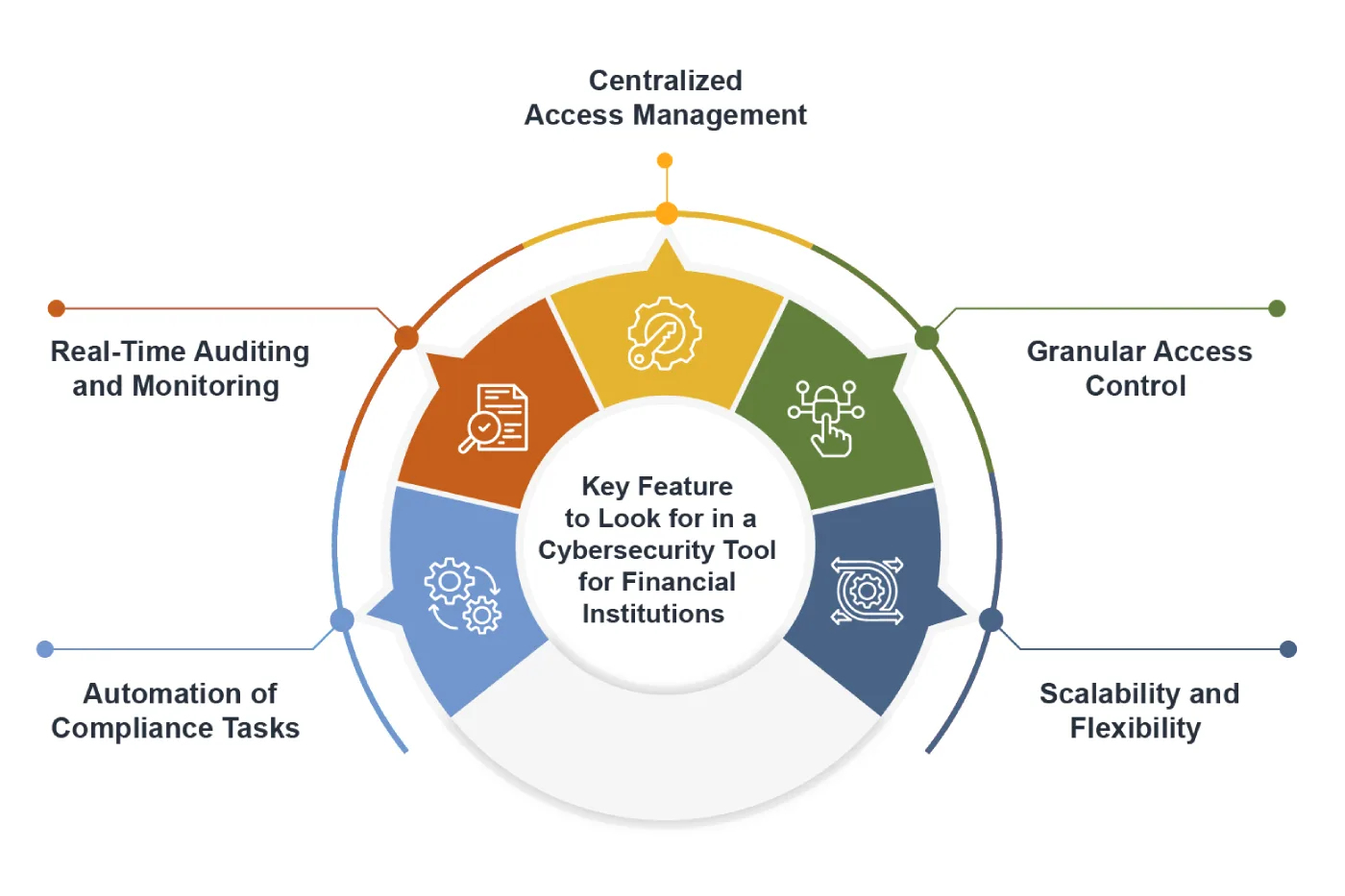
Centralized Access Management
Ensure the solution makes it:
- Easy to manage secure access across different systems.
- Simplifies access control for databases, servers, and cloud platforms.
Real-Time Auditing and Monitoring
Choose a solution that:
- Tracks user activities in real-time for compliance.
- Provides detailed tracking to meet logging requirements.
Granular Access Control
Choose a solution that:
- Enforces strict access limits.
- Uses least-privilege and zero-trust models to limit access.
- Ensures only authorized people can access sensitive data.
Automation of Compliance Tasks
Ensure the solution:
- Automates actions like reporting, vulnerability scanning, and compliance checks.
- Reduces manual work and errors.
- Ensures a consistent and reliable compliance process.
Scalability and Flexibility
Choose a solution that can:
- Scale with your business needs and adapt to changes.
- Seamlessly works with changing regulations.
How Fidelis Elevate® Can Help You Stay Compliant and Secure
Financial institutions need the right security tool to maintain cybersecurity and stay compliant with regulations. Fidelis Elevate®, a top XDR platform, is the perfect solution! How?
This all-in-one security platform offers complete cybersecurity protection for the financial sector, eliminating any vulnerabilities to attackers.
It integrates three powerful tools into a single platform:
- Fidelis Network®: Provides deep visibility into network traffic, identifying threats wherever they may hide.
- Fidelis Endpoint®: Secures endpoints, ensuring that data remains protected across all user devices.
- Fidelis Deception®: Employs deception tactics to confuse attackers, adding extra layers of protection.
It protects across:
- Networks
- Endpoints
- DLP
- Active Directory
In addition, its advanced deception technology can strengthen threat detection and support broader security, operational resilience, and compliance initiatives.This lets you monitor and secure data across different platforms to ensure your systems stay resilient against evolving threats.
- Identify and neutralize threats faster
- Gain full visibility across your attack surface
- Automate security operations for efficiency
Key Capabilities of Fidelis Elevate® to Meet Compliance Needs
Comprehensive Threat Detection
Uses AI to spot risks early, before they become major issues. It also uses the MITRE ATT&CK framework to track known attack methods, helping teams respond to threats faster.
Visibility into Data in Motion
Helps monitor sensitive customer data as it moves through your network. The platform offers Deep Session Inspection™ for better visibility of data helping detect data loss or unauthorized access before it leads to serious issues.
Active Defense with Integrated Deception
Integrated deception technology features mislead attackers with decoys and breadcrumbs, keeping them away from real assets and helping companies stay ahead of threats. And it’s particularly useful for countering sophisticated threats.
Real-Time Auditing and Forensics
It offers real-time monitoring of user activity as well as detailed forensics to track all actions. This helps financial institutions meet reporting requirements under specific regulations. The platform ensures that logs and audits are ready for compliance checks.
Addressing Key Challenges for Financial Institutions
Here is how Fidelis Elevate® helps financial institutions tackle common cybersecurity challenges while maintaining compliance:
1. Real-Time Auditing and Forensics
- Simplifies secure access to both on-premises and network systems.
- Gives you centralized control over all security aspects.
- Ensures compliance with data protection regulations by keeping security consistent across all systems.
Scalability
- Scales with your financial organization, adapting to meet new needs.
- Offers greater flexibility, ensuring your security solution stays effective as compliance needs change.
3. Efficient Incident Response
- Detects attacks 9x faster than traditional methods, by enabling a quick and efficient response to incidents, reducing the time your systems are vulnerable.
Fidelis protects your financial institution’s data and stops attackers even before they can cause harm, keeping your data and reputation safe.
In conclusion
Financial institutions need a proactive approach to protect sensitive data while meeting evolving cybersecurity and regulatory requirements. Strong data governance establishes how financial information should be managed, accessed, protected, and monitored, while cybersecurity controls help enforce those policies across complex environments.
Fidelis Elevate® brings together network, endpoint, deception, Active Directory, and data security capabilities to help financial institutions improve visibility, detect threats, investigate suspicious activity, and protect critical data. By connecting data governance with continuous security monitoring and protection, banks and other financial institutions can strengthen compliance while building a more resilient security posture.
Frequently Asked Questions
Why is cybersecurity so important for financial institutions?
Financial institutions hold sensitive and private data, making them top targets for cyberattacks. Hence, protecting data is essential to avoid breaches that can damage reputation, lead to legal consequences, or cause financial losses. A strong cybersecurity plan, combined with regulatory compliance, ensures data is secure and builds trust with customers.
What are some common challenges financial institutions face with cybersecurity regulations?
The main challenges financial institutions face with regulations are:
- Regulations can overlap or conflict, making compliance harder.
- Complex reporting requirements increase the workload.
- Security measures like encryption and firewalls may disrupt normal operations.
- Managing access across network and on-premises systems can be tricky.
- Tracking user activity for compliance takes a lot of time and resources.
How can Fidelis Elevate® help financial institutions stay compliant with cybersecurity regulations?
Fidelis Elevate® is an all-in-one security platform that addresses multiple cybersecurity challenges. It covers protection across, endpoints, networks, DLP, and AD. Additionally, the platform uses deception technology to lure and trap attackers and protect sensitive data.
It offers:
- Real-time auditing
- Centralized access management, and
- Advanced threat detection to ensure compliance for financial institutions.
What are the key features to look for in a compliance tool for financial institutions?
A tool that,
- Simplifies security across different systems.
- Tracks user activity to ensure compliance.
- Enforces strict access limits with least-privilege and zero-trust models.
- Reduces manual work and errors in tasks like reporting and vulnerability scanning.
- Adapts to business needs and changes in cybersecurity regulations.