
Key Takeaways
- CNAPP prevents risks early, while CDR detects and responds to active threats in real time.
- CNAPP secures the full cloud lifecycle, whereas CDR focuses on runtime security.
- CNAPP and CDR work best together to provide complete cloud protection.
- Solutions like Fidelis CloudPassage Halo® combine visibility, prevention, and real-time threat response.
Cloud security models at an advanced level are becoming much more popular within organizations as more move towards cloud-native architectures. As a result, terms such as CNAPP vs CDR are beginning to surface and cause confusion. As cloud security models are advanced in nature, it is essential to understand how each terms stack up against one another. In this blog, we look into what, why, and how for each of the terms.
Understanding CNAPP (Cloud Native Application Protection Platform)
A Cloud Native Application Protection Platform (APPP) protects cloud applications throughout their entire lifecycle – development, deployment and run time. CNAPP consolidates multiple security capabilities into a single platform, including:
- Cloud Security Posture Management (CSPM)
- Cloud Workload Protection (CWPP)
- Identity and entitlement management
- Infrastructure-as-Code (IaC) scanning
- Application security posture management
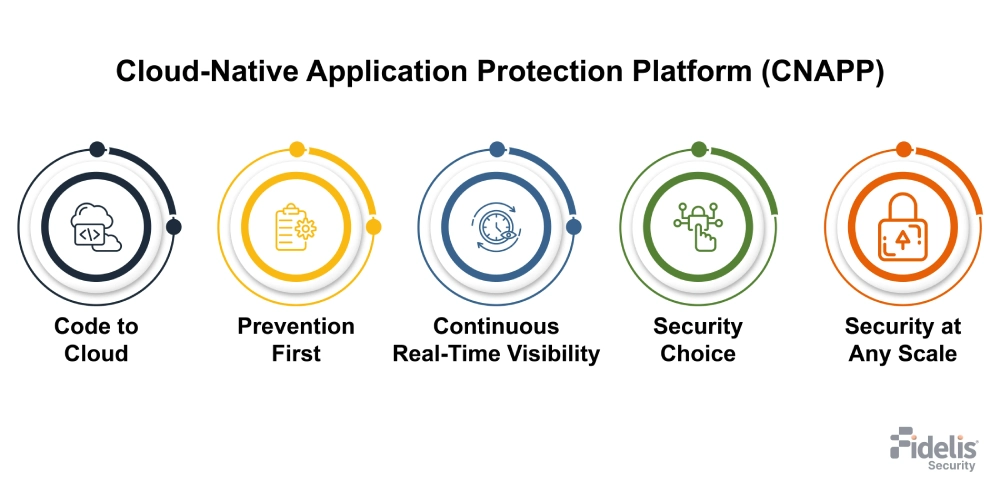
Main objective of CNAPP is to ensure the proactive security. It helps in identifying the misconfigurations, the vulnerabilities, and the compliance issues before being the target of a malicious attack.
Unlike other security tools, CNAPPs integrate DevOps processes to find and fix security vulnerabilities and misconfigurations in cloud native applications from the beginning of the development cycle – rather than later on.
Understanding CDR (Cloud Detection and Response)
Cloud detection and response are primarily concerned with the detection and response to real time threats inside cloud environments.
CDR solutions constantly scan cloud workloads, user activity, APIs, and configurations in order to identify suspicious behavior. After detection, CDR tools either offer automated or guided responses to the threat to help mitigate it.
Key capabilities of CDR include:
- Real-time threat detection
- Behavioral analytics and anomaly detection
- Threat hunting and investigation
- Automated incident response,
- Centralized visibility across cloud assets
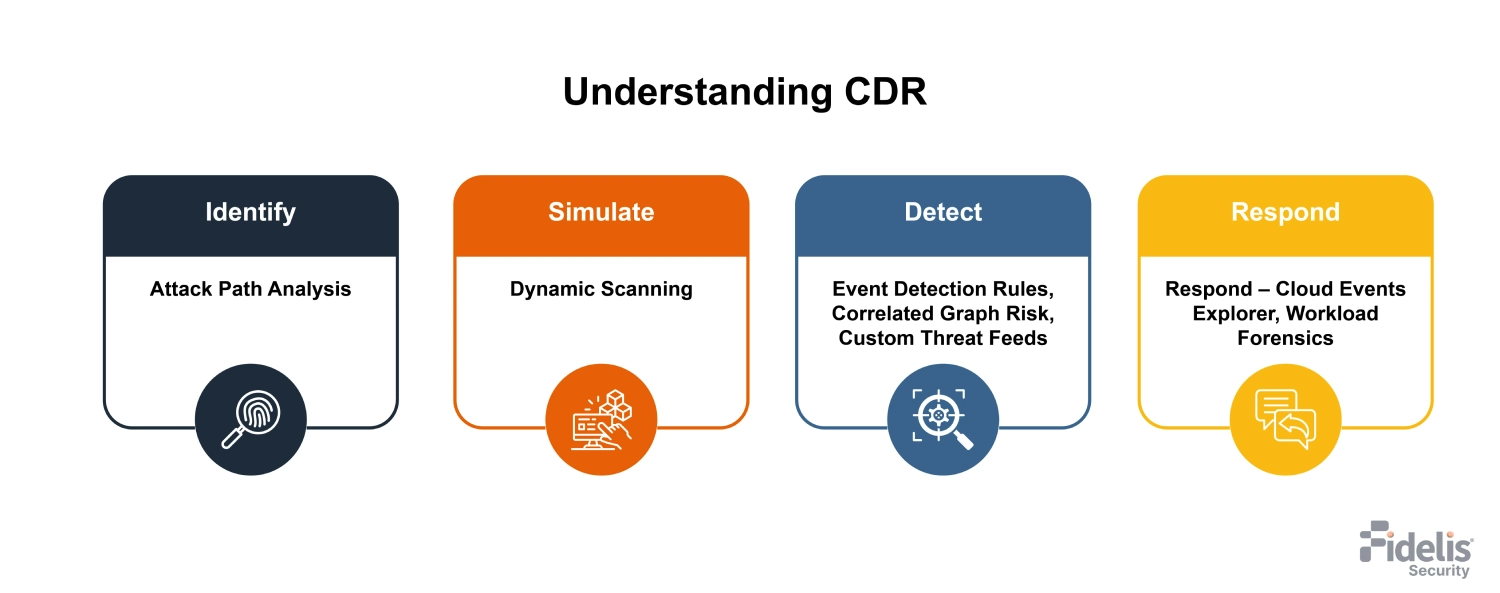
CDR is a main runtime security solution. It scans live activity across cloud systems to detect active threats like credential misuse, horizontal movement, or malware.
It is important to detect threats in the clouds so organizations can respond to the incidents and minimize dwell time as fast as possible.
CNAPP vs CDR: Core Differences
To move beyond the basics, it’s important to recognize that CNAPP vs. CDR is more than just a debate over definitions. These approaches differ in a number of dimensions, including strategy, scope, design, and use cases. The two approaches share some characteristics, but they have very different underlying goals and designs.
1. Preventive vs Reactive Security Models
Cloud Native Application Protection Platform (CNAPP) is based on a preventive approach. In this approach, vulnerabilities like misconfiguration, dirty code, and excessive permissions are detected before the product is deployed in the production environment. Hence, in simple terms it is known as “shift-left” where security is brought into the development of pipelines and thus reducing the attack surface.
Unlike prevention controls, cloud detection and response (CDR) are reactive types of control. The fact is that not all attacks can be prevented. Therefore, the focus is on detecting and mitigating real-time threats as they occur. CDR solutions use a combination of workload, user behavior, and cloud-based telemetry to identify and prevent active attacks.
A CNAPP secures the development process from the start by preventing threats from appearing, while a CDR secures the incident response process by preventing attackers from proceeding with their attack.
2. Lifecycle Coverage vs Runtime Focus
Another major distinction lies in how much of the cloud lifecycle each solution covers.
CNAPP provides end-to-end lifecycle security, covering:
- Development (code, IaC scanning)
- Deployment (configuration validation)
- Runtime (limited monitoring and protection)
This renders CNAPP to be an all-inclusive platform that protects applications across the code and cloud.
CDR, on the other hand, is mainly concerned with runtime environments. It scans real-time activity in the cloud, including API calls, User behavior, Workload execution, Network traffic.
Its advantage is deep runtime visibility and not pre-deployment security.
3. Breadth vs Depth of Security
CNAPP and CDR differ significantly in how they approach visibility.
CNAPP gives you full visibility across the whole cloud environment, including identities, configurations, workloads, and compliance in a single pane of glass.
CDR offers a very different perspective on endpoint behavior than static security solutions and offers the deepest visibility of endpoint activity while providing real time analytics and telemetry to the Endpoint Management Center, which helps detect a wider variety of advanced threats such as lateral movement and privilege escalation.
In simple terms:
- CNAPP = wide-angle lens (everything across the environment)
- CDR = zoom lens (detailed threat activity)
4. Configuration-Based vs. Behavior-Based Analysis
CNAPP primarily relies on configuration and policy analysis. It scans:
- Infrastructure-as-Code templates
- Cloud configurations
- Container images
- Identity permissions
This helps identify known risks, such as vulnerabilities or compliance violations, before exploitation.
CDR, however, uses behavioral analytics. It focuses on:
- Anomalies in user or system behavior
- Suspicious API activity
- Indicators of compromise
This allows CDR to detect unknown or zero-day threats that may not be visible through static analysis alone.
5. DevSecOps Integration vs SOC-Centric Operations
CNAPP is deeply integrated into DevSecOps workflows. It works within CI/CD pipelines to ensure that applications are secure before deployment. Developers, cloud architects, and compliance teams are primary users.
CDR is designed for Security Operations Centres (SOC). It supports:
Security analysts usually rely on CDR to investigate and respond to active threats.
- 5 signs that your InfoSec team isn’t keeping up
- Best Practices
- Automation
6. Response Mechanisms and Speed
The response to the risks of each solution is also very dissimilar.
- CNAPP response includes such remediation measures as fixing code, updating configurations, and patching vulnerabilities.
- Such measures are usually taken at the pre-deployment or post-deployment stage, and not immediately.
CDR response is automatic and immediate and involves:
- Isolating workloads
- Revoking access
- The prevention of bad behavior.
- The process of CDR takes a matter of seconds or minutes with the aim of containing threats prior to their propagation.
7. Compliance vs Threat Intelligence Focus
CNAPP has a strong emphasis on compliance and governance. It helps organizations align with frameworks such as: PCI-DSS, HIPAA, CIS benchmarks
CDR, however, is more aligned with threat intelligence and attack detection. It uses:
- Threat feeds
- Behavioral models
- Machine learning
To identify evolving attack patterns and adversary techniques.
8. Platform Architecture and Complexity
CNAPP is a unified platform that consolidates multiple security capabilities into one solution. This makes it powerful but sometimes complex to implement at scale.
CDR is often deployed as a specialized tool or capability focused on detection and response. It relies heavily on:
- Log ingestion
- Event correlation
- Analytics engines
While lighter in scope, it requires strong data integration to be effective.
9. Role in the Security Lifecycle
CNAPP is important in the initial and mid-cycle phases of the security lifecycle:
- Build securely
- Deploy securely
- Maintain posture
CDR is the last line of defense, which guarantees that:
- Active threats are detected
- Incidents are contained
- Damage is minimized
They form a closed-loop security model together that includes prevention of response.
10. Time-to-Action Perspective
CNAPP operates on a “before deployment” timeline, stopping insecure code and configurations from reaching production.
CDR operates on a “during attack” timeline, reacting instantly to suspicious or malicious activity.
This difference in timing is critical; CNAPP reduces risk exposure, while CDR minimizes breach of impact.
How CNAPP and CDR Work Together
CNAPP and CDR are complementary, rather than substitutes for each other.
Most of the current security architectures actually combine both these methods. The CDR solutions utilize CNAPP insights to enhance the process of threat detection and prioritization.
Here’s how they work together:
- CNAPP detects such risks as credentials or misconfigurations.
- CDR observes the activity of the exploitation of those risks.
- Sharing knowledge enhances priority and precision of response.
- Other platforms go as far as to incorporate CNAPP features into more extensive CDR platforms, building complete cloud security platforms.
Challenges of CNAPP and CDR
CNAPP Challenges
- Can generate large volumes of alerts
- Requires integration with DevOps pipelines
- May lack deep runtime detection capabilities
CDR Challenges
- Reactive by nature (detects after threats occur)
- Requires skilled SOC teams
- Depends on the quality of telemetry and integrations
CNAPP vs CDR: Which One Should You Choose?
The decision between CNAPP vs. CDR is not about choosing one over the other-it’s about understanding your organization’s needs.
- If your priority is preventing vulnerabilities and securing development pipelines, CNAPP is essential.
- If your focus is on detecting and responding to live threats, CDR is critical.
For most enterprises, the best approach is a combined strategy that integrates both.
Role of Fidelis in CNAPP and CDR
In the analysis of the capabilities of current CDR solutions and CNAPP, the presence of such platforms as Fidelis CloudPassage (Halo)® Cloud Secure™ is one of the best examples of cloud security.
Fidelis offers:
- Protection of workloads in cloud environments.
- Live threat monitoring and mitigation.
- Vulnerability and misconfiguration visibility.
- Sustenance of hybrid and multi-cloud implementations.
- Cloud-friendly Deployment
- Hyper-scalable Workload Protection
- Agentless Cloud Posture Management
Future of Cloud Security: Convergence of CNAPP and CDR
The future of cloud native security lies in platform consolidation.
Organizations are moving away from fragmented tools toward unified solutions that combine:
- Posture management
- Workload protection
- Threat detection and response
It is commonly known today that most CNAPPs cover everything except for data remanence. At the same time, most modern CDRs can also capture configuration data. This means that there are now several solutions that offer Security Coverage across the entire cloud lifecycle.
Application detection and response combined with preventive security controls will become the new normal in the ever evolving and increasingly complex cloud environments.
Conclusion
It is important to know the difference between CNAPP and CDR, which can be used to develop a powerful approach to cloud security. Whereas CNAPP is more concerned with the mitigation of risks throughout the lifecycle of the application, CDR focuses on identifying and remedying the threats on the go.
The two are critical in the current cybersecurity:
- CNAPP gives you better security posture.
- CDR guarantees fast response and detection.
Together, they form a complete defense system for the cloud environment, protecting from development time through to run time.
Cloud-native is a fundamentally different approach to building software, and in today’s threat landscape, organizations deploying cloud-native technologies such as microservices, containers and serverless cannot afford to be using traditional security approaches. Instead, they will have to adopt hybrid models that bring together the best of both worlds.