
Key Takeaways
- Application security has shifted from isolated testing to continuous risk management, making posture-based approaches, such as ASPM, essential for modern environments.
- ASPM provides a unified, lifecycle-wide view of security risks by correlating signals across development, deployment, and runtime.
- By prioritizing vulnerabilities based on business impact and exploitability, ASPM helps teams focus on what truly matters instead of chasing alerts.
- ASPM strengthens collaboration between security, development, and business stakeholders by translating technical findings into actionable risk insights.
- As applications become more complex, ASPM is becoming the foundation for scalable and resilient application security programs.
Applications, such as customer platforms, internal systems, and APIs, are essential to modern firms’ operations, income, and innovation. Applications have grown to be a significant and intricate target for attacks as software delivery speeds up.
Cloud-native, microservices, and CI/CD are examples of current designs that boost speed but also present new security threats. Vulnerabilities can appear at any time and often do so faster than traditional security measures. Frequently, depending only on scans leads to:
- Fragmented insights
- Overwhelming alerts
- Limited understanding of actual business risk
Application Security Posture Management (ASPM) can help with this. ASPM offers a comprehensive view of application risk throughout development, deployment, and production, in contrast to isolated security checks. ASPM enables teams to manage risk proactively rather than reactively by compiling security signals, adding context, and continuously monitoring applications.
ASPM is regarded by analysts as a crucial stage in contemporary application security. It assists businesses in scaling their security while keeping up with complex application environments and rapid development.
What Is Application Security Posture Management?
ASPM is an organized method for managing, evaluating, and enhancing application security over the course of its lifecycle. Important characteristics consist of:
- Holistic coverage: Links security data across development, deployment, and runtime
- Risk prioritization: Focuses on the most critical vulnerabilities
- Continuous enforcement: Embeds security in pipelines, beyond one-time scans
ASPM is a fundamental competency for contemporary AppSec programs since it essentially turns application security into a continuous, quantifiable process integrated into the development, deployment, and operation of applications.
What Is ASPM in Cybersecurity?
Within an organization’s broader cybersecurity strategy, Application Security Posture Management (ASPM) focuses on securing the application layer—one of today’s most frequently exploited attack surfaces.
Why applications are a prime attack target
Modern attackers increasingly target applications because they:
- Expose APIs, services, and business logic directly to the internet
- Contain third-party dependencies and open-source components
- Handle sensitive business and customer data
- Change frequently, making gaps harder to track
From an ASPM cybersecurity standpoint, applications represent a dynamic and high-risk environment that traditional security controls often fail to fully cover.
ASPM’s Role in Incident Response
ASPM strengthens incident response by:
- Identifying which applications and services are affected during an incident
- Highlighting proximity to sensitive data such as PII, PHI, or PCI-regulated information
- Enabling faster prioritization and containment decisions
Bridging technical findings and business risk
One of the most valuable aspects of ASPM security is its ability to translate technical issues into business-relevant risk. Rather than presenting raw vulnerability data, ASPM connects findings to:
- Application criticality
- Data sensitivity
- Business impact
This helps security leaders make decisions that align with business priorities.
- Real-world post-breach detection using advanced signal correlation
- How Fidelis identifies weak signals tied to known attack vectors
- Actionable insights to strengthen threat hunting and response
Why Application Security Posture Management Is Important Today
The need for Application Security Posture Management has grown rapidly due to fundamental changes in how software is built and delivered.
Key challenges driving ASPM adoption
-
Growing application complexity and velocity
- Cloud-native architectures, microservices, and serverless workloads
- Frequent code changes and rapid release cycles
- Constant evolution of application dependencies
-
AppSec and cloud security tool sprawl
- Multiple tools across SAST, DAST, SCA, IaC, and runtime security
- Siloed ownership across security, development, and platform teams
- Limited correlation between findings
-
Difficulty prioritizing vulnerabilities at scale
- Thousands of alerts with similar severity scores
- Little context around exploitability or business impact
- Backlogs that grow faster than teams can remediate
-
Developer fatigue and alert overload
- Repetitive or low-value alerts
- Reduced trust between security and engineering teams
- Security controls being bypassed or ignored
Why posture-based management is replacing reactive security
ASPM moves security from reactive fixes to proactive, risk-based management, enabling continuous assessment and focused protection that scales with development.
How ASPM Works Across the Application Lifecycle
From code generation to production runtime, Application Security Posture Management offers ongoing supervision throughout the whole software development lifecycle (SDLC).
Security signal aggregation across the SDLC
ASPM brings together insights from multiple stages and sources, including:
- Code analysis – findings from static and dynamic testing
- Dependency risk – open-source and third-party component exposure
- Infrastructure configuration – misconfigurations and policy violations
- CI/CD pipelines – security signals during build and deployment
- Production environments – runtime context and exposure
From raw findings to actionable risk
Once ingested, ASPM platforms:
- Correlate related findings across tools and environments
- Normalize data into a consistent risk model
- Deduplicate repeated or overlapping issues
-
Enrich vulnerabilities with context, such as:
- Ownership
- Asset importance
- Data exposure
Continuous Posture Assessment vs. Point-in-time Scans
| Traditional AppSec | ASPM |
|---|---|
| Point-in-time scans | Continuous posture monitoring |
| Tool-specific findings | Unified application risk view |
| Severity-based prioritization | Risk- and business-based prioritization |
| Manual triage | Automated correlation and context |
Automation as a core enabler
An essential component of efficient ASPM administration is automation. ASPM’s integration with DevSecOps guarantees scalable monitoring and enforcement, maintaining application security in line with rapid development.
Core Capabilities of Modern ASPM Platforms
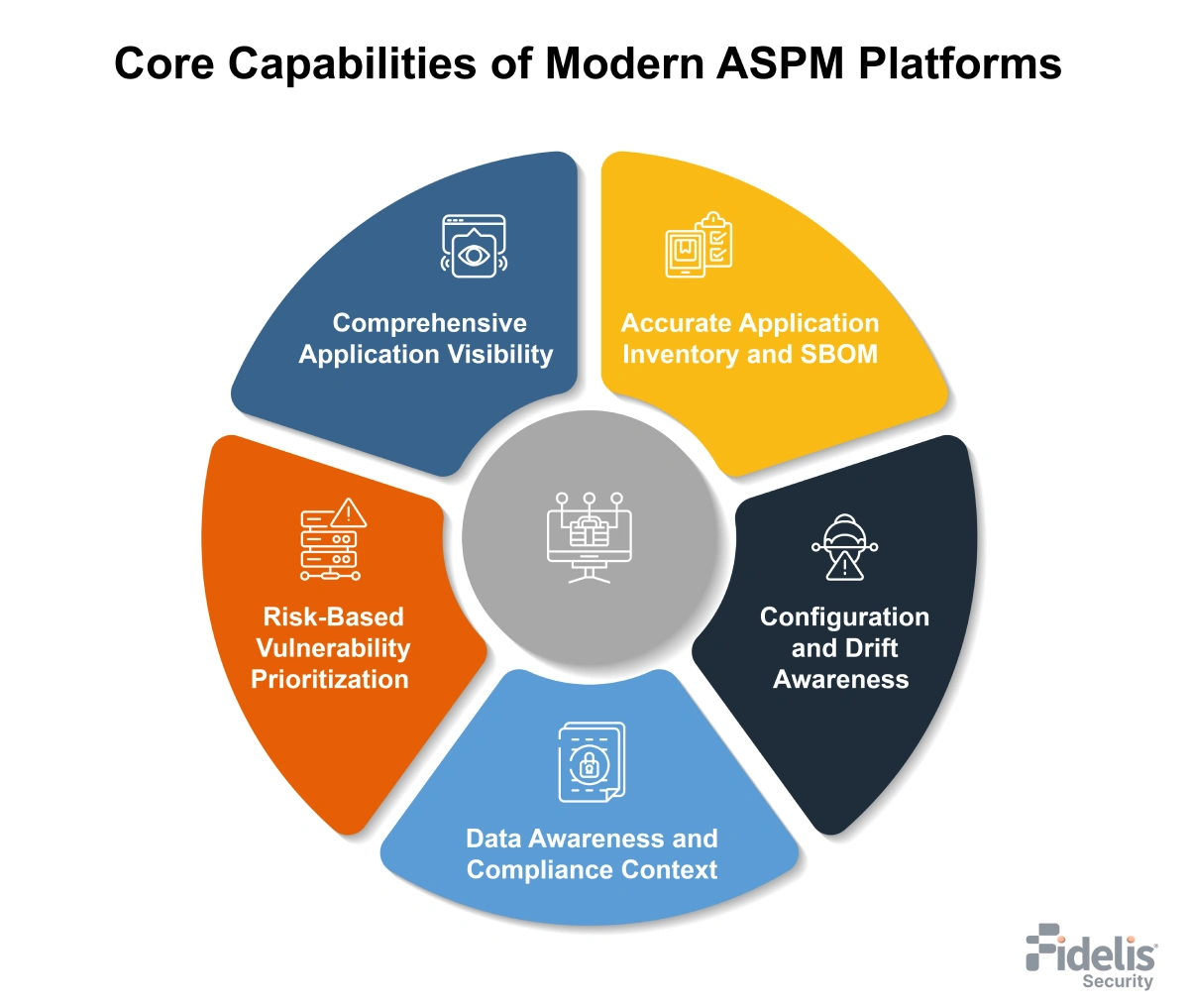
Modern ASPM tools are designed to provide continuous, contextual insight into application risk—far beyond what isolated security tools can offer. The most effective ASPM platforms share several core capabilities.
1. Comprehensive Application Visibility
ASPM provides a complete view of how applications are built and operate by:
- Mapping services, APIs, dependencies, and communication paths
- Identifying relationships between application components
- Covering both cloud-native and on-premises environments
This visibility eliminates blind spots that often exist when applications span multiple platforms, teams, and environments.
2. Accurate Application Inventory and SBOM
A foundational capability of ASPM is maintaining a living system of record that includes:
- An up-to-date application inventory
- Software bills of materials (SBOMs) for dependencies and libraries
This constantly updated inventory helps with supply chain security and compliance initiatives and makes risk assessment more precise.
3. Risk-Based Vulnerability Prioritization
Rather than relying on severity scores alone, ASPM prioritizes vulnerabilities by:
- Considering asset criticality and business importance
- Evaluating exploitability and exposure
- Correlating related findings across tools
This risk-based approach helps teams focus remediation efforts on issues that truly threaten the organization.
4. Configuration and Drift Awareness
ASPM detects unexpected changes by:
- Establishing secure architectural baselines
- Monitoring for configuration or dependency drift
- Highlighting unauthorized or risky changes over time
This capability ensures applications remain secure as they evolve.
5. Data Awareness and Compliance Context
To better assess impact, ASPM identifies:
- Where sensitive data resides within applications
- How data flows across services and APIs
- Risk proximity to regulated data, such as PII or PHI
This context strengthens compliance and data protection strategies.
Key Benefits of Application Security Posture Management
ASPM provides quantifiable enhancements to an organization’s application security posture by integrating visibility, context, and automation.
-
Operational and security benefits
- Centralized visibility: A unified view of application risk across teams and environments
- Reduced alert fatigue: Correlated findings and fewer false positives
- Faster remediation: Clear prioritization shortens the time to fix critical issues
-
DevSecOps and governance benefits
- Improved collaboration: Shared context between security, development, and operations teams
- Consistent enforcement: Security policies applied across the SDLC
- Audit and compliance readiness: Continuous monitoring supports regulatory requirements
-
Long-term resilience
ASPM helps organizations move from reactive firefighting to proactive security across use cases like supply chain risk, cloud-native applications, and CI/CD security. This strategy gradually creates more robust apps that can resist changing threats without impeding innovation.
ASPM vs Traditional Application Security Approaches
Conventional AppSec can produce fragmented, difficult-to-use results since it employs different technologies at different phases.
Limitations of traditional AppSec
- Disconnected findings across SAST, DAST, and SCA
- Duplicate alerts and inconsistent severity scoring
- Limited context around ownership, impact, or exploitability
- Minimal enforcement and long-term risk tracking
ASPM shifts AppSec to risk-based management, providing continuous visibility and prioritizing fixes by business impact.
ASPM vs Other Security Posture Models
As organizations adopt multiple security posture frameworks, understanding how ASPM fits alongside them is critical.
ASPM vs ASOC
ASPM vs ASOC is often misunderstood because ASOC capabilities are frequently embedded within ASPM platforms.
-
ASOC (Application Security Orchestration and Correlation) focuses on:
- Automating security workflows
- Aggregating findings from AppSec tools
- Improving operational efficiency
-
ASPM, on the other hand:
- Manages application security posture holistically
- Prioritizes risk based on business impact
- Governs AppSec programs at scale
In practice, ASOC enables tactical automation, while ASPM provides strategic risk governance. ASOC capabilities serve as a foundation within broader ASPM initiatives.
ASPM vs CSPM
The comparison of ASPM vs CSPM highlights a critical layer distinction.
- CSPM secures cloud infrastructure by identifying misconfigurations, policy violations, and compliance gaps.
- ASPM secures applications by analyzing code, dependencies, APIs, and runtime exposure.
CSPM alone can’t cover application risks, as it misses code, data flows, and dependencies. Combined with ASPM, they offer complete protection across applications and infrastructure.
ASPM vs SAST and DAST
SAST and DAST are testing tools, not posture management frameworks.
-
SAST/DAST
- Deliver point-in-time results
- Focus on individual vulnerability detection
- Operate at specific SDLC stages
-
ASPM
- Provides continuous visibility across the SDLC
- Correlates results across tools and environments
- Tracks risk over time and across releases
ASPM contextualizes testing results, transforming raw findings into actionable risk insights.
ASPM vs DSPM
- DSPM focuses on securing data assets and exposure.
- ASPM focuses on securing applications that access and process that data.
They operate at different layers but deliver complementary outcomes when used together.
How ASPM Improves an Organization’s Security Posture
Application Security Posture Management improves security outcomes by shifting organizations toward asset-first, risk-driven decision-making.
Key improvements include:
- Asset-first risk management, prioritizing applications based on business importance
- Smarter resource allocation, focusing effort where risk is highest
- Faster detection and fixes through connected insights
- Stronger alignment between security, development, and business leaders
ASPM turns technical problems into business risks, enabling smarter security decisions without slowing innovation.
Application Security Posture Management Gap Analysis
Understanding how to perform application security posture management gap analysis is essential for improving AppSec maturity.
An ASPM gap analysis evaluates:
- Visibility – Are all applications, services, and dependencies accounted for?
- Coverage – Are security controls applied consistently across the SDLC?
- Prioritization – Are risks ranked by business impact or just severity?
Key steps in a gap assessment:
- Inventory existing applications and AppSec tools
- Identify blind spots and overlapping tooling
- Assess risk prioritization effectiveness
- Measure posture maturity across development and production
This structured approach answers how to perform application security posture management gap assessment and helps organizations define a clear roadmap for improvement.
ASPM Best Practices for Successful Adoption
Following proven ASPM best practices helps organizations realize value faster and at scale.
Application security posture management best practices include:
- Start with complete application discovery and ownership mapping
- Define posture metrics tied to business risk
- Embed ASPM into CI/CD workflows for continuous visibility
- Automate policy enforcement and remediation triggers
- Regularly reassess posture as applications evolve
Successful ASPM adoption treats security as an ongoing program, not a one-time implementation.
ASPM, Supply Chain Security, and the Future of AppSec
ASPM plays a growing role in software supply chain security by providing visibility into dependencies, third-party components, and build pipelines. SBOMs and dependency tracking enable teams to assess exposure quickly and respond to emerging threats.
In order to combat next-generation threats, ASPM will eventually combine with more comprehensive security systems to enable unified risk management across apps, infrastructure, and data.
Conclusion
ASPM allows for continuous, risk-based security throughout the application lifecycle by going beyond reactive repair and isolated tools.
For organizations seeking to scale AppSec programs without slowing development, ASPM provides the visibility, context, and governance needed to protect what matters most. As application environments continue to evolve, ASPM is becoming the foundation of sustainable, effective application security.
Frequently Ask Questions
What is Application Security Posture Management (ASPM)?
ASPM is a continuous approach to managing application security, unifying tool findings, adding business context, and helping teams prioritize and reduce risk efficiently.
How is ASPM different from traditional application security tools?
Traditional tools give one-time results, while ASPM tracks risks continuously, correlates findings, and prioritizes them by business impact.
How does ASPM improve an organization’s security posture?
ASPM boosts security by centralizing visibility, prioritizing risks, and speeding up fixes, helping security teams focus on critical issues while aligning with business goals.
What is the difference between ASPM and CSPM?
ASPM secures code, APIs, and dependencies, while CSPM handles cloud misconfigurations. CSPM can’t cover application logic or data, so using both gives full protection.
How do you perform an Application Security Posture Management gap analysis?
An ASPM gap analysis checks application visibility, security coverage, and risk prioritization, identifying blind spots and gaps to guide improvements in security posture.