
Summary
CVE-2026-23813 is a critical flaw in HPE Aruba AOS-CX that lets unauthenticated attackers bypass login and reset admin passwords, risking full device control. It requires no privileges or user action and is easy to exploit, so patching is essential.
Urgent Actions Required
- Upgrade to patched AOS-CX versions: 10.13.1170, 10.16.1030, and 10.17.0002.
- Restrict management access via VLANs or segmentation.
- Allow only trusted systems using ACLs.
- Disable unused HTTP/HTTPS interfaces.
- Enable logging and monitoring.
Which Systems Are Vulnerable to CVE-2026-23813?
Technical Overview
-
Vulnerability Type:
Authentication Bypass (Improper Authentication - CWE-287) -
Affected Software/Versions:
HPE Aruba AOS-CX- 10.17.x ≤ 10.17.0001
- 10.16.x ≤ 10.16.1020
- 10.13.x ≤ 10.13.1160
- 10.10.x ≤ 10.10.1170
-
Attack Vector:
Network (HTTP/HTTPS management interface) -
CVSS Vector: v3.1
- Attack Vector: Network
- Attack Complexity: Low
- Privileges Required: None
- User Interaction: None
- Scope: Unchanged
- Confidentiality Impact: High
- Integrity Impact: High
- Availability Impact: High
-
Patch Availability: Yes, available
HPESBNW05027 rev.1 - HPE Aruba Networking AOS-CX, Multiple Vulnerabilities
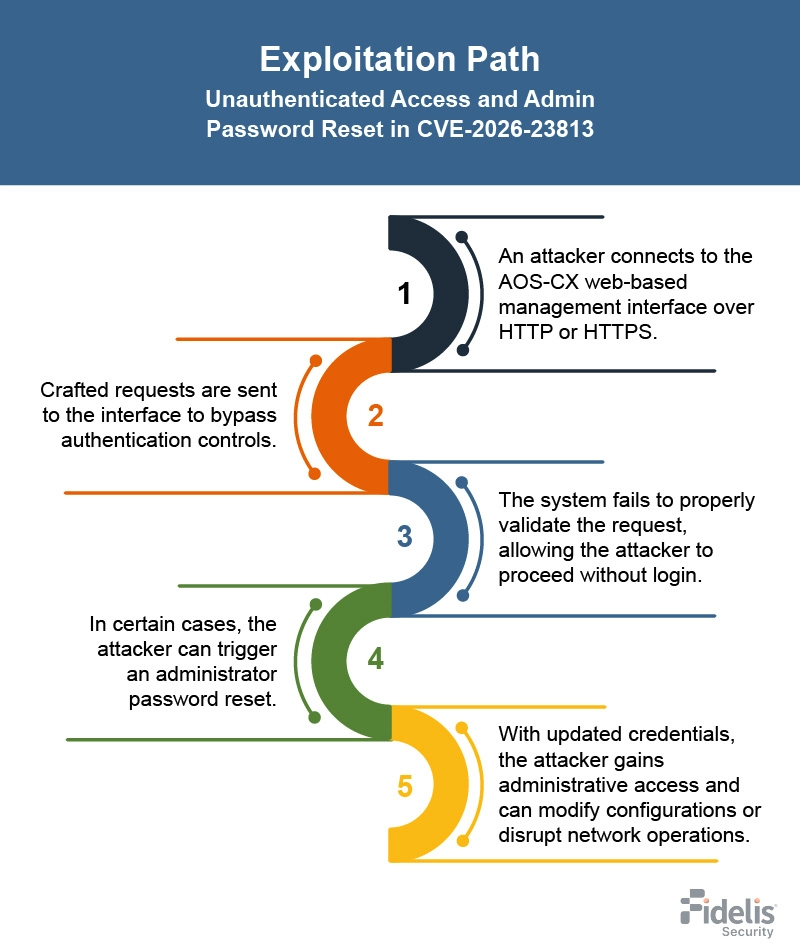
How Does the CVE-2026-23813 Exploit Work?
The attack typically follows these steps:
What Causes CVE-2026-23813?
Vulnerability Root Cause:
This flaw is due to weak authentication in the AOS-CX web interface (CWE-287). It fails to enforce checks properly, allowing crafted requests to bypass login and reset admin passwords, leading to unauthorized access.
How Can You Mitigate CVE-2026-23813?
If immediate patching is delayed or not possible:
- Isolate management access using VLANs.
- Allow only trusted systems with ACLs.
- Disable unused HTTP/HTTPS interfaces.
- Restrict REST/HTTP access with control plane ACLs.
- Enable logging and monitoring.
Which Assets and Systems Are at Risk?
-
Asset Types Affected:
- AOS-CX switches running vulnerable versions
- Web-based management interfaces (HTTP/HTTPS)
-
Business-Critical Systems at Risk:
- Network Infrastructure - Core switches handling enterprise network traffic
- Management Interfaces - Systems used for device configuration and administration
-
Exposure Level:
- Internet-facing management interfaces - Directly accessible over HTTP/HTTPS
- Unrestricted internal networks - Where access controls to management interfaces are weak or absent
How Can You Detect CVE-2026-23813 Exploitation?
Exploitation Signatures:
Look for unauthorized HTTP/HTTPS requests to the AOS-CX management interface, especially those triggering password reset actions without prior authentication.
Indicators of Compromise (IOCs/IOAs):
- Password reset events without valid login sessions
- Unexpected configuration changes on switches
- Unusual HTTP/HTTPS requests to management endpoints
Behavioral Indicators:
- Access to the management interface without authentication
- Sudden credential changes (e.g., admin password updates)
- Abnormal activity logs related to the management interface
Alerting Strategy:
- Priority: High
-
Trigger alerts for:
- Unauthenticated access attempts to management interfaces
- Password reset or configuration changes without valid sessions
- Suspicious HTTP/HTTPS activity targeting management endpoints
Remediation & Response
-
Remediation Timeline:
- Immediate: Restrict access to management interfaces and apply ACLs.
- As soon as possible: Upgrade to patched AOS-CX versions (10.13.1170, 10.16.1030, and 10.17.0002).
-
Incident Response Considerations:
- Monitor for unauthorized access attempts
- Check logs for unexpected password resets or changes
- Enable detailed logging and auditing to support investigation
Compliance & Governance Notes
-
Audit Trail Requirement:
- Enable logging for all management interface activity.
- Track access attempts, including unauthorized requests.
- Monitor and record password reset events and configuration changes.
-
Policy Alignment:
- Restrict access to management interfaces using network segmentation and ACLs
- Enforce strict access controls for HTTP/HTTPS and REST management endpoints
- Implement continuous monitoring of the management interface activity
Keep Exploring
Detailed insights into critical and emerging CVEs
CVSS Breakdown Table
| Metric | Value | Description |
|---|---|---|
| Base Score | 9.8 (Critical) | Critical severity with high impact and ease of exploitation |
| Attack Vector | Network | Can be exploited remotely via the web-based management interface (HTTP/HTTPS) |
| Attack Complexity | Low | No special conditions required for exploitation |
| Privileges Required | None | Does not require authentication or prior access |
| User Interaction | None | No user involvement needed |
| Scope | Unchanged | Impact is limited to the affected component |
| Confidentiality Impact | High | May expose sensitive configurations and credentials |
| Integrity Impact | High | Allows unauthorized changes, such as password resets and configurations |
| Availability Impact | High | Can disrupt network services and operations |
References: