


Summary
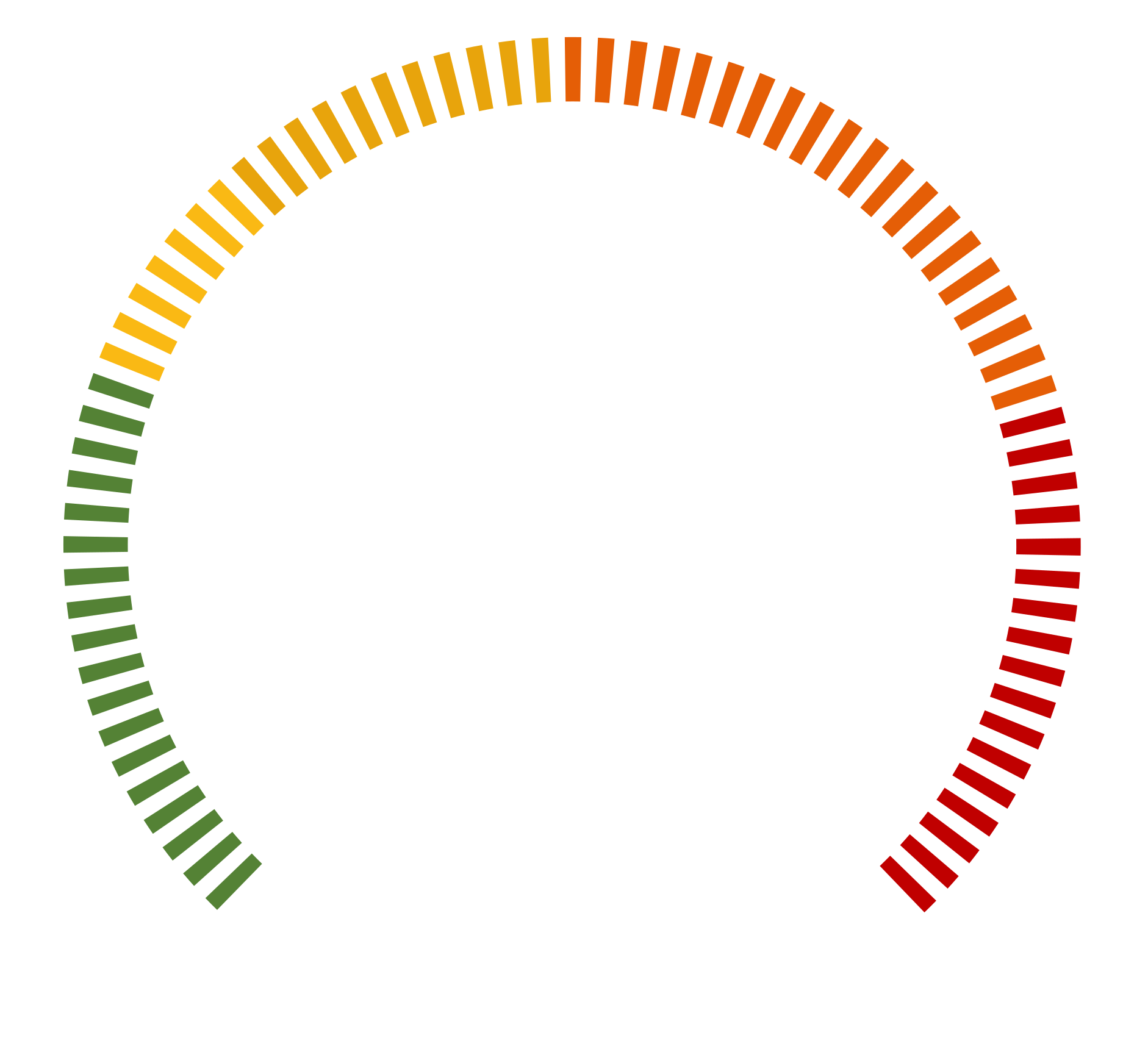
CVE-2025-40778 is a vulnerability in BIND 9’s recursive resolver logic that can cause the server to accept and cache DNS records that were not legitimately solicited. An attacker who can influence or spoof DNS responses may insert forged A/CNAME (and other) records into a resolver’s cache during a query. Poisoned caches can then return attacker-controlled results for subsequent lookups until those entries expire or are flushed, allowing redirection of clients to malicious infrastructure.
Urgent Actions Required
- Update BIND 9 to versions 9.18.41, 9.20.15, or 9.21.14 (or 9.18.41-S1 / 9.20.15-S1 for Preview Editions).
- Patch internet-facing and recursive resolvers first.
- Restrict recursion to trusted networks if patching is delayed.
- Enable DNSSEC validation where possible.
- Apply vendor security updates immediately.
Which Systems Are Vulnerable to CVE-2025-40778?
Technical Overview
- Vulnerability Type: Cache Poisoning via Unsolicited DNS Records
-
Affected Software/Versions:
- BIND 9.11.0 – 9.16.50
- BIND 9.18.0 – 9.18.39
- BIND 9.20.0 – 9.20.13
- BIND 9.21.0 – 9.21.12
- BIND 9-S1 versions 9.11.3-S1 – 9.16.50-S1, 9.18.11-S1 – 9.18.39-S1, 9.20.9-S1 – 9.20.13-S1
- Attack Vector: Network (DNS)
-
CVSS Vector: v3.1
- Attack Vector: Network
- Attack Complexity: Low
- Privileges Required: None
- User Interaction: None
- Scope: Changed
- Confidentiality Impact: None
- Integrity Impact: High
- Availability Impact: None
- Patch Availability: Yes, available[1][5]
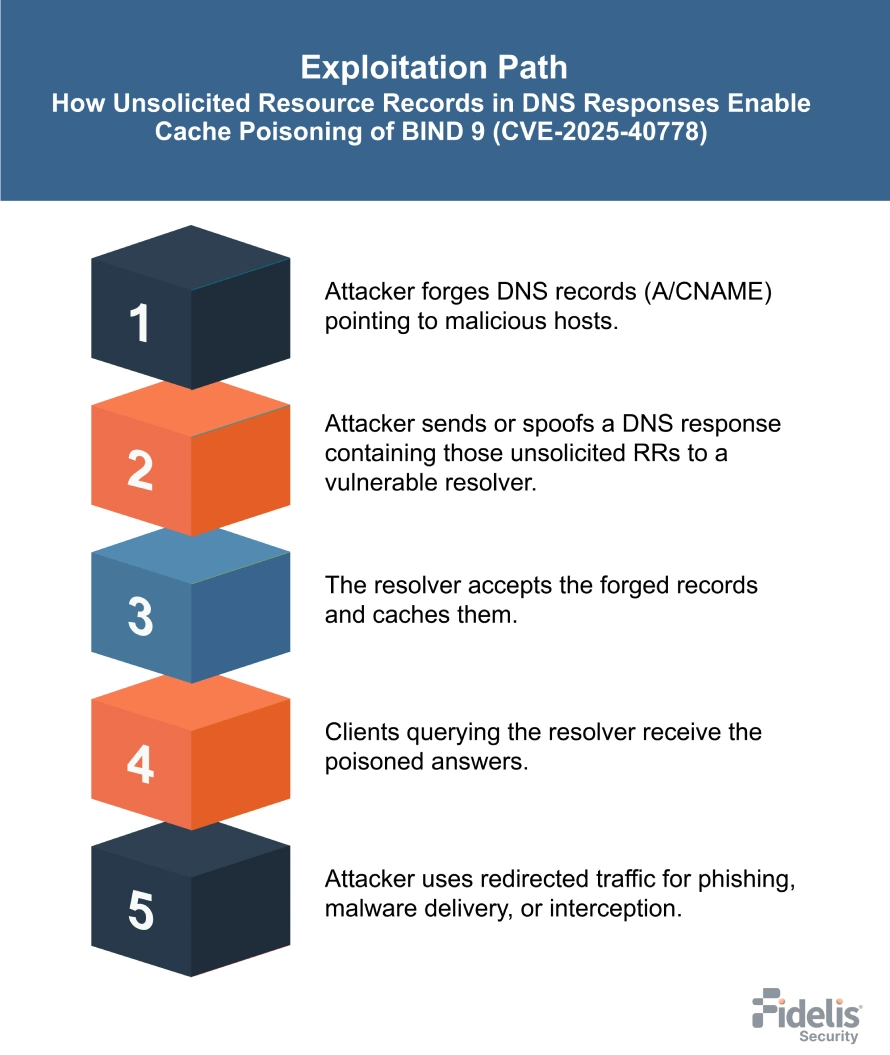
How Does the CVE-2025-40778 Exploit Work?
The attack typically follows these steps:
What Causes CVE-2025-40778?
Vulnerability Root Cause:
The flaw is in BIND 9’s resolver logic that fails to properly validate resource records carried in DNS responses. The resolver may store unsolicited DNS records that don’t match the query or fall outside the expected domain. Since these aren’t properly checked, forged A or CNAME records can be cached and later returned to clients. This breaks the resolver’s assumption that only relevant, authoritative records are cached and enables remote cache poisoning.
How Can You Mitigate CVE-2025-40778?
If immediate patching is delayed or not possible:
- Restrict recursion to trusted IP ranges only; disable open recursion.
- Ensure authoritative-only servers are not performing recursion.
- Enable DNSSEC validation on resolvers to reject forged records where feasible.
- Reduce maximum cache TTL (for example, to 24 hours or less) while you roll out fixes.
- Limit external exposure by using firewalls or ACLs to block DNS queries from untrusted networks to resolvers.
- Apply query rate limiting to reduce the impact of spoofed or repetitive responses.
- Monitor resolver caches and query logs for unexpected or suspicious records and unusual traffic.
Which Assets and Systems Are at Risk?
Asset Types Affected:
- DNS resolvers using vulnerable BIND 9 versions with recursion enabled
- Authoritative DNS servers inadvertently performing recursive queries
- DNS infrastructure components relying on shared caching or forwarding
Business-Critical Systems at Risk:
- Enterprise networks and ISPs where internal or customer-facing resolvers can be poisoned
- Cloud or hosting environments using shared or public recursive resolvers
- Security and monitoring systems dependent on DNS integrity for endpoint or domain resolution
Exposure Level:
- Internet-facing DNS resolvers accepting queries from untrusted sources
- Internal recursive resolvers exposed to external networks or misconfigured for open recursion
- Environments without DNSSEC validation or query access restrictions
Will Patching CVE-2025-40778 Cause Downtime?
Patch application impact: Low. Update to BIND 9.18.41, 9.20.15, 9.21.14, 9.18.41-S1, or 9.20.15-S1 to fix the issue. Restarting may briefly disrupt service; update redundant resolvers in sequence.
How Can You Detect CVE-2025-40778 Exploitation?
Exploitation Signatures:
- Unexpected resource records appearing in the resolver cache (A, CNAME, or other RRs that were not requested).
- Cache entries for names that fall outside the responding server’s expected bailiwick.
- Resolver returning IPs that differ from known authoritative answers for the same names.
Indicators of Compromise (IOCs/IOAs):
- Newly cached A/CNAME records that point to suspicious or attacker-controlled IP addresses.
- Sudden appearance of answer-section RRs that do not match the original query name.
- Anomalous query/response patterns around the time poisoned entries appear (e.g., spikes in responses containing unsolicited RRs).
- Public PoC availability — treat any matching activity as higher risk.
Behavioral Indicators:
- Clients being redirected to unexpected IPs or domains after previously stable resolution.
- Increase in traffic to unknown endpoints corresponding to recently cached records.
- Resolver cache entries persisting for unusual durations relative to expected authoritative TTLs.
Alerting Strategy:
- Priority: High
- Trigger high-priority alerts when a resolver cache gains an unsolicited RR or a cached record points to an unfamiliar IP.
- Alert on sizeable or sudden changes in resolver cache contents.
- Alert on spikes in queries or responses that coincide with new unsolicited RR cache entries.
- Escalate incidents rapidly because a public PoC exists.
Remediation & Response
Mitigation Steps if No Patch:
- Restrict recursion to trusted IP ranges; disable open recursion.
- Ensure authoritative-only servers are not performing recursion.
- Enable DNSSEC validation where feasible to reject forged records.
- Reduce maximum cache TTL (for example to 24 hours or less) while fixes are rolled out.
- Limit DNS query access from untrusted networks with firewalls or ACLs.
- Apply query rate limiting to reduce the impact of spoofed or repetitive responses.
- Monitor resolver caches and query logs for unexpected records and anomalous patterns.
Incident Response Considerations:
- Alert on new cached A/CNAME records that point to unfamiliar or suspicious IPs.
- Investigate any unsolicited answer-section records that do not match the original query name.
- Collect resolver logs, query/response captures, and timestamps around suspicious cache entries.
- Treat activity matching public PoC behavior as high risk and escalate accordingly.
- After patching, continue monitoring caches to confirm removal or expiry of any forged entries.
Where Can I Find More Information on CVE-2025-40778?
CVSS Breakdown Table
| Metric | Value | Description |
|---|---|---|
| Base Score | 8.6 | High severity vulnerability allowing cache poisoning in BIND 9 DNS resolvers |
| Attack Vector | Network | Exploitable remotely through DNS queries and responses |
| Attack Complexity | Low | Exploitation does not require special conditions or advanced setup |
| Privileges Required | None | Attackers can exploit the flaw without authentication |
| User Interaction | None | No user involvement is needed for exploitation |
| Scope | Changed | Compromised DNS responses can affect other systems relying on the resolver |
| Confidentiality Impact | None | No direct data disclosure noted |
| Integrity Impact | High | Attackers can inject forged data into DNS caches |
| Availability Impact | None | Exploitation primarily affects data accuracy, not service uptime |