


Summary
CVE-2025-27840 affects Espressif ESP32 Bluetooth firmware, which contains 29 undocumented HCI commands, including 0xFC02 (Write Memory), allowing modification of internal memory. These hidden commands can be accessed via standard Bluetooth tools. While initially described as a backdoor, they represent hidden functionality, not a remotely exploitable flaw. No official fix or workaround was provided at disclosure in March 2025.
Urgent Actions Required
- Update ESP32 firmware where vendor updates are available and closely follow Espressif security communications for Bluetooth-related mitigations.
- Restrict access to HCI communication paths and limit Bluetooth interactions to trusted components only.
- Monitor Bluetooth HCI traffic for unusual or undocumented commands, especially memory write attempts.
Which Systems Are Vulnerable to CVE-2025-27840?
Technical Overview
- Vulnerability Type: Hidden functionality exposed through undocumented Bluetooth HCI commands (memory write capability)
-
Affected Software/Versions:
- Espressif ESP32 chips
- Espressif ESP32 Bluetooth firmware (versions not specifically bounded in disclosures)
- CVSS Score: 6.8
-
CVSS Vector: v3.1
- Attack Vector: Physical
- Attack Complexity: High
- Privileges Required: High
- User Interaction: None
- Scope: Changed
- Confidentiality Impact: High
- Integrity Impact: High
- Availability Impact: Low
- Patch Availability: No vendor-provided fix or workaround was listed at the time of disclosure.
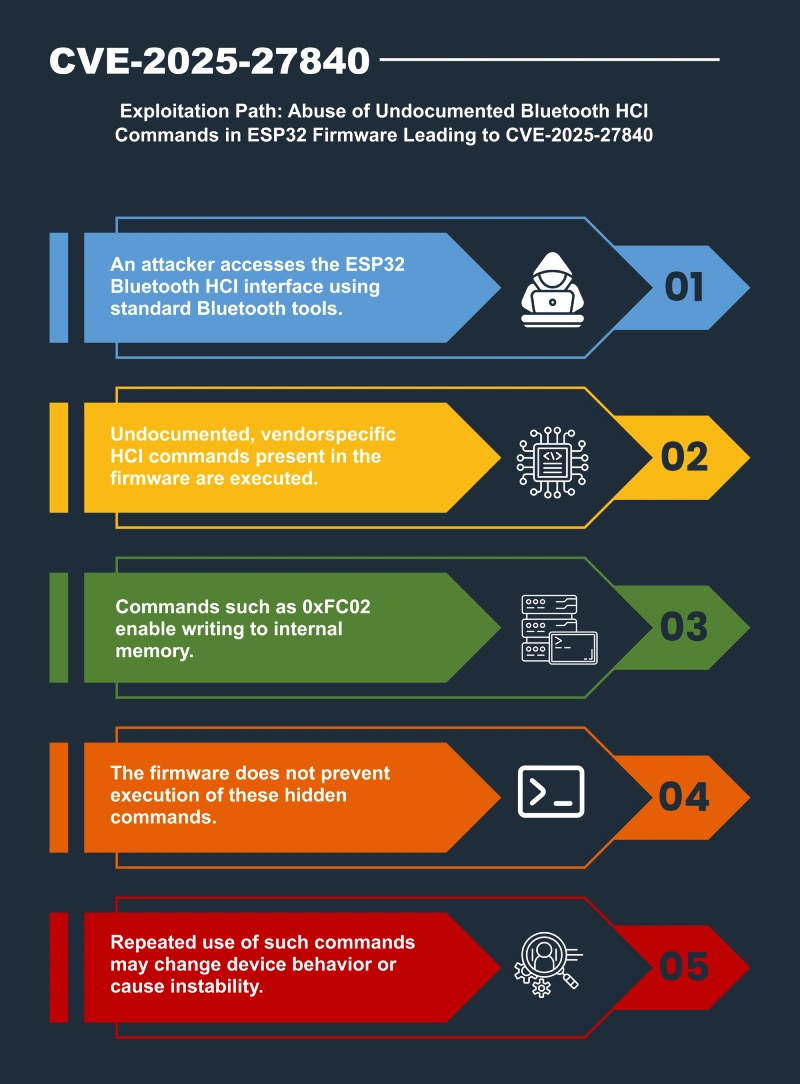
How Does the CVE-2025-27840 Exploit Work?
The attack typically follows these steps:
What Causes CVE-2025-27840?
Vulnerability Root Cause:
CVE-2025-27840 arises from hidden, vendor-specific Bluetooth HCI commands in ESP32 firmware that remain accessible and allow sensitive actions like memory modification.
How Can You Mitigate CVE-2025-27840?
If immediate remediation is delayed or not possible:
- Conduct focused Bluetooth security assessments on ESP32based devices to identify exposure to undocumented HCI commands.
- Use dedicated auditing tools, such as BluetoothUSB developed by the researchers, to test Bluetooth behavior across operating systems.
- Review device designs and firmware usage to understand how hidden HCI functionality could be reached through standard Bluetooth interfaces.
- Enable manufacturers and security teams to perform internal validation and testing of Bluetooth implementations on affected devices.
Which Assets and Systems Are at Risk?
Asset Types Affected:
- ESP32based Devices – Hardware using Espressif ESP32 Bluetooth chips containing undocumented HCI commands
- IoT Devices – Lowcost, massdeployed devices where ESP32 chips are commonly embedded
Business-Critical Systems at Risk:
- Consumer and Enterprise Devices – Systems using ESP32 Bluetooth that could face impersonation or long-term compromise
- Sensitive Equipment – Researchers note risks to devices like phones, computers, smart locks, and medical equipment if exploited
Exposure Level:
- BluetoothEnabled Devices – Systems accessible through Bluetooth interfaces on macOS, Windows, or Linux
- Widely Deployed Hardware – Devices using ESP32 chips, with over one billion units reportedly sold, increasing the potential impact surface
CVSS Breakdown Table
| Metric | Value | Description |
|---|---|---|
| Base Score | 6.8 | Indicates a moderateseverity vulnerability with meaningful security impact under specific conditions |
| Attack Vector | Physical | Exploitation requires physical proximity or direct access to the target device or its interfaces |
| Attack Complexity | High | Successful exploitation depends on complex conditions and is not easily repeatable without technical expertise |
| Privileges Required | High | The attacker must already have elevated or trusted access to interact with the vulnerable interface |
| User Interaction | None | No action is required from a legitimate user for exploitation to occur |
| Scope | Changed | Exploitation can impact components beyond the initially vulnerable module or security boundary |
| Confidentiality Impact | High | Unauthorized access can lead to significant exposure of sensitive data or internal memory contents |
| Integrity Impact | High | An attacker can modify internal memory or device behavior in an unauthorized manner |
| Availability Impact | Low | Device availability impact is limited, with disruption possible but not the main risk |