
Summary
CVE-2025-24085 is a memory management defect (use-after-free) in Apple’s multimedia stack (Core Media / related components) across multiple Apple operating systems. A malicious application can trigger the condition, manipulate freed memory, and cause the execution of attacker-controlled code with elevated privileges. Apple reported active exploitation against iOS releases prior to 17.2 and released fixes in January 2025.
Urgent Actions Required
- Update devices immediately to iOS/iPadOS 18.3, macOS Sequoia 15.3, watchOS 11.3, tvOS 18.3, or visionOS 2.3.
- Find vulnerable devices and patch them first.
- Uninstall apps from untrusted sources.
- Avoid opening untrusted media on unpatched devices.
- Treat unpatched devices as high risk and follow agency guidance.
- Watch for unusual app behavior or crashes.
Which Systems Are Vulnerable to CVE-2025-24085?
Technical Overview
- Vulnerability Type: UseAfterFree in memory management
-
Affected Software/Versions:
- iOS < 18.3
- iPadOS < 18.3
- macOS Sequoia < 15.3
- watchOS < 11.3
- tvOS < 18.3
- visionOS < 2.3
- CVSS Score: 7.8
-
CVSS Vector: v3.1
- Attack Vector: Local
- Attack complexity: Low
- Privileges required: None
- User interaction: Required
- Scope: Unchanged
- Confidentiality impact: High
- Integrity impact: High
- Availability impact: High
-
Patch Availability: Yes, available
- About the security content of iOS 18.3 and iPadOS 18.3 - Apple Support
- About the security content of watchOS 11.3 - Apple Support
- About the security content of visionOS 2.3 - Apple Support
- About the security content of tvOS 18.3 - Apple Support
- About the security content of macOS Sequoia 15.3 - Apple Support
How Does the CVE-2025-24085 Exploit Work?
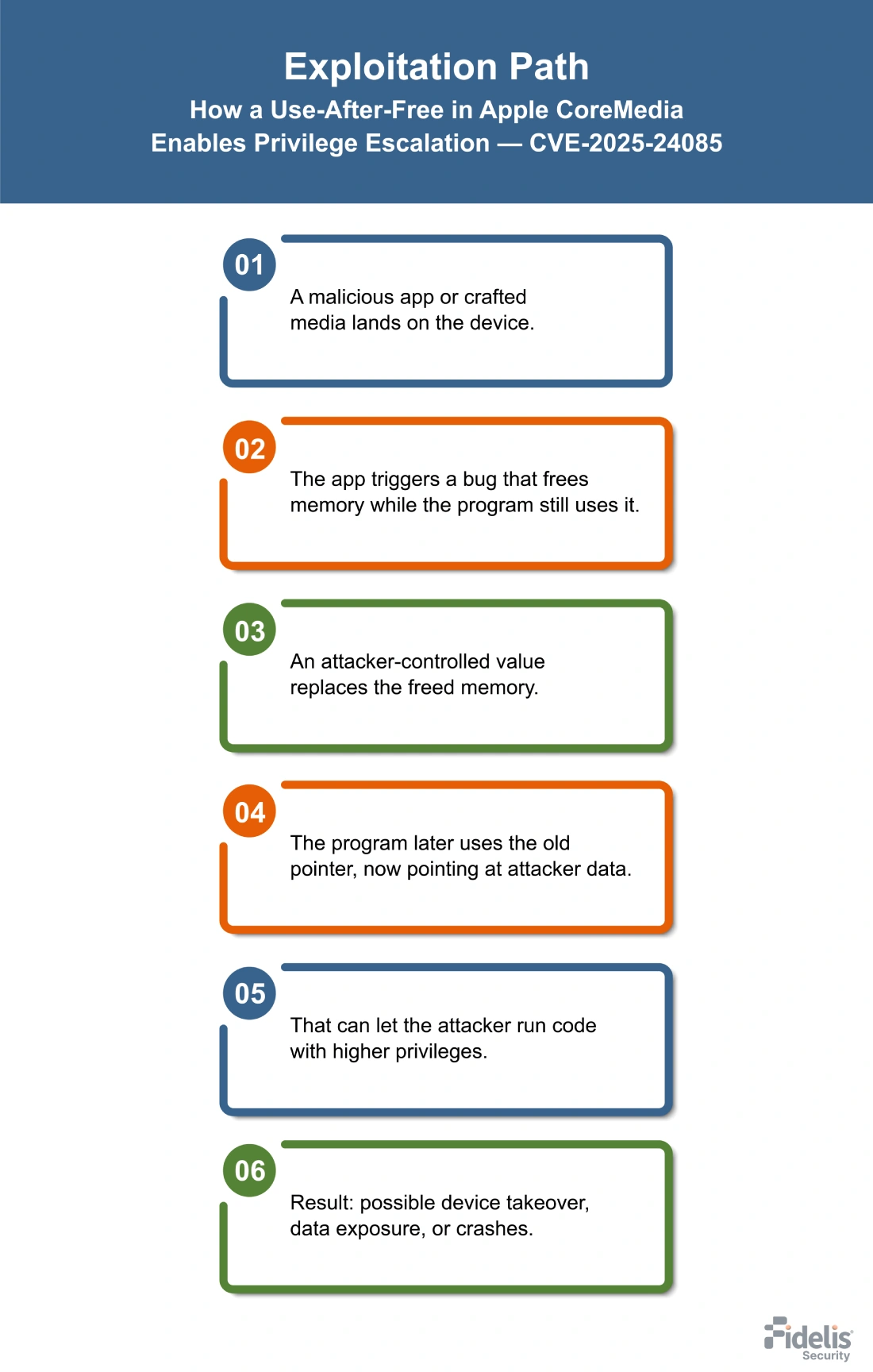
The attack typically follows these steps:
What Causes CVE-2025-24085?
Vulnerability Root Cause:
The flaw is a useafterfree in Apple’s media processing code (Core Media / related components). Object lifetimes were not handled correctly: code freed memory while a live reference remained, allowing that memory to later be replaced with attackercontrolled data. When the program continued to use the stale reference, it could execute or act on the injected data, enabling elevation of privileges. Apple’s advisories state the issue was fixed by improving memory management in the affected components.
How Can You Mitigate CVE-2025-24085?
If immediate patching is delayed or not possible:
- Remove or avoid installing untrusted apps.
- Do not open media files from unknown sources.
- Isolate vulnerable devices from networks when possible.
- Follow Apple and CISA guidance for mitigation.
- Prioritize updating devices to the patched OS versions.
- Monitor devices for crashes, unusual activity, or potential compromise.
Which Assets and Systems Are at Risk?
Asset Types Affected:
- Apple devices running vulnerable OS versions: iOS, iPadOS, macOS Sequoia, watchOS, tvOS, and visionOS
- Applications on these platforms that handle media files
Business-Critical Systems at Risk:
- Devices storing sensitive data, including emails, messages, and business apps
- Systems used for work or personal financial management
Exposure Level:
- Any Apple device running affected OS versions prior to iOS/iPadOS 18.3, macOS Sequoia 15.3, watchOS 11.3, tvOS 18.3, visionOS 2.3
- Devices handling untrusted media
Will Patching CVE-2025-24085 Cause Downtime?
Patch application impact: Low — updating to the latest OS versions fixes the issue with minimal downtime.
Mitigation (if immediate patching is not possible): None documented; devices remain at risk until updated.
How Can You Detect CVE-2025-24085 Exploitation?
Exploitation Signatures:
- Malicious applications attempting to use freed memory to execute code.
- Detect privilege escalation attempts on vulnerable Apple devices.
Indicators of Compromise (IOCs/IOAs):
- App crashes or system errors.
- Unauthorized system access or privilege escalation.
Behavioral Indicators:
- Apps behaving unpredictably after memory operations.
- System services terminating unexpectedly.
Alerting Strategy:
- Priority: High
- Watch for crashes, system stops, or privilege abuse on vulnerable Apple devices.
Remediation & Response
Incident Response Considerations:
- Prioritize unpatched devices since active exploits exist.
- Isolate any suspected compromised systems.
- Monitor for unusual crashes or privilege changes and alert IR if found.
- After patching, confirm all systems are updated and keep monitoring for IOCs.
Compliance & Governance Notes
Audit Trail Requirement:
- Record patch deployment details: date, time, device/OS version, and applied update.
- Ensure all affected Apple devices are updated to iOS/iPadOS 18.3, macOS Sequoia 15.3, watchOS 11.3, tvOS 18.3, and visionOS 2.3.
Policy Alignment:
- Update patch policy to ensure quick fixes for CVE-2025-24085 on all Apple devices.
- Monitor systems to confirm all devices are updated.
CVSS Breakdown Table
| Metric | Value | Description |
|---|---|---|
| Base Score | 7.8 | High severity vulnerability due to potential privilege escalation |
| Attack Vector | Local | Exploit requires local access on the device |
| Attack Complexity | Low | Exploitation does not require special conditions |
| Privileges Required | None | No prior privileges needed to trigger the vulnerability |
| User Interaction | Required | User must open or interact with a malicious app or file |
| Scope | UnChanged | Impacts only the affected Apple OS component |
| Confidentiality Impact | High | Exploit could allow access to sensitive system data |
| Integrity Impact | High | Exploit could enable modification of system memory or execution of arbitrary code |
| Availability Impact | High | Exploit could cause crashes or instability in affected systems |