

Summary
CVE-2025-20309 is a critical Cisco Unified CM/SME vulnerability from hardcoded root credentials, giving attackers full unauthenticated access. It impacts 15.0.1.13010-1 to 15.0.1.13017-1, fixed in 15SU3 (July 2025) and a patch file. Versions 12.5 and 14 are unaffected. Compromise can be spotted via SSH root logins in syslog. Urgent patching is required.
Urgent Actions Required
- Patch with ciscocm.CSCwp27755_D0247-1.cop.sha512 or upgrade to 15SU3 (July 2025) immediately.
- Check /var/log/active/syslog/secure for root SSH logins.
- Limit access to management networks running 15.0.1.13010-1 to 15.0.1.13017-1 until patched.
Which Systems Are Vulnerable to CVE-2025-20309?
Technical Overview
- Vulnerability Type: Remote Root Access via Hardcoded SSH Credentials
-
Affected Software/Versions:
- Cisco Unified Communications Manager (Unified CM) Engineering Special releases 15.0.1.13010-1 through 15.0.1.13017-1
- Cisco Unified Communications Manager Session Management Edition (Unified CM SME) Engineering Special releases 15.0.1.13010-1 through 15.0.1.13017-1
- Attack Vector: Network (SSH)
-
CVSS Vector: CVSS: 3.1
- Attack Vector: Network
- Attack Complexity: Low
- Privileges Required: None
- User Interaction: None
- Scope: Changed
- Confidentiality Impact: High
- Integrity Impact: High
- Availability Impact: High
- Patch Availability: Yes, fixed in Unified CM/SME version 15SU3 (July 2025) or via patch file ciscocm.CSCwp27755_D0247-1.cop.sha512[1]
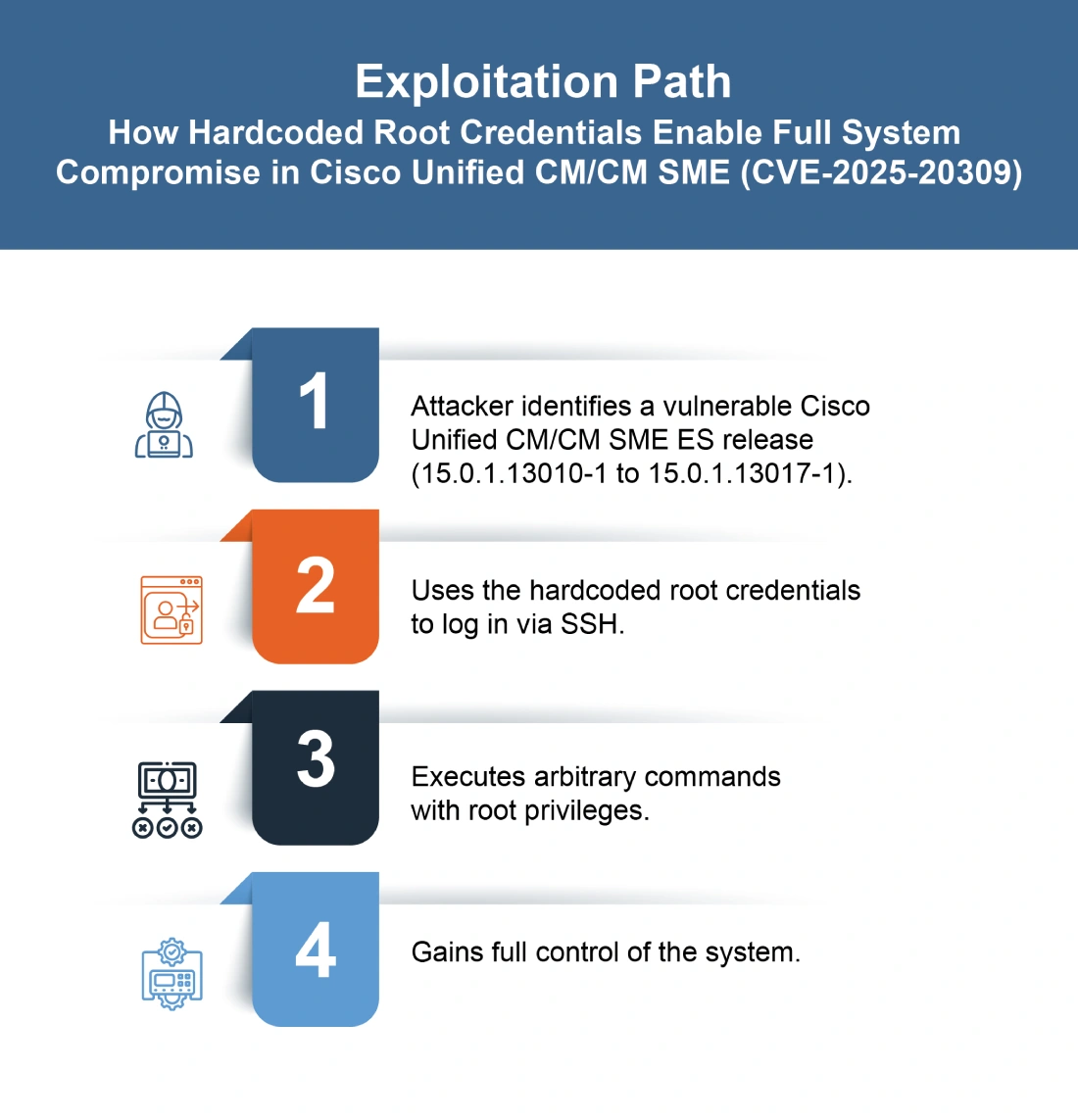
How Does the CVE-2025-20309 Exploit Work?
The attack typically follows these steps:
What Causes CVE-2025-20309?
Vulnerability Root Cause:
CVE-2025-20309 exists because certain Cisco Unified CM and CM SME Engineering Special releases include hardcoded root credentials meant for development. These credentials cannot be changed or removed, allowing an unauthenticated attacker to log in as root. The flaw lies in leaving development-stage credentials in production systems, giving attackers full control over the affected device without any authentication.
How Can You Mitigate CVE-2025-20309?
If immediate patching is delayed or not possible:
- Limit access to Cisco Unified CM/SME systems to trusted management networks.
- Watch SSH logs (/var/log/active/syslog/secure) for root logins to spot possible attacks.
- Temporarily isolate vulnerable devices from critical systems until patched.
- Add network segmentation to reduce risk to affected systems.
Which Assets and Systems Are at Risk?
Asset Types Affected:
- Cisco Unified Communications Manager (Unified CM) – Engineering Special (ES) releases 15.0.1.13010-1 through 15.0.1.13017-1
- Cisco Unified Communications Manager Session Management Edition (Unified CM SME) – same ES releases
Business-Critical Systems at Risk:
- Enterprise telephony systems – voice, video, and messaging platforms
- Call processing and management systems that rely on Unified CM/SME for routing and control
- Any system where compromise could lead to full root access and arbitrary command execution
Exposure Level:
- Devices accessible on the management network or internal network segments
- Systems where ES releases are in use and unpatched, as attackers can log in remotely without authentication
- All affected devices are vulnerable regardless of configuration, and no workarounds exist
Will Patching CVE-2025-20309 Cause Downtime?
Patch application impact: Low. Update Cisco Unified CM/SME to 15SU3 (July 2025) or apply ciscocm.CSCwp27755_D0247-1.cop.sha512. Minimal downtime is expected with standard maintenance.
Mitigation (if immediate patching is not possible): No full workaround exists. Monitor SSH root logins in /var/log/active/syslog/secure. Systems remain vulnerable until patched.
How Can You Detect CVE-2025-20309 Exploitation?
Exploitation Signatures:
- Look for SSH logins as root on affected devices.
- Check /var/log/active/syslog/secure for unexpected root access attempts.
Indicators of Compromise (IOCs/IOAs):
- Successful unauthenticated logins using the root account.
- Execution of arbitrary commands by the root user.
Behavioral Indicators:
- Access to system settings or commands without any authentication.
- Unusual system activity initiated by the root account.
Alerting Strategy:
- Priority: Critical
-
Trigger alerts for:
- Any SSH root login from untrusted or external sources.
- Any command execution by root that was not initiated by administrators.
Remediation & Response
Patch/Upgrade Instructions:
- Cisco Advisory[1]
Remediation Timeline:
- Immediate (0–2 hrs): Review SSH logs for unauthorized root access attempts.
- Within 24 hrs: Apply the patch or upgrade to 15SU3 on all affected devices.
- Post-Patch: Verify no vulnerable versions remain in production and check logs for any unusual root activity.
Incident Response Considerations:
- Isolate affected devices if signs of unauthorized access appear.
- Collect /var/log/active/syslog/secure logs for forensic review.
- Ensure all privileged accounts are monitored and audit SSH access regularly.
Compliance & Governance Notes
Audit Trail Requirement:
- Monitor SSH logs for root login attempts, especially in /var/log/active/syslog/secure, as indicators of compromise.
- Verify that all affected Unified CM/SME systems (versions 15.0.1.13010-1 through 15.0.1.13017-1) have been patched or upgraded to 15SU3 or via patch file ciscocm.CSCwp27755_D0247-1.cop.sha512.
Where Can I Find More Information on CVE-2025-20309?
CVSS Breakdown Table
| Metric | Value | Description |
|---|---|---|
| Base Score | 10.0 | Critical severity vulnerability with maximum impact and exploitabilitylnerability with maximum impact and exploitability |
| Attack Vector | Network | Can be exploited remotely over the network without local access |
| Attack Complexity | Low | Exploitation is straightforward and requires no special conditions |
| Privileges Required | None | No authentication or credentials needed to exploit |
| User Interaction | None | Exploitation requires no user action |
| Scope | Changed | Exploitation extends impact beyond the vulnerable component |
| Confidentiality Impact | High | Full disclosure of sensitive data possible due to root-level access |
| Integrity Impact | High | Allows unauthorized modification and execution of arbitrary commands |
| Availability Impact | High | Complete system compromise can disrupt services and availability |