

Key Takeaways
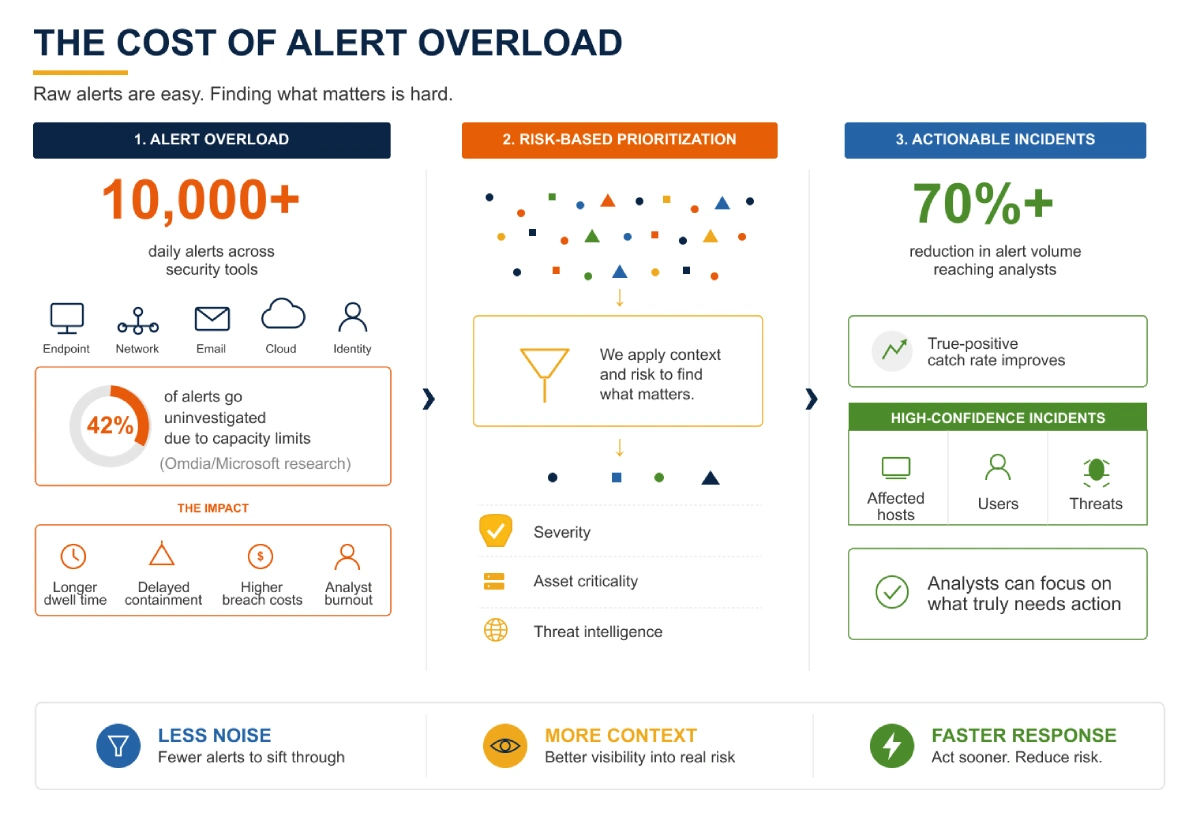
- Enterprise SOCs handle thousands to tens of thousands of alerts a day, and up to 42% go uninvestigated due to capacity limits.
- Real prioritization scores alerts on severity, asset criticality, and likelihood together, not any one factor alone.
- Validating risk intelligence means checking indicators against internal telemetry and asset context, not just trusting the feed.
- Cloud alerts need the same scoring rigor as everything else, with extra weight on identity and permission changes.
- Automation should handle enrichment and noise suppression, freeing analysts for actual judgment calls.
- Fidelis Elevate's Alert Noise Cancellation™ correlates network, endpoint, email, and cloud signals into one enriched incident.
- Fidelis Network® applies real-time risk scoring to traffic using behavioral analytics and threat intelligence.
Every SOC operates on one core assumption: when something bad happens, someone catches it. That assumption is getting shakier by the year. Enterprise security teams are now fielding anywhere from a few thousand to tens of thousands of alerts a day, and most of it is static. Omdia ran a study for Microsoft[1] not long ago and found something telling: 42% of alerts never get looked at, not because they’re unimportant, but because nobody had the hours. Throwing two more analysts at that doesn’t fix it. The alerts themselves are being generated, scored, and routed in a way that stopped scaling a while back, and that gap is basically why alert prioritization has become such a live topic in security circles lately.
Here’s what tends to get missed: the breach that actually hurts rarely comes with a loud warning attached. It’s usually a scattering of quiet signals sitting in separate queues, each one looking fine on its own, none of them connected in time. Solving that is the whole point of alert prioritization, pushing the alerts with real risk to the front of the line and letting the routine noise get filtered, automated, or bumped down without pulling analysts away from what matters.
Fidelis Security has built its answer to this into the product itself rather than a dashboard layered on top. It combines correlation, enrichment, risk context, and noise reduction into one platform. What follows covers why alert overload happens in the first place, what actually separates a worthwhile alert from noise, and how Fidelis approaches that problem on both the network side and the extended detection side.
The Alert Overload Problem in Modern Security Operations
Alert fatigue isn’t really about individual analysts falling short. It’s a math problem: too many signals, not enough hours, and a detection system that tags almost everything as urgent. When every alert is labeled “high priority,” the label loses its meaning.
Take a single phishing email. On its own, it looks minor. But it can set off a suspicious-attachment alert at the gateway, a macro execution flag on the endpoint, a strange outbound DNS request, and a data exfiltration anomaly on the network- four alerts, four dashboards, one actual incident. Unless something ties those together, an analyst has no way of knowing they’re looking at pieces of the same attack.
The fallout builds quietly. Time gets eaten up chasing dead ends instead of the handful of alerts that actually matter, and triage itself becomes the delay. A real breach alert can sit buried under a pile of low-confidence noise for hours before anyone opens it. Analysts who’ve been doing this for years eventually burn out, and then you’re training someone new on the same broken process all over again. None of this is hypothetical. It shows up in dwell time, breach costs, and how fast good people quit.
What Is Security Alert Prioritization?
Security alert prioritization, in plain terms, means deciding what gets looked at first. Not by when it landed in the queue, but by how much risk it actually represents: how severe the activity is, what asset it touches, what it could cost the business. Simple to say. Much harder to do consistently at 2 a.m., when the person on shift has been an analyst for all of six months.
Most teams that get this right keep coming back to the same handful of questions, not really a checklist, more a gut check that’s become a habit over time. How bad is the technical activity on its own? What does it actually touch? Is this likely a live attack, or just something that looks odd? A critical flaw on a payment gateway needs eyes right away. The same flaw sitting on a forgotten printer in a locked closet can wait for the next maintenance window. That gap between two technically identical alerts is the whole reason context beats severity labels, and it’s the backbone of any threat alerting program worth calling mature.
Frameworks give this some shape instead of leaving it to instinct. MITRE ATT&CK is the one most teams lean on. It gives analysts a shared vocabulary for tying a strange-looking event to a known attacker technique, so something like unusual PowerShell activity doesn’t get judged in isolation; it gets read as a possible step in a longer chain.
Risk scoring does something similar with numbers instead of tactics, adding weight for asset value, data sensitivity, and threat intel matches. If you score high, it gets escalated on the spot. Score low, and it sits in a log, maybe reviewed next week, maybe never.
The Building Blocks of a Working Triage Process
A functioning alert prioritization workflow generally moves through a few consistent stages, regardless of which vendor’s tools sit underneath it.
It starts with ingestion and correlation, where alerts from different tools, endpoint, network, identity, email, cloud, get pulled into a single operational view instead of living in separate silos. A login anomaly by itself might look harmless. The same anomaly combined with a failed authentication spike and an unfamiliar login location tells a very different story once it’s correlated.
From there, alerts get severity and risk scoring based on factors like asset criticality, user privileges, known threat indicators, and behavioral anomalies. An alert tied to a domain administrator account touching a critical server should never sit in the same queue tier as the same activity on a standard laptop.
Automated triage handles the next layer, enriching alerts with threat intelligence and asset data, checking known indicators of compromise, and closing out alerts that clearly represent benign, expected activity. Using automation to reduce alert fatigue in security operations is no longer optional at scale; it’s what makes it possible to triage alerts fast enough to matter.
What’s left goes to analyst investigation, often split across tiers so junior analysts handle initial validation while senior analysts dig into complex, multi-stage threats. And when something is confirmed, response and containment kick in, whether that’s isolating an endpoint, disabling an account, or blocking malicious traffic.
- Learning to prioritize real threats
- Gaining unified visibility
- Exclusive walkthrough Fidelis Solution
How Fidelis Helps Focus on the Threats That Matter
Fidelis Elevate® combines network detection, endpoint, deception, Active Directory, and DLP into one system, and alert prioritization is built into that combined layer instead of sitting on top as a separate dashboard.
The core of that is Alert Noise Cancellation™, which pulls telemetry from integrated sensors across network, endpoint, cloud, and email into a single system instead of letting each tool raise its own isolated alarm. The platform holds onto rich metadata, up to 360 days of it, covering protocol and application details, endpoint process behavior, email headers and content, and cloud telemetry, then maps all of it against MITRE ATT&CK so a signal isn’t judged on its own, it’s tagged to where it sits in an attack: getting in, running code, sticking around, moving sideways, getting data out. Related alerts get merged and enriched automatically instead of landing as ten separate tickets for what was really one break-in attempt.
Does it work? Yes, Our customers on Fidelis Elevate are catching post-breach activity over nine times faster. Most of that speed comes from skipping the manual correlation step analysts used to burn hours on.
That same approach extends to network traffic through Fidelis Network®, which prioritizes each alert using risk context: the severity of what’s happening, how important the asset is, and whether threat intel backs up the concern, so an analyst scanning the queue can tell in seconds what actually needs their attention right now.
That scoring runs on continuous behavioral analytics and machine learning, building a baseline of normal network activity and flagging the moments it breaks, including the kind of lateral movement a signature-based tool would likely miss.
Sandboxing and cyber terrain mapping round out the risk picture for each detected threat. And when something clears the bar for high-risk, the response doesn’t wait on a person to click approve, it isolates the device or blocks the traffic automatically.
The result is fewer alerts reaching analysts, but higher-confidence ones, because the platform is doing correlation and scoring work that used to eat hours out of an analyst’s shift. And because Fidelis Elevate pulls network, endpoint, email, cloud, and deception signals into one place, the gaps that usually let noise hide, the ones that show up when each capability lives in a separate tool, close automatically instead of needing someone to stitch them together by hand.
Frequently Asked Questions
How do companies prioritize and validate risk intelligence alerts?
Mostly by checking indicators against what’s actually happened in their own environment, not just trusting the feed. They also weigh how fresh and relevant the source is, and keep a record of what turned out real versus what didn’t, so the scoring gets sharper over time. Automation does the legwork, people make the final call.
How do you prioritize cloud security alerts?
Start with what data’s actually exposed, then weight anything touching identity or permissions higher than routine drift. Cloud alerts get correlated with on-prem activity instead of sitting in their own silo, and known deployment noise gets filtered out automatically.
What is alert prioritization in cybersecurity?
It’s ranking alerts by how much risk they carry, severity, asset value, likelihood of a real attack, rather than working through them in the order they showed up.
Why does alert fatigue happen even with good security tools?
Usually because the tools don’t talk to each other. One incident can set off separate alerts across five different dashboards, and without correlation, nobody connects the dots.
Can XDR and NDR work together for alert prioritization?
They’re meant to. NDR handles the deep network visibility, XDR pulls that together with endpoint, email, and cloud signals into a single incident, which is the setup behind Fidelis Network® and Fidelis Elevate®.
What's a realistic first step for a SOC drowning in alerts?
Before buying anything new, tier your assets and clean up detection rules. That single step usually removes more noise than a new platform would.