

Key Highlights
- Hybrid cloud environments increase complexity by spreading data across public cloud, private infrastructure, and on-prem systems.
- Traditional perimeter-based security models cannot effectively protect data in distributed hybrid cloud environments.
- Key risks include data movement vulnerabilities, misconfigurations, identity management challenges, and compliance complexity.
- Organizations need a data-centric security approach with encryption, centralized visibility, and Zero Trust access controls.
- Platforms like Fidelis CloudPassage Halo® help secure workloads and improve visibility across hybrid and multi-cloud environments.
As companies look for flexible, cost-effective, and agile solutions, hybrid cloud environments are becoming the new normal. Private environments, such as on-premises data centers or private clouds, are being coupled with public cloud platforms like AWS, Azure, and Google Cloud. The data center environment that has been cost-effective for years with traditional data protection has now been added to the public cloud. With that comes a host of new security challenges and data protection concerns that traditional methods of data protection are not well-equipped to handle.
Workloads, applications and data are spread across an increasing number of locations; hybrid cloud environments demand a different approach to data security. Moving away from legacy center-based, perimeter-based security controls and toward a data centric, distributed security model will help provide an appropriate level of protection for the various places that the data may now reside.
Understanding Hybrid Cloud
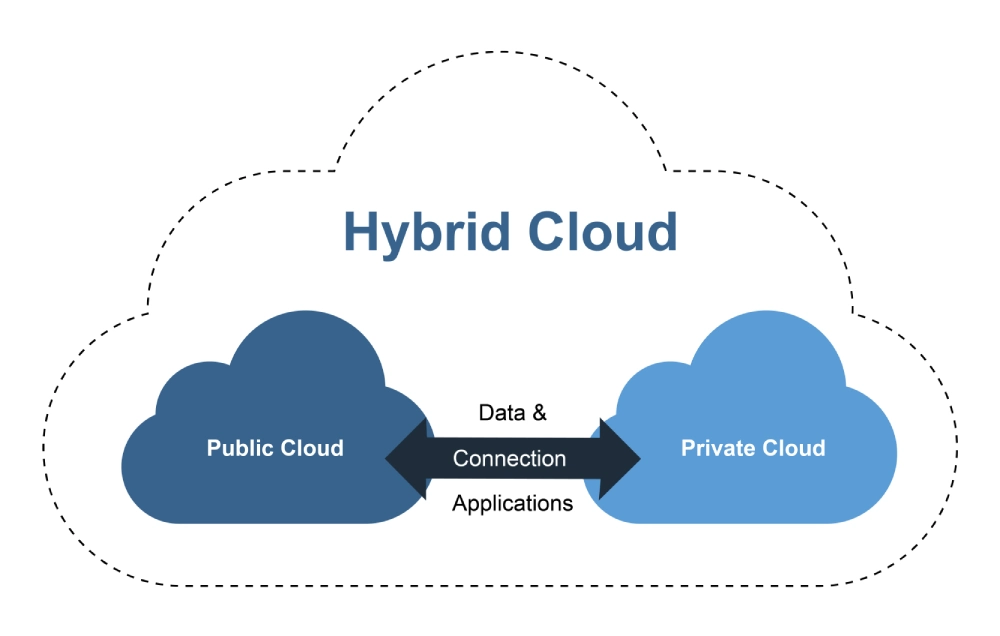
A hybrid cloud is a configuration of using both a public cloud and a private infrastructure, which enables the data and workloads to be shifted between the environments according to the demands of the business. The arrangement allows the companies to maintain sensitive workloads in their own systems and capitalize on the scalability and cost advantages of public cloud infrastructures.
Nevertheless, the hybrid model introduces a more complicated ecosystem in which data flows endlessly between environments, and thus data security in hybrid cloud environments is more difficult to manage. The security teams need to keep an eye on various platforms, implement uniform policies, and achieve compliance across the various infrastructures.
Why Traditional Data Security Models Fail in Hybrid Cloud
Traditional enterprise security is based on the model of a defined perimeter – the corporate network and data center. In this model, firewalls, network segmentation, and perimeter-based monitoring protect the internal systems.
Hybrid cloud architecture breaks this model. Data now moves across multiple platforms, devices, and cloud services. This means the traditional “secure the network edge” approach is no longer sufficient.
Key reasons traditional approaches fail include:
- Understanding your Visibility Gaps
- Practical Playbook for Improving Visibility
- Solution Guide
1. Data is Distributed Across Multiple Environments
Data in hybrid environments is spread across public cloud, private cloud, on premises infrastructure and edge systems. Managing hybrid cloud data protection is a problem as organizations must enforce consistency in their security policies across all these environments.
Another challenge in the world of security operations without having a clear view into an organization, how does a security operations team know where sensitive data has been exposed, and who has been accessing it.
2. Increased Attack Surface
With multiple cloud platforms, premises systems, endpoints, APIs and services, security teams are left with a chaotic maze of solutions to keep their environment secure. More systems are now exposed to attack because the IT infrastructure has grown. This also provides more entry points for the attackers and more opportunities to abuse the vulnerabilities in the IT systems. Meanwhile, the number of systems containing important enterprise data is also growing.
3. Lack of Visibility and Monitoring
Hybrid environments introduce a whole range of new security risks. A major challenge in hybrid environments is lack of visibility in your infrastructure. These days, workloads are more than likely deployed across on-prem, one or multiple clouds, or edge locations and data centers across the world. Traditional management tools simply aren’t able to keep up to abnormal activity. Security teams rarely have visibility of hybrid environment network traffic, endpoint behavior, or data flow.
Key Security Challenges in Hybrid Cloud Environments
Organizations that are moving to hybrid models will need to address a number of critical challenges in order to successfully protect their data in hybrid cloud environments.
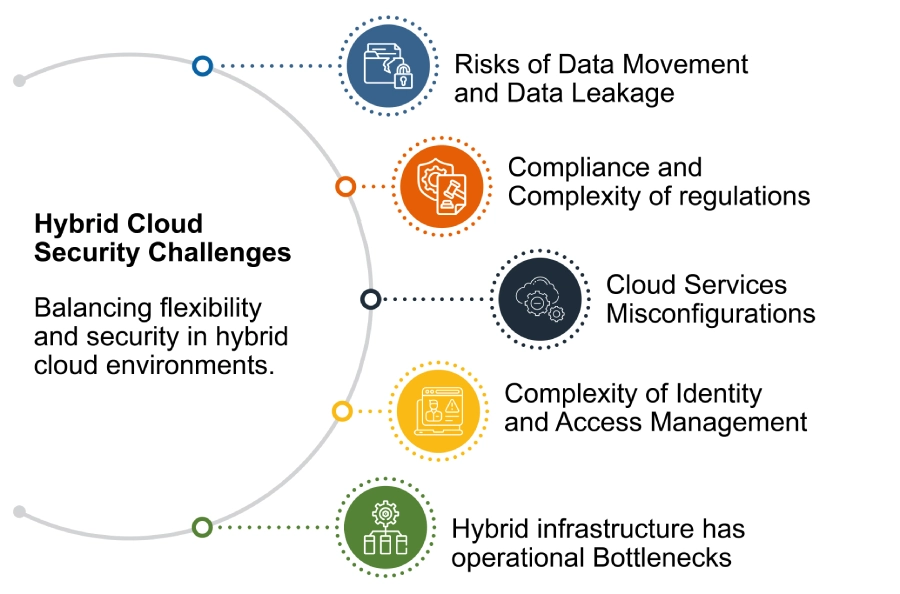
1. Risks of Data Movement and Data Leakage.
In hybrid setup, there is often a flow of information between the on-premises systems and the public cloud platforms. Both transfers pose a threat of being intercepted, unauthorized access, or misconfigured. Lack of encryption or adequate access controls may reveal sensitive information in the process of data transfers.
2. Compliance and Complexity of regulations.
The regulatory requirements are usually different based on the location of storing or processing data. For example, financial, healthcare, and government organizations must adhere to stringent privacy and data protection laws.
Compliance of hybrid cloud data in more than one cloud provider and region can prove to be very tricky. Security teams should make sure that data governance policy will not be different in other environments.
3. Cloud Services Misconfigurations.
The most frequently encountered causes of data breach include cloud misconfigurations. False permissions, storage buckets that are left unsecured, and insecure access control can expose sensitive information to attackers. Since hybrid environments involve a mixture of cloud platforms and internal systems, configuration management gets even more complicated.
4. Complexity of Identity and Access Management.
The emerging security boundary in clouds is identity. Hybrid infrastructures demand central identity that limits access to platforms. In the absence of robust identity and access management (IAM) policies, attackers can use the stolen credentials and move laterally across systems.
5. Hybrid infrastructure has operational Bottlenecks.
The hybrid cloud operations in data centers have common bottlenecks that are easily encountered in organizations. These include:
- Across platform fragmentation of tools.
- Delay in synchronization of data.
- The discrepancies in security policy.
- Multifaceted interconnection of cloud service providers and on-prem infrastructure.
6. Data Discovery Across Multiple Clouds
Today’s enterprises are running workloads across multiple cloud providers, which means they need hybrid multi-cloud data discovery to understand where sensitive data is located across clouds.Without adequate discovery tools, sensitive data may be left exposed on servers in the cloud, or in less permanent environments such as testing or staging systems.
7. Managing Hybrid Cloud Data Lakes
Many enterprise environments have complex hybrid cloud data lake environments to support their analytics, machine learning, and big data initiatives.
Data lakes were created by collecting data from numerous sources including premise systems, IoT sources, and cloud applications.
8. Why a New Security Approach Is Necessary
Cloud Infrastructure is not sufficient for hybrid cloud complexity. Cloud infrastructure is becoming more complex with the evolution of hybrid cloud and multi-cloud architectures. To make sense of this complexity, organizations need to start thinking differently and focus more on data than infrastructure.
These resource points multiply the risk of operation and slow the response time of incidents.
Key principles of modern hybrid cloud data security include:
1. Data-Centric Security
Protection of network perimeters is just a single part of the necessary protection. Cryptographic protection of data, access control, and classification of sensitive information are all other important parts. Protecting data involves not only encrypting the data, whether it is stored or transmitted.
2. Unified Security Visibility
Security teams are asking for a unified monitoring platform across hybrid environments that allows them to gain visibility into data flow, identify malicious activity, and respond to incidents.
3. Zero Trust Security Model
In a hybrid cloud environment, a zero-trust model needs to be applied in such a way so as to question each user, device, and application to make sure that data access is authenticated. Companies that implement a Zero Trust paradigm require ongoing authentication, minimal access, and strict checking of personalities and devices.
Security Technologies that support Hybrid Cloud Security.
Several contemporary security platforms are hybrid environment specific.
Fidelis CloudPassage Halo® is a cloud workload protection platform that provides the most dependable cloud security to the most sensitive workloads of the toughest organizations in the hybrid and multi-cloud environments. Secure workloads, detect and prevent unauthorized activity, control risk, and real-time visibility.
Fidelis CloudPassage Halo® can be used to secure data in hybrid cloud environments since it provides an all-encompassing platform of security that secures workloads across numerous sites.
Best Practices to Secure Hybrid Cloud Environments for Enterprise Data
Hybrid cloud is an increasingly common way for organizations to deploy resources and applications to provide necessary business value and operational ability. With today’s almost daily pace of technology advancement, IT leaders must prioritize securing their hybrid cloud. Here are a few recommendations for hybrid cloud security.
-
Implement Strong Data Encryption
Encrypt sensitive information that will be sent over the network and that will be stored on the computer. If information were to fall into the wrong hands, the attackers would have only encrypted data to play with, which the system wouldn’t be able to do anything with. -
Establish Centralized Identity and Access Control
Use unified IAM systems with multi-factor authentication and least-privilege access policies. -
Automate Security Monitoring
Continuous monitoring tools provide real-time visibility into suspicious activities occurring across your hybrid environment. An effective vulnerability management strategy must include the assessment of all IT assets across on-premises and cloud infrastructures and inform timely remediation actions. -
Enforce Data Governance Policies
Ensuring that we have good governance procedures in place will allow us to ensure that our data collection, and data use and storage, is carried out in accordance with legislation and regulation, and that data is managed, stored and shared appropriately. -
Maintain Consistent Security Configurations
All environments should have the same security policies in place whether on premises or in the cloud.
- Cloud-friendly Deployment
- Hyper-scalable Workload Protection
- Agentless Cloud Posture Management
The Future of Hybrid Cloud Data Security
Enterprises are quickly adopting hybrid and multi-cloud infrastructures in production. There needs to be corresponding advances in security models that reflect the significant change in compute placement approaches.
Next year organizations will face a raft of evolving threats and are expected to throw more resources into protecting themselves from these. Companies are likely to rely more on automated systems and technologies including AI and advanced analytics to help monitor distributed environments. New security products and technologies are expected to focus on providing more data, better identity-based protection, as well as improved auto compliance management.
Cloud computing has become widely accepted as a viable and competitive approach to managing and governing IT resources and associated costs. The hybrid cloud model represents the next evolutionary step with unparalleled flexibility and scalability. As a result, organizations will need to re-evaluate their approach to security.
Conclusion
The use of hybrid clouds is also becoming increasingly popular since organizations are seeking flexibility, scalability, and cost-efficiency. However, the given architecture changes the way of storing, accessing, and protecting enterprise data radically.
The traditional security design that had been developed based on the network boundaries cannot be used in protecting the workloads and data streams that are distributed in nature. Instead, organizations must ensure that they leverage a data-centric approach to data security hybrid on clouds which aims at data visibility, identity management, encryption, and centralized monitoring. In a world where information flows continuously across different environments, insuring not only the infrastructure, but also the data, should be the priority of enterprise security policies.