
Summary
CVE-2026-32201 is a Microsoft SharePoint Server spoofing vulnerability caused by improper input validation. The flaw allows an unauthenticated remote attacker to perform network-based spoofing attacks without user interaction, potentially enabling unauthorized access to limited information or manipulation of SharePoint content. The issue affects SharePoint Enterprise Server 2016, SharePoint Server 2019, and SharePoint Server Subscription Edition and is actively exploited in the wild. Microsoft addressed the vulnerability in its April 2026 security updates, and CISA has added it to the Known Exploited Vulnerabilities (KEV) Catalog.
Urgent Actions Required
- Apply the April 2026 Microsoft SharePoint security updates immediately.
- Update affected SharePoint deployments to the latest patched builds.
- Restart SharePoint services or reboot servers after applying updates.
- Monitor SharePoint logs and network activity for suspicious spoofing attempts.
- Restrict unnecessary internet exposure of SharePoint servers where possible.
Which Systems Are Vulnerable to CVE-2026-32201?
Technical Overview
- Vulnerability Type: Spoofing Vulnerability caused by Improper Input Validation (CWE-20)
-
Affected Software/Versions:
- Microsoft SharePoint Enterprise Server 2016
- Versions earlier than 16.0.5548.1003
- Microsoft SharePoint Server 2019
- Versions earlier than 16.0.10417.20114
- Microsoft SharePoint Server Subscription Edition
- Versions earlier than 16.0.19725.20210
-
CVSS Vector: v3.1
- Attack Vector: Network
- Attack Complexity: Low
- Privileges Required: None
- User Interaction: None
- Scope: Unchanged
- Confidentiality Impact: Low
- Integrity Impact: Low
- Availability Impact: None
- Patch Availability: Yes, available
How Does the CVE-2026-32201 Exploit Work?
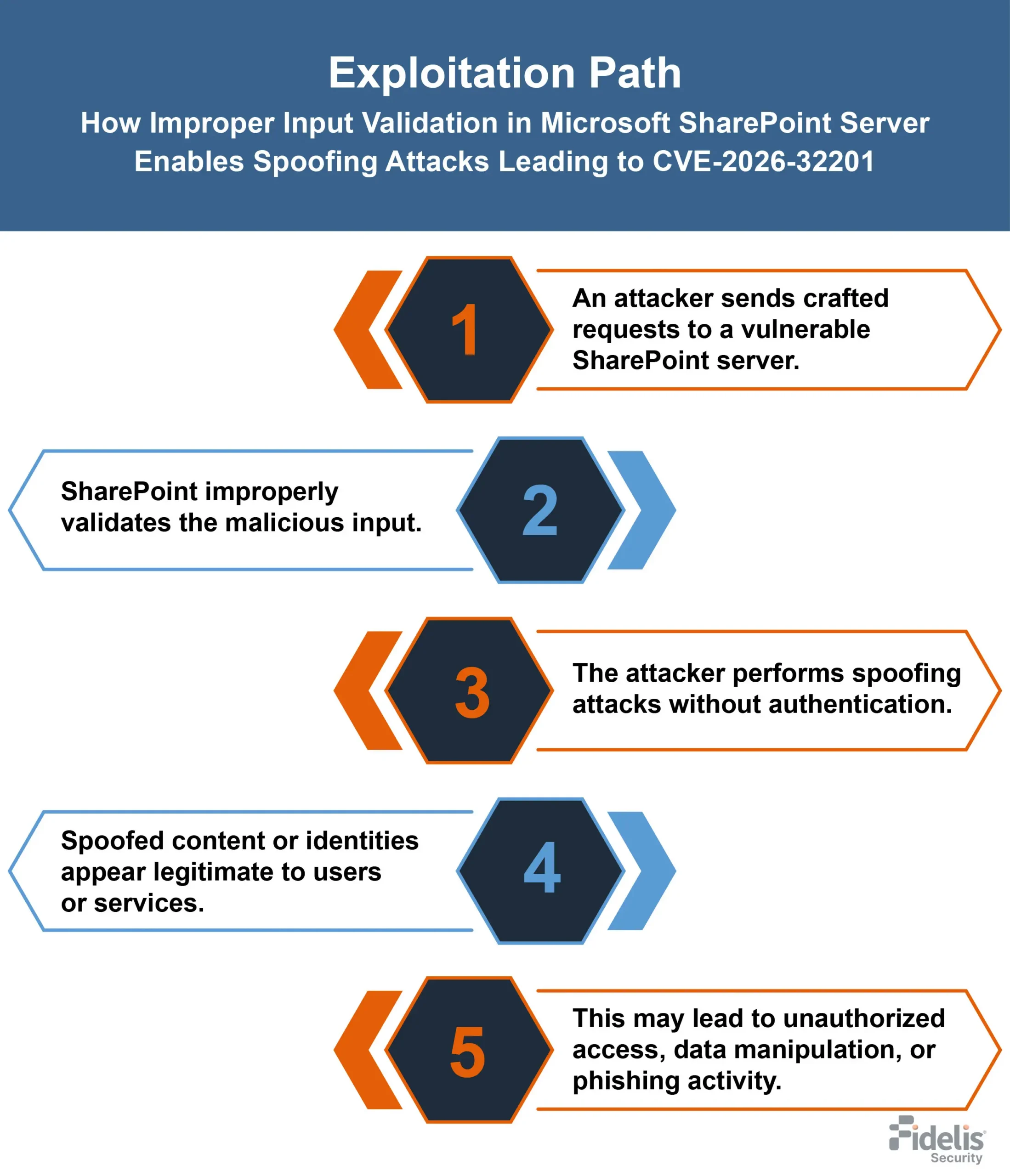
The attack typically follows these steps:
What Causes CVE-2026-32201?
Vulnerability Root Cause:
CVE-2026-32201 is caused by improper input validation in Microsoft SharePoint Server. The flaw occurs because SharePoint does not properly validate certain user-supplied input during request processing. An attacker can send crafted network requests, enabling spoofing attacks without authentication or user interaction.
How Can You Mitigate CVE-2026-32201?
If immediate patching is delayed or not possible:
- Restrict external access to SharePoint servers using firewall rules, VPN access, or reverse proxies.
- Deploy WAF rules to detect and block malformed or suspicious SharePoint requests.
- Monitor SharePoint authentication logs and IIS logs for unusual request activity or spoofing attempts.
- Enable enhanced logging on SharePoint and IIS servers for security monitoring and investigation.
- Review SharePoint environments for suspicious processes, unexpected file creation, or abnormal network activity.
Which Assets and Systems Are at Risk?
-
Asset Types Affected:
- Microsoft SharePoint Enterprise Server 2016 deployments
- Microsoft SharePoint Server 2019 deployments
- Microsoft SharePoint Server Subscription Edition deployments
- IIS servers hosting SharePoint environments
-
Business-Critical Systems at Risk:
- SharePoint collaboration platforms containing internal organizational data
- Document management and publishing environments hosted on SharePoint
- Enterprise portals relying on SharePoint for content access and sharing
- SharePoint environments exposed to external or remote access
-
Exposure Level:
- Internet-facing SharePoint servers
- On-premises SharePoint deployments running vulnerable builds
- SharePoint systems without the April 2026 security updates installed
- Environments with unrestricted external access to SharePoint services
Will Patching CVE-2026-32201 Cause Downtime?
Patch application impact: Low. Updates may require brief IIS resets or short service interruptions during deployment.
Mitigation (if immediate patching is not possible): Restrict external SharePoint access, enable WAF protections, and monitor logs for suspicious activity.
How Can You Detect CVE-2026-32201 Exploitation?
Exploitation Signatures:
Look for unusual or malformed requests targeting SharePoint endpoints, including suspicious POST requests to /_vti_bin.
MITRE ATT&CK Mapping:
- T1059.001 - PowerShell
- T1505.003 - Web Shell
Indicators of Compromise (IOCs/IOAs):
- Suspicious child processes spawned by w3wp.exe
- Unexpected .aspx, .ashx, .asmx, or .config files in SharePoint web directories
- Unexpected authentication or session activity in SharePoint logs
Behavioral Indicators:
- Suspicious command execution from IIS worker processes
- Unexpected outbound connections from SharePoint servers
Alerting Strategy:
- Priority: Critical
-
Trigger alerts for:
- Process creation from w3wp.exe involving cmd.exe or powershell.exe
- New executable or script files in SharePoint web paths
- Unexpected authentication activity on SharePoint servers
Remediation & Response
-
Remediation Timeline:
- Immediate: Restrict external access to SharePoint servers and enable enhanced logging.
- As soon as possible: Apply Microsoft’s April 2026 SharePoint security updates.
- After patching: Verify all affected SharePoint servers are updated and monitor for suspicious activity.
-
Incident Response Considerations:
- Isolate potentially affected SharePoint servers if compromise is suspected.
- Review IIS, SharePoint ULS, and Windows Event logs for suspicious activity.
- Check for suspicious child processes spawned by w3wp.exe and unexpected files in SharePoint web directories.
- Monitor for unusual authentication behavior, outbound connections, or suspicious POST requests to /_vti_bin.
Compliance & Governance Notes
-
Audit Trail Requirement:
- Log suspicious SharePoint requests, authentication activity, and access to /_vti_bin endpoints.
- Record patch deployment details, including update version and deployment time.
- Maintain logs for IIS, SharePoint ULS, and Windows Event activity during investigation and remediation.
-
Policy Alignment:
- Update vulnerability management processes to prioritize actively exploited SharePoint vulnerabilities.
- Review SharePoint access controls and external exposure policies.
- Enhance monitoring policies for suspicious SharePoint and IIS activity.
See How Fidelis Elevate® Strengthens Proactive Cyber Defense
-
-
- Real-time cyber terrain mapping
- Advanced threat detection and risk analysis
- Faster visibility and response across environments
-
CVSS Breakdown Table
| Metric | Value | Description |
|---|---|---|
| Base Score | 6.5 | Medium severity spoofing vulnerability |
| Attack Vector | Network | Exploitable remotely over the network |
| Attack Complexity | Low | Exploitation does not require special conditions |
| Privileges Required | None | No authentication required |
| User Interaction | None | No user action needed for exploitation |
| Scope | Unchanged | Impact remains within the vulnerable SharePoint component |
| Confidentiality Impact | Low | Limited exposure of sensitive information possible |
| Integrity Impact | Low | Limited unauthorized data modification possible |
| Availability Impact | None | No direct impact on service availability |
References: