

Understanding Open Extended detection and response (XDR)
What is Open XDR?
Open XDR is a vendor-agnostic XDR solution that interacts effortlessly with an organization’s existing security infrastructure. It is intended to collect, correlate, and analyze data from many security tools and platforms, resulting in a unified view of the security landscape.
Unlike traditional XDR systems, Open XDR allows enterprises to select the finest security products for their individual needs without being restricted to a single vendor’s ecosystem. Modern open XDR security solutions help organizations unify multiple security tools into a single detection and response platform.
Open XDR Use Case: Solving Today’s Security Operations Challenges
Key Challenges in Security Operations:
-
Non-User-Friendly Nature of Products
- Products are challenging to configure effectively.
- Manual processes are often required for upkeep.
- Many tools are tailored for expert users only.
- Even with correct implementation, tools operate independently.
-
Alert Overload
- Security tools generate overwhelming volumes of data.
- Overlapping capabilities lead to unnecessary alerts.
- Analysts may work on the same incidents unknowingly.
- Critical attacks can be missed in the data flood.
-
Talent Gap
- Difficulty in finding skilled security analysts.
- Key team members are often overextended.
- Team members frequently tackle unfamiliar tasks.
- Many roles involve redundant manual work.
-
Response Lag
- Too many notifications hinder timely investigations.
- Manual workflows slow down response times.
- Attackers gain more time to execute their plans.
- Current technologies fail to improve response efficiency.
Lessons Learned from Open XDR Deployments
Organizations implementing Open XDR often discover that technology integration alone does not solve security operations challenges. In many deployments, the biggest gains come from reducing alert fatigue and improving investigation of workflows rather than simply adding more telemetry sources.
For example, SOC teams commonly report that correlating endpoints, identity, and network telemetry reduces duplicate investigations and shortens mean time to respond (MTTR). However, integration planning is critical, as onboarding disconnected tools without normalization can create additional operational complexity.
Security teams adopting Open XDR typically achieve better outcomes when they prioritize use cases such as ransomware detection, insider threat monitoring, and cloud workload visibility before expanding integrations across the environment.
How does Open XDR improve threat detection and response?
- Open XDR integrates all security tools into a single, unified system, removing operational silos that traditionally exist between endpoint, network, cloud, and identity security solutions. This consolidation simplifies management and ensures that threats are analyzed in context rather than in isolation.
- It collects and correlates telemetry from multiple sources to eliminate duplicate alerts and surface meaningful attack patterns. Instead of overwhelming analysts with raw signals, Open XDR prioritizes actionable incidents that represent real risk to the organization.
- By automating investigation steps such as enrichment, correlation, and validation, Open XDR reduces manual workloads. This enables smaller or less specialized teams to respond effectively without relying heavily on expert-level analysts.
- Automated detection and response workflows significantly reduce attacker dwell time. Faster containment and remediation directly address delayed response issues common in traditional security operations.
Open XDR improves detection accuracy by correlating telemetry across multiple security layers using behavioral analytics, threat intelligence, and attack pattern mapping. For example, suspicious endpoint activity combined with anomalous identity behavior and unusual network communication may indicate lateral movement attempts that standalone tools could miss.
Many Open XDR platforms also align detections with frameworks such as MITRE ATT&CK, enabling analysts to map attack techniques, understand adversary behavior, and prioritize remediation actions more effectively.
What are the main features of Open XDR architecture?
Open XDR architecture typically consists of telemetry collection layers, normalization engines, correlation systems, analytics pipelines, and response orchestration components. These layers work together to ingest security signals from multiple domains, enrich events with contextual intelligence, and automate investigation workflows.
A modern architecture supports API-driven integrations, cloud-native scalability, and centralized visibility across hybrid environments.
Open, Extensible Architecture
Detects every threat, thereby giving you enhanced visibility over your entire attack surface through integration with the security solutions you currently have and will have in the future, allowing you to integrate disparate tools. This open approach ensures flexibility and adaptability to dynamic security environments.
Cloud Native
Modernized security delivered on prem and in cloud scale with better visibility, detection of threats that is more accurate and simplified operations of the security. Lower TCO-this kind of cloud-native architecture ensures seamless integration across your security stack.
Unified Detection
Unify security tools, vendors, and telemetry types in one single XDR platform. All security data will be centralized, corralled, and analyzed, ensuring that you have a unified view across your extended detection and response.
Open XDR security tools integrate endpoint, network, cloud, and identity telemetry to provide a centralized security operations experience.
Automatic Response
Velocity improvements are brought through integrations to speed up the investigation and incident response as actions are automated based on playbooks and response capabilities. This causes minimal amounts of time spent on responses and offers a better, non-compromised attack at critical incidents.
Low Overhead
Reduce total licensing cost and shrink tool sprawl, saving a security team time and money to do more impactful projects and critical incidents. It also reduces the operational burden and removes lock-ins with vendors.
Continuous Optimization
Make better tool choices by optimizing and using telemetry across your entire attack surface for efficiency and better security outcomes. This ensures that your XDR solution evolves in support of the dynamic needs of your organization, providing ongoing value.
Real-World Applications of Open XDR
Open XDR has numerous real-world applications across various industries. For instance,
- In the finance sector, Open XDR can help detect and respond to sophisticated cyber-attacks that target sensitive financial data.
- In the healthcare industry, Open XDR can aid in protecting patient data and preventing ransomware attacks.
- In the retail sector, Open XDR can help prevent data breaches and protect customer information.
By providing a unified and comprehensive security solution, Open XDR can help organizations across various industries improve their threat detection and response capabilities, reducing the risk of cyber-attacks and data breaches.
How do you evaluate and shortlist top Open XDR vendors for your organization’s security needs?
When evaluating Open XDR vendors, organizations must look beyond feature lists and focus on operational fit and long-term value.
-
Vendor-agnostic integration capability
A strong Open XDR platform should integrate seamlessly with existing security tools across endpoints, networks, cloud, and identity. This ensures organizations can retain current investments while improving visibility and detection. -
Depth of detection and response capabilities
The platform should support advanced detection techniques, automated response actions, and proactive threat hunting. This is critical for identifying complex attacks that bypass standalone tools. -
Unified visibility and correlation
Vendors should provide a centralized view that correlates telemetry across the entire attack surface. This enables security teams to understand the full scope of an attack rather than investigating isolated alerts. -
Scalability and operational flexibility
The platform must scale with growing data volumes and adapt to hybrid or multi-cloud environments without increasing operational burden.
- Detection Coverage
- Behavioral Analytics
- Response Speed
- Integration Ease

Evaluating vendors against these criteria helps organizations shortlist solutions that align with both immediate security needs and future growth.
Which Open XDR platform is best for a SOC looking to improve incident response and automation?
For SOC teams, the best Open XDR platform is one that is designed around real-world operational challenges rather than individual security tools.
-
Centralized SOC workflows
An effective Open XDR platform brings alerts, investigations, and response actions into a single interface. This reduces context switching, shortens investigation time, and improves analyst productivity. -
Automation-first incident response
Automation plays a key role in reducing response times. Platforms that support playbook-driven actions can automatically enrich alerts, isolate compromised assets, and trigger remediation steps, ensuring consistent and timely responses. -
Cross-domain threat correlation
SOCs benefit from platforms that correlate endpoint, network, cloud, and identity data to build complete attack timelines. This context helps analysts quickly understand attack progression and impact. -
Efficiency for lean SOC teams
Open XDR platforms that reduce alert noise and manual investigation effort enable smaller SOC teams to manage high alert volumes without burnout or skill constraints.
How does Open XDR differ from traditional security solutions?
| Aspect | Traditional Security Solutions | Open XDR |
|---|---|---|
| Tool Coverage | Isolated tools (SIEM, EDR, NDR) | Unified multi-domain platform |
| Data Correlation | Manual and analyst-driven | Automated cross-domain correlation |
| Alert Volume | High noise and duplication | Reduced, prioritized alerts |
| Response | Largely manual | Automated and playbook-driven |
| Visibility | Fragmented | End-to-end attack visibility |
| SOC Impact | High workload | Optimized SOC efficiency |
Traditional security tools often require manual correlation and analysis, leading to delayed response times and increased risk. Open XDR eliminates these limitations by providing unified detection and automated response across the attack surface.
Open XDR vs Native XDR
An XDR platform that relies on integrations with third parties for the collection of other forms of telemetry and execution of response actions related to that telemetry
Forrester defines open/hybrid XDR
An XDR suite that integrates with other security tools from their portfolio for the collection of other forms of telemetry and execution of response actions related to that telemetry.
Forrester defines native XDR
So, let’s put it this way:
Open XDR integrates tools from various vendors, avoiding vendor lock-in and easily fitting into your existing security stack. However, Native XDR ties you to a single vendor, which may reduce flexibility. Open XDR collects security data from multiple sources, whereas Native XDR limits data collection within its own ecosystem, restricting extensibility.
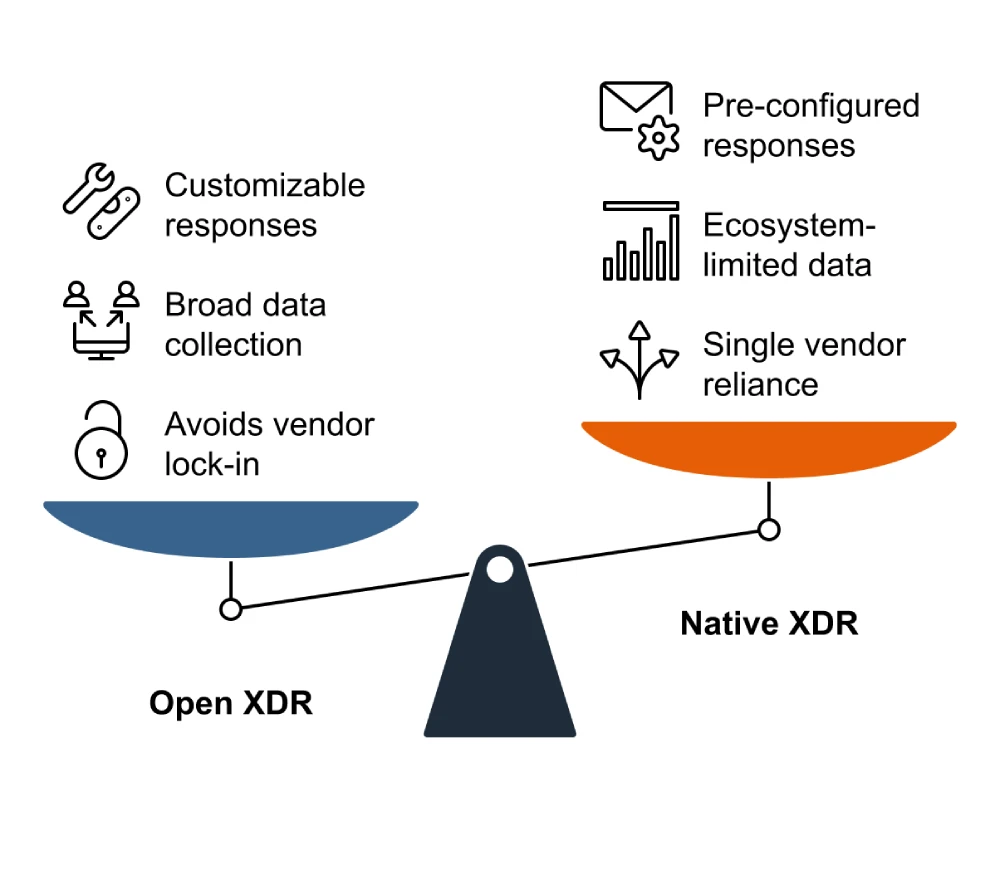
Furthermore, Open XDR offers customizable and automated responses across diverse solutions, while Native XDR relies on pre-configured responses. Also, Open XDR enhances threat hunting by combining intelligence from different sources, but Native XDR is confined to built-in intelligence. One more thing, Open XDR supports scalable cloud-native environments, whereas Native XDR is more tightly coupled with the vendor’s infrastructure, limiting flexibility in hybrid setups.
Open XDR is often confused with open source XDR, but both are different. Open XDR focuses on vendor-agnostic integration, while open source XDR typically refers to community-driven security frameworks and tools.
- Related Reading: What is the Difference Between Open XDR Vs Native XDR?
Industry Frameworks and Research Supporting Open XDR
Open XDR adoption and architecture principles align closely with several industry-recognized frameworks and research initiatives:
- MITRE ATT&CK Framework for attack mapping and threat detection methodologies
- Forrester research on Open and Native XDR architectures
- NIST Cybersecurity Framework for detection and response maturity practices
- CISA guidance on threat visibility and incident response modernization
- Identify and neutralize threats faster
- Gain full visibility across your attack surface
- Automate security operations for efficiency
Using industry frameworks helps organizations validate detection strategies and build more mature security operations programs.
Future of Open XDR
Considering the nature of complexity in cyber threats and the huge demand for advanced security solutions, the future of Open XDR seems very promising. The future of Open XDR might be defined by several leading trends and developments including but not limited to:
1. Artificial Intelligence and Machine Learning
Artificial intelligence and machine learning will play an enormous role in Open XDR. These will assist in improving the detection accuracy of threats, automatically automate routine jobs, and offer deeper insights into the threat landscape.
2. Cloud Integration
As organizations increasingly migrate more into cloud environments, the open XDR solutions will have to mature in delivering end-to-end protection across hybrid and multi-cloud architectures. Such an integration will allow security teams to gain full visibility into all areas of their IT infrastructure.
3. Advanced Threat Hunting
Threat hunting capabilities will become smarter. Security teams will proactively look for and mitigate threats before they are able to really cause damage. Open XDR platforms will bring cutting-edge threat hunting tools and techniques to keep themselves off the emerging threats.
4. Collaboration and Information Sharing
Open XDR will be sustained and improved by the open-source community with increased collaboration and information-sharing across organizations as well as among security professionals for innovation and effectiveness overall of the platform.
5. Regulatory Compliance
From this perspective, Open XDR solutions will also start integrating features that ensure such compliance as data privacy becomes stricter. This will involve data protection and also incorporate auditing and reporting capabilities.
Read the Case Study.
Frequently Asked Questions
Is XDR open source?
While some open-source XDR projects are found, most of the XDR platforms are not. Open XDR architecture is also said to be the flexibility of integration with many third-party tools, offering automated responses and advanced threat intelligence, although they are mostly proprietary software, not free for anyone to access and manipulate. Open XDR vendors typically offer more commercial and custom solutions.
What's the difference between Open XDR and SIEM?
Open XDR employs a range of technologies to enhance detection and response. It facilitates the integration of diverse detection instruments and supports automated reactions.
It delivers sophisticated analytics by merging data from endpoints, networks, and the cloud. SIEM primarily gathers and retains security data for logging and compliance purposes. It provides rudimentary alerting but falls short on advanced response capabilities, which are offered by XDR.
Open XDR boosts threat detection and response by unifying disparate tools. Conversely, SIEM is more concentrated on data gathering and examination.
What is open xdr architecture?
Open XDR architecture represents a unified security framework that links all kinds of security tools and data sources together into one single platform. It then enhances visibility, improves threat detection, and streamlines incident response by breaking down silos and automating workflows, thus ensuring more efficient threat management.