



Summary
CVE-2026-46333 is a high-severity vulnerability in the Linux kernel’s ptrace subsystem caused by improper permission checks. Under specific conditions, a local attacker can disclose sensitive information or gain root privileges. The issue is fixed through upstream Linux kernel patches and vendor security updates.
Urgent Actions Required
- Update the Linux kernel to a patched version.
- Set kernel.yama.ptrace_scope=2 until patched.
- Limit CAP_SYS_PTRACE to trusted users.
- Review systems for possible credential exposure.
Which Systems Are Vulnerable to CVE-2026-46333?
Technical Overview
- Vulnerability Type:Improper Privilege Management in the Linux kernel ptrace subsystem caused by incorrect permission validation using the get_dumpable() logic
-
Affected Software/Versions:
- Linux kernel
-
CVSS Vector: v3.1
- Attack Vector: Local
- Attack Complexity: Low
- Privileges Required: Low
- User Interaction: None
- Scope: Unchanged
- Confidentiality Impact: High
- Integrity Impact: High
- Availability Impact: None
- Patch Availability: Yes, available
How Does the CVE-2026-46333 Exploit Work?
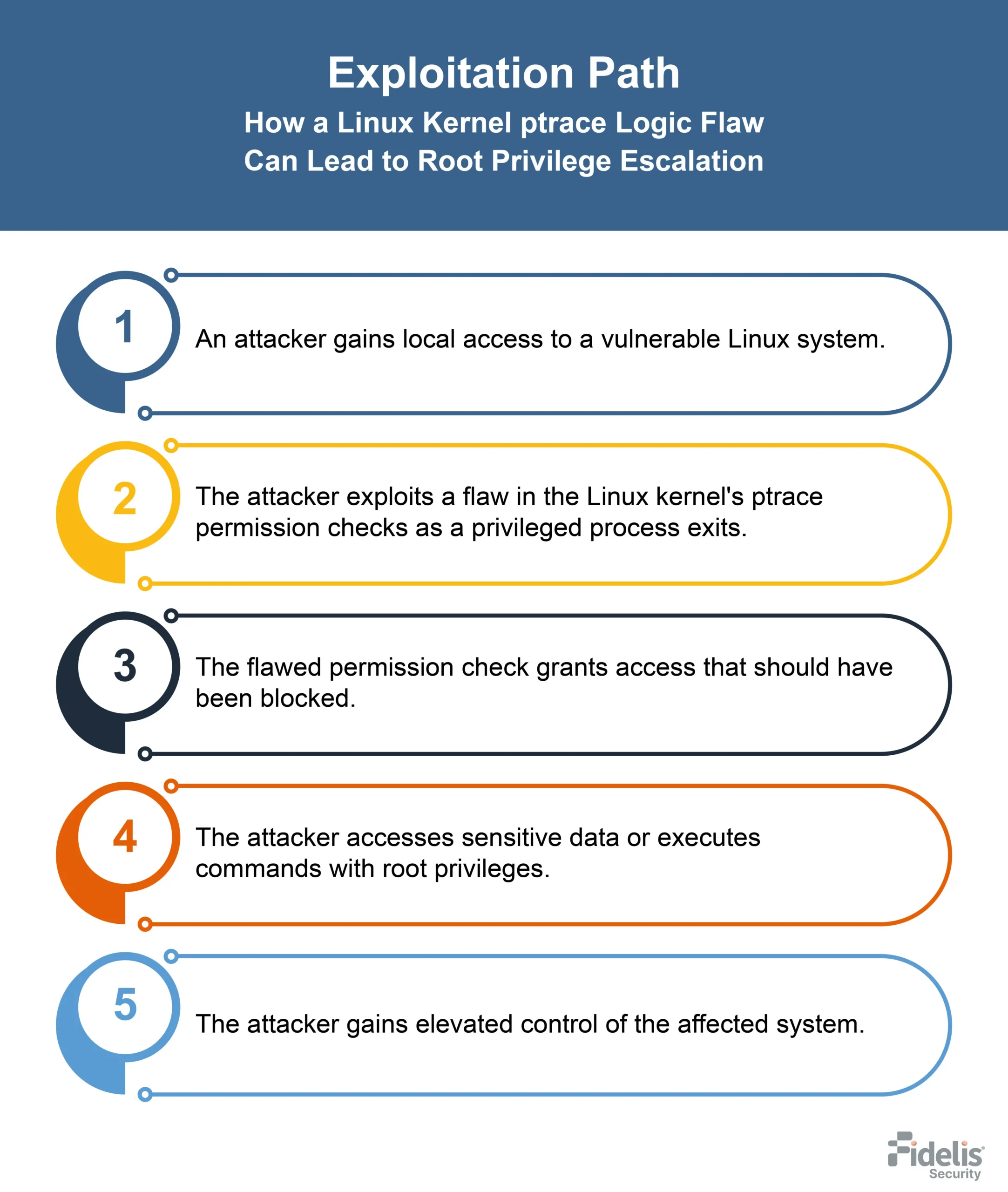
The attack typically follows these steps:
What Causes CVE-2026-46333?
Vulnerability Root Cause:
CVE-2026-46333 is caused by a logic mistake in the Linux kernel’s ptrace subsystem. Improper permission checks may, in some cases, allow unauthorized access to privileged processes, which could lead to the escalation of privileges or the revelation of private information.
How Can You Mitigate CVE-2026-46333?
If immediate patching is delayed or not possible:
- Restrict cross-process ptrace access by setting kernel.yama.ptrace_scope=2 to require CAP_SYS_PTRACE for process attachment.
- Limit the CAP_SYS_PTRACE capability to trusted administrative processes only.
- Reduce local attack opportunities by restricting access to trusted users and minimizing privileged accounts.
- Monitor for unexpected ptrace activity using security monitoring tools such as auditd or eBPF.
- Verify that affected systems are updated with the latest vendor-recommended kernel fixes as soon as they become available.
Which Assets and Systems Are at Risk?
-
Asset Types Affected:
- Linux systems - Systems running vulnerable Linux kernel versions
- Linux workstations and servers - Hosts where untrusted users can obtain local access
- Privileged Linux processes - Processes that run with elevated privileges and may be targeted during exploitation
Will Patching CVE-2026-46333 Cause Downtime?
Patch application impact: Apply the latest Linux kernel update from your operating system vendor. Schedule the update during your regular maintenance window.
Mitigation (if immediate patching is not possible): Set kernel.yama.ptrace_scope=2 to restrict ptrace access until the kernel update is applied.
Remediation & Response
-
Remediation Timeline
- Right away: Use the most recent Linux kernel updates that your distribution has to offer.
- To help prevent known exploitation approaches, set kernel.yama.ptrace_scope=2 until patching is finished.
- To make sure the upgraded kernel is operating, restart the system after patching.
-
Incident Response Considerations:
- Identify systems running vulnerable Linux kernel versions.
- Review whether untrusted local users had access before patching.
- Rotate SSH host keys and review sensitive credentials if exposure is suspected.
- Verify that patched kernels are active across all affected systems.
Learn How XDR Helps Detect Linux Privilege Escalation Attacks
-
-
- Understand MITRE ATT&CK-aligned detection and response strategies
- Learn how to identify credential theft and post-exploitation activity
- Explore how XDR extends visibility beyond traditional EDR
-
CVSS Breakdown Table
| Metric | Value | Description |
|---|---|---|
| Base Score | 7.1 | High severity vulnerability with significant impact on affected Linux systems |
| Attack Vector | Local | The attacker must have local access to the target system |
| Attack Complexity | Low | Exploitation does not require complex conditions or specialized techniques |
| Privileges Required | Low | The attacker requires low-level privileges on the target system |
| User Interaction | None | No user action is required to exploit the vulnerability |
| Scope | Unchanged | he impact remains within the vulnerable Linux kernel component |
| Confidentiality Impact | High | Successful exploitation can expose sensitive data and credentials |
| Integrity Impact | High | An attacker may gain elevated privileges and execute unauthorized actions |
| Availability Impact | None | The vulnerability does not directly affect system availability |