

Summary
CVE-2026-42018 is an improper authentication vulnerability in JFrog Artifactory that can cause an internal anonymous-user token to be returned to an unauthenticated caller even when anonymous access is disabled. An attacker can use the token to access resources available to the anonymous identity, potentially including sensitive repository resources, artifacts, and build metadata. The vulnerability can be exploited remotely without credentials or user interaction.
Urgent Actions Required
- Upgrade affected JFrog Artifactory deployments to an applicable fixed release, including 7.111.21, 7.117.28, 7.125.20, 7.133.29, or 7.146.38, as applicable to the deployment's release branch.
- Review Artifactory access and request logs for unauthenticated token requests and unexpected activity associated with the anonymous identity.
- Restrict network access to Artifactory API endpoints, particularly for internet-exposed instances, until the affected deployment is patched.
- Review permissions assigned to the anonymous user and remove unnecessary access to sensitive repositories.
- If the instance was exposed while vulnerable, investigate for signs of exploitation and post-exploitation activity rather than relying on patching alone.
Which Systems Are Vulnerable to CVE-2026-42018?
Technical Overview
- Vulnerability Type: Improper Authentication / Anonymous Token Exposure
-
Affected Software/Versions:
JFrog Artifactory versions:- Earlier than 7.111.20
- 7.117.0 – 7.117.27
- 7.125.0 – 7.125.19
- 7.133.0 – 7.133.28
- 7.146.0 – 7.146.8
-
CVSS Vector: v3.1
- Attack Vector: Network
- Attack Complexity: Low
- Privileges Required: None
- User Interaction: None
- Scope: Unchanged
- Confidentiality Impact: High
- Integrity Impact: None
- Availability Impact: None
- Patch Availability: Yes, fixed releases are available.
How Does the CVE-2026-42018 Exploit Work?
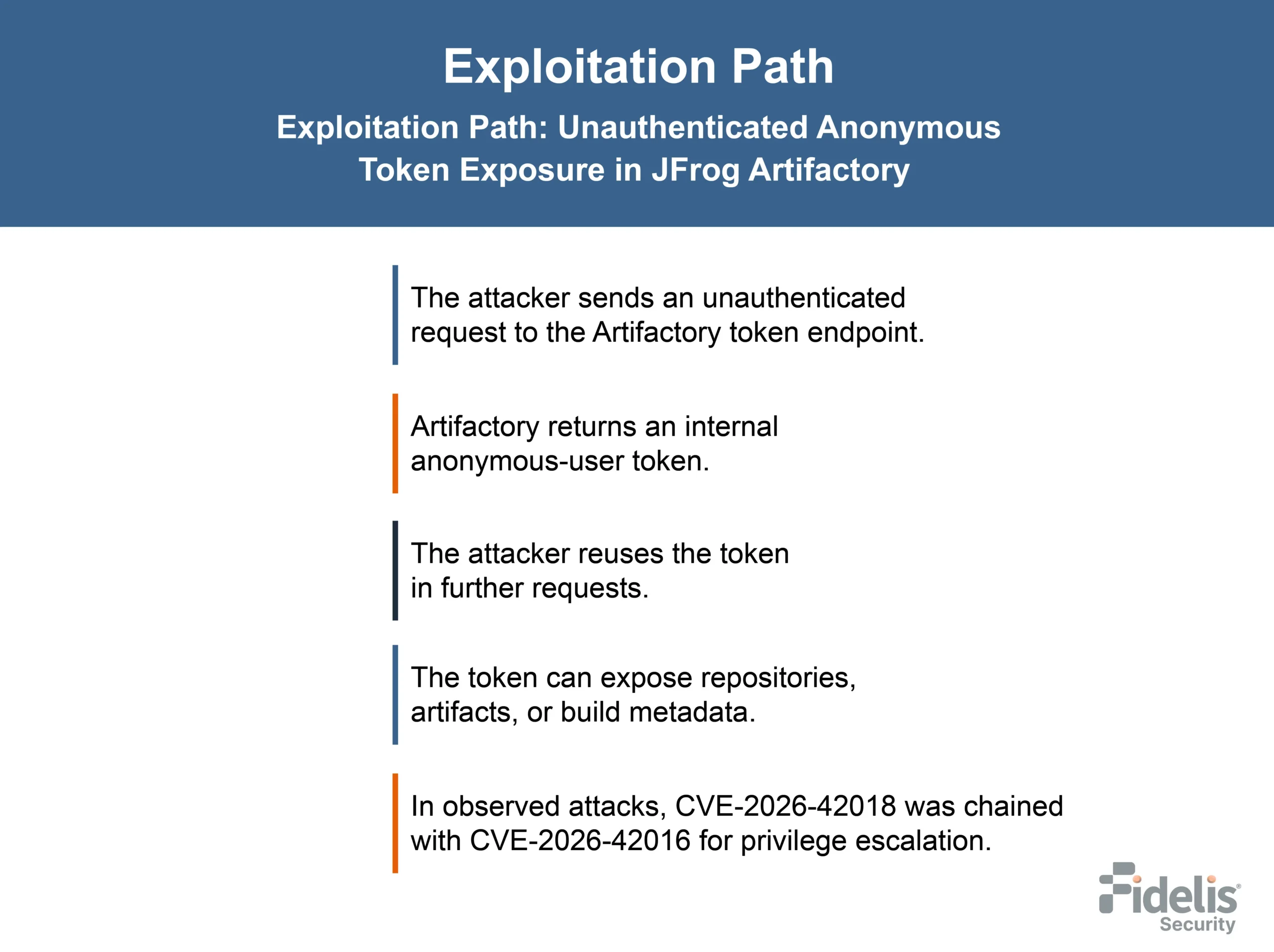
The attack typically follows these steps:
What Causes CVE-2026-42018?
Vulnerability Root Cause:
CVE-2026-42018 is caused by improper authentication handling during anonymous-user token generation in JFrog Artifactory. When anonymous access is disabled, the affected token endpoint can still issue an internal token to an unauthenticated requester. This allows an attacker without credentials to obtain a token associated with the anonymous identity and use it to access resources available to that identity, potentially exposing sensitive repository or artifact data.
How Can You Mitigate CVE-2026-42018?
If immediate patching is delayed or not possible:
- Restrict access to Artifactory API endpoints, especially the /access/api/v1/aws/token/ endpoint.
- Place Artifactory behind a firewall, reverse proxy, or authenticated gateway that blocks unauthenticated token requests.
- Limit Artifactory access to trusted networks or users until the affected instance can be upgraded.
- Review anonymous-user permissions and remove access to sensitive repositories or resources where possible.
- Monitor Artifactory logs for unexpected token requests, anonymous activity, and unusual repository downloads.
- Hunt for signs of exploitation, including suspicious administrative accounts or other post-exploitation activity.
Which Assets and Systems Are at Risk?
-
Asset Types Affected:
- JFrog Artifactory Instances - Artifactory deployments running affected versions that can issue an internal anonymous-user token to unauthenticated requests.
- Artifactory API Endpoints - Particularly the token endpoint involved in the vulnerability.
-
Business-Critical Systems at Risk:
- Private Repositories - Sensitive artifacts or repository data accessible through the exposed anonymous-user token.
- Build and Repository Data - Build metadata and other resources available to the affected anonymous identity.
-
Exposure Level:
- Internet-Exposed Artifactory Instances - Especially systems running affected versions and reachable by unauthenticated network clients.
- Externally Accessible Artifactory APIs - Systems where unauthenticated requests can reach the affected token endpoint.
How Can You Detect CVE-2026-42018 Exploitation?
Exploitation Signatures:
Look for unauthenticated requests to /access/api/v1/aws/token/ that return 200 OK. A 401 response on the bare path followed by a 200 OK response for a path variant from the same IP within a short period is a strong indicator.
Indicators of Compromise (IOCs/IOAs):
- Unauthenticated requests to /access/api/v1/aws/token/ returning a token
- Anonymous or low-privilege identities minting tokens unexpectedly
- Unexpected user enumeration or suspicious token activity
- Persistent administrative accounts created after suspicious token requests
Behavioral Indicators:
- Anonymous identities accessing resources or repositories unexpectedly
- Unusual repository downloads following suspicious token activity
- Token generation followed by administrative account creation or other privilege-related activity
Alerting Strategy:
-
- Alert on successful token requests from unauthenticated clients
- Correlate 401 followed by 200 OK responses from the same source IP
- Monitor for suspicious token generation and subsequent administrative activity
Remediation & Response
-
Remediation Timeline:
- Immediate: Identify affected Artifactory instances and prioritize internet-exposed systems
- As soon as possible: Upgrade to a fixed Artifactory release
- After patching: Review logs and investigate suspicious token requests or signs of compromise
-
Incident Response Considerations:
- Review Artifactory logs for suspicious requests to /access/api/v1/aws/token/
- Investigate unexpected anonymous token activity, repository access, and administrative account creation
- Preserve relevant evidence and hunt for post-exploitation activity before and after patching
- Rotate tokens, API keys, or credentials that may have been exposed through affected resources
Compliance & Governance Notes
-
Standards Impacted:
- CISA BOD 26-04: CVE-2026-42018 is listed in the CISA KEV Catalog and requires applicable organizations to follow the associated remediation requirements
-
Audit Trail Requirement:
- Retain logs for requests to /access/api/v1/aws/token/, including source IP and timestamp
- Document Artifactory patching details, including the version applied and affected systems
- Maintain records of vulnerability investigation and remediation activities
-
Policy Alignment:
- Ensure vulnerability management procedures address timely remediation of actively exploited vulnerabilities
- Include Artifactory token activity and suspicious anonymous access in relevant monitoring and incident-response procedures
Choose the Right NDR Solution
-
-
- Key features to look for in an NDR solution
- Must-have capabilities for effective threat detection & response
- Insights into scalability, support, and cost
- Practical NDR buyers’ checklist
-
CVSS Breakdown Table
| Metric | Value | Description |
|---|---|---|
| Base Score | 7.5 | High-severity vulnerability with high confidentiality impact |
| Attack Vector | Network | Can be exploited remotely by an unauthenticated network attacker |
| Attack Complexity | Low | Exploitation does not require special conditions |
| Privileges Required | None | The attacker does not need authentication or prior privileges |
| User Interaction | None | Exploitation does not require user involvement |
| Scope | Unchanged | The impact remains within the vulnerable security authority |
| Confidentiality Impact | High | Exploitation can expose sensitive resources accessible to the anonymous identity |
| Integrity Impact | None | The CVSS assessment does not assign an integrity impact |
| Availability Impact | None | The CVSS assessment does not assign an availability impact |
References: