

Summary
CVE-2026-42016 is an incorrect authorization vulnerability in JFrog Artifactory Self Hosted that can allow a user with a valid low-privilege token to perform actions beyond its intended permissions. Affected versions verify the token signature and issuer but fail to properly enforce its scope during authorization. The vulnerability affects versions before 7.133.11 and is fixed in version 7.133.11 and later. Wiz has documented in-the-wild exploitation, and CISA added the vulnerability to its Known Exploited Vulnerabilities catalog on September 11, 2026.
Urgent Actions Required
- Upgrade JFrog Artifactory Self Hosted to version 7.133.11 or later.
- Revoke and reissue Artifactory access tokens after patching and rotate relevant CI/CD credentials.
- Review access and audit logs for low-privilege or internal identities creating tokens or accessing privileged user-management and plugin APIs.
- Check for unexpected administrative accounts, permission targets, repository changes, and artifact uploads or overwrites.
- Restrict access to Artifactory management endpoints to trusted administrative networks where possible.
- For potentially compromised instances, investigate for unauthorized accounts, plugins, configuration changes, and other post-exploitation activity rather than relying on patching alone.
Which Systems Are Vulnerable to CVE-2026-42016?
Technical Overview
- Vulnerability Type: Incorrect Authorization due to Insufficient Token Scope Validation
-
Affected Software/Versions:
- JFrog Artifactory Self Hosted versions before 7.133.11
-
CVSS Vector: v3.1
- Attack Vector: Network
- Attack Complexity: Low
- Privileges Required: Low
- User Interaction: None
- Scope: Unchanged
- Confidentiality Impact: High
- Integrity Impact: High
- Availability Impact: None
- Patch Availability: Yes, available
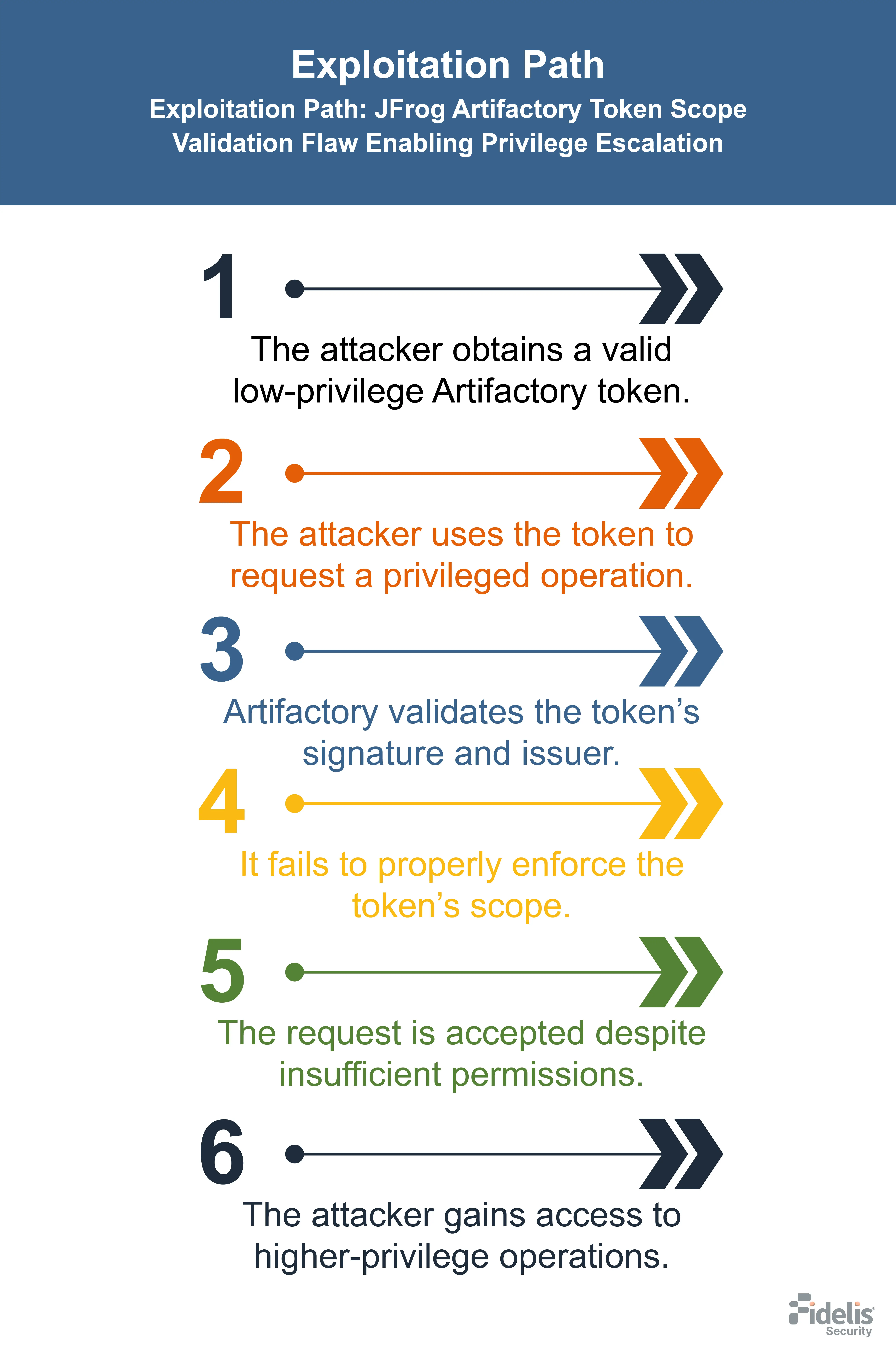
How Does the CVE-2026-42016 Exploit Work?
The attack typically follows these steps:
What Causes CVE-2026-42016?
Vulnerability Root Cause:
The flaw occurs because Artifactory checks the token’s signature and issuer but not its scope, allowing low-privilege tokens to gain higher privileges.
How Can You Mitigate CVE-2026-42016?
If immediate patching is delayed or not possible:
- Rotate long-lived Artifactory access tokens.
- Use short-lived, narrowly scoped tokens where possible.
- Restrict Artifactory management endpoints to trusted administrative networks.
- Limit network access to affected Artifactory instances.
- Review access and request logs for unusual token use or privileged API activity.
- Monitor for unexpected administrative accounts, repository changes, and artifact uploads or overwrites.
Which Assets and Systems Are at Risk?
-
Asset Types Affected:
- JFrog Artifactory Self Hosted - Versions before 7.133.11
- Self-managed Artifactory instances - Particularly deployments where authenticated users can obtain and use access tokens
-
Business-Critical Systems at Risk:
- Artifact Repositories - Unauthorized users may gain access to higher-privilege repository operations
- Artifactory Administrative Functions - Privilege escalation can expose user management, repository configuration, and other administrative operations
-
Exposure Level:
- Internet-accessible Artifactory instances - These should be prioritized for remediation and investigation
- Authenticated Artifactory environments - The vulnerability can be exploited using a valid low-privilege token
How Can You Detect CVE-2026-42016 Exploitation?
Exploitation Signatures:
Look for low-privilege identities using token creation or privileged APIs beyond their expected permissions.
Indicators of Compromise (IOCs/IOAs):
- Low-privilege or internal identities creating access tokens
- Unexpected access to user-management APIs
- Low-privilege identities reading or modifying plugin APIs
- New administrative accounts or permission targets
Behavioral Indicators:
- Token use outside the assigned scope
- Unexpected repository configuration changes
- Unusual artifact uploads or overwrites
- Privileged API activity from low-privilege accounts
Alerting Strategy:
-
Alerting Strategy: Priority: High
- Alert on privileged API activity from low-privilege identities
- Monitor unusual token creation and administrative changes
- Investigate unexpected account, repository, and artifact modifications
Remediation & Response
-
Incident Response Considerations:
- Prioritize internet-accessible Artifactory instances for investigation.
- Review access and audit logs for unusual token creation and privileged API activity.
- Check for unexpected administrative accounts, permission targets, repository changes, and artifact modifications.
- Investigate potentially compromised instances for unauthorized plugins, configuration changes, and other post-exploitation activity.
- Do not rely on patching alone if compromise is suspected. Review and remediate attacker-created accounts and other persistence mechanisms.
Compliance & Governance Notes
-
Audit Trail Requirement:
- Preserve Artifactory access and request logs for investigation.
- Record patching of affected instances, including the version applied.
- Document access-token rotation and credential changes following remediation.
- Maintain records of suspicious administrative activity, repository changes, and other findings identified during the investigation.
Build a more proactive cyber defense with Open and Active XDR
-
-
- Extend security across networks, cloud, and endpoints
- Bring network security, deception, and Active Directory protection together
- Detect post-breach attacks up to 9x faster
- Strengthen your cyber-resilient environment
-
CVSS Breakdown Table
| Metric | Value | Description |
|---|---|---|
| Base Score | 8.1 | High-severity vulnerability with network-based exploitation and significant confidentiality and integrity impact |
| Attack Vector | Network | The vulnerability can be exploited remotely over a network |
| Attack Complexity | Low | Exploitation does not require special or complex conditions |
| Privileges Required | Low | The attacker needs a valid low-privilege token |
| User Interaction | None | No action from another user is required for exploitation |
| Scope | Unchanged | The impact remains within the vulnerable Artifactory security context |
| Confidentiality Impact | High | Successful exploitation can provide access to information beyond the token's intended permissions |
| Integrity Impact | High | Exploitation can enable unauthorized privileged actions and changes |
| Availability Impact | None | The JFrog CNA assessment does not identify a direct availability impact |
References: