
Key Takeaways
- Stolen credentials drive a major share of breaches and bypass traditional controls without detection
- Credential harvesting traps expose attackers during reconnaissance before privilege escalation begins
- Honey credentials and fake accounts create zero-noise, high-confidence alerts for security teams
- Traps reveal attacker movement across systems with precise forensic context
- Combining deception with MFA, strong passwords, and access controls strengthens overall security posture
- Early detection reduces response time from months to hours and limits blast radius
Stolen credentials bypass every perimeter control you have. Deception-based traps catch the attacker during reconnaissance, before they ever reach a privileged account.
22%
of confirmed breaches traced back to stolen credentials as the initial access vector
88%
of web application attacks used stolen login credentials to gain access
186
days median time to identify a breach caused by compromised credentials
46%
of unmanaged devices found in infostealer logs carried corporate login credentials
Set a fake domain admin account in Active Directory. Seed a honey credential into LSASS memory on three endpoints. Drop a breadcrumb file on a real file share pointing at a decoy server. Now wait. Any attacker who dumps credentials post-compromise sweeps up the honey credential. Any attacker doing AD reconnaissance queries the fake account. The moment either credential gets used, you have source host, target, timestamp, and confirmed unauthorized access, before a single production asset is touched.
That is the operational premise of credential harvesting traps. Stolen login credentials let attackers blend into normal authentication traffic without triggering behavioral alerts. Traps remove behavioral analysis from the equation entirely. Interacting with a deceptive object is the detection event, not a deviation from a statistical baseline that an attacker can study and avoid.
How do attackers steal credentials and move toward privileged accounts?
The 2025 Verizon DBIR found 46% of unmanaged devices in infostealer logs carried corporate credentials, and 30% of corporate-managed devices appeared in the same logs[1]. Infostealer malware runs silently on personal laptops and unmanaged endpoints, pulling browser-stored passwords, session tokens, and application credentials. That data gets packaged and sold. An attacker buys a working credential set, skips the breach entirely, and authenticates directly into your environment.
Phishing-based credential theft uses spoofed login portals to capture passwords directly, while MFA fatigue attacks send repeated push notifications until a user approves a fraudulent request out of frustration. Credential stuffing takes a different route: automated tools run through username-password pairs harvested from unrelated data breaches and test them against enterprise login portals at scale. Per the 2025 DBIR, credential stuffing made up a median 19% of all authentication attempts in analyzed SSO provider logs[1]. One in five login requests hitting your identity infrastructure is likely automated.
Once inside, attackers go after credentials stored in memory. LSASS holds password hashes, Kerberos tickets, and in some configurations plaintext passwords: a single dump yields dozens of usable credentials in seconds, which MITRE ATT&CK categorizes as OS Credential Dumping (T1003) under Credential Access (TA0006)[2]. Kerberoasting (T1558.003) requests service ticket hashes from AD, takes them offline, and cracks them without generating network noise. DCSync (T1003.006) goes further: by abusing AD replication permissions from a non-domain controller, an attacker can pull the entire credential store at scale. Brute force and password spraying address accounts with weak passwords by rotating guesses across many accounts simultaneously, avoiding any single-account lockout threshold. At this point the attacker has privileged account candidates and a path to escalate.
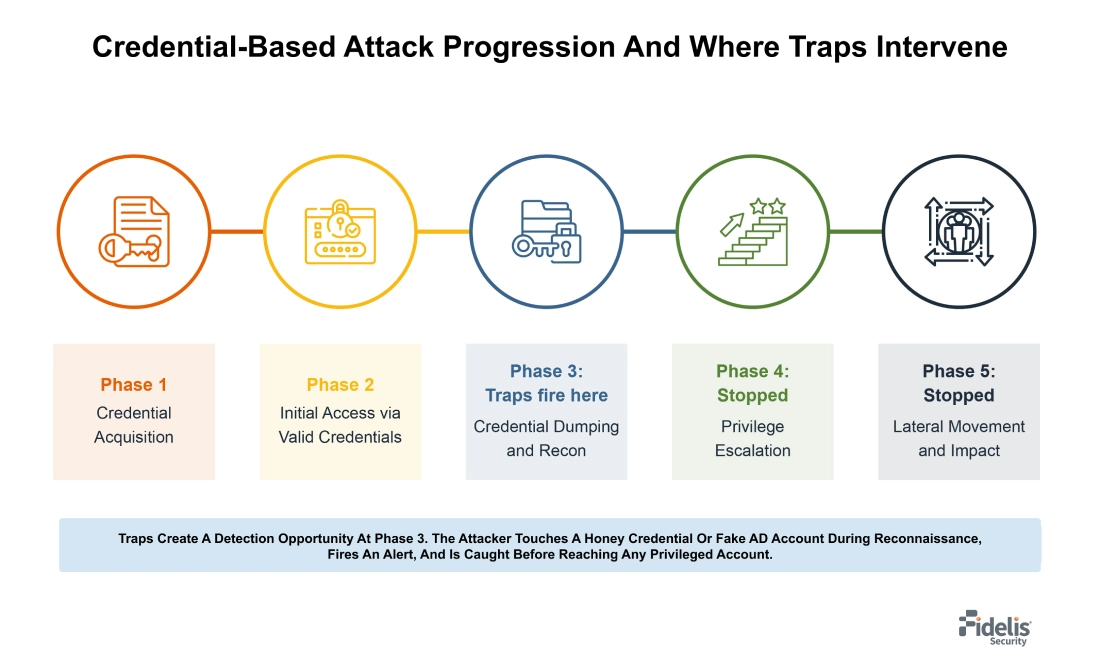
Password spraying works because per-account lockout policies are blind to distributed attempts. Testing five commonly used passwords across 2,000 accounts generates 10,000 login attempts with zero lockouts, and against any organization that has not enforced strong password complexity, some percentage of those attempts succeed. The attacker exits this phase with working credentials and a plan for which accounts to target next.
Why do EDR and SIEM tools fail to detect credential theft attacks?
Mimikatz accesses LSASS. So does Windows Credential Manager, some antivirus products, and several legitimate monitoring tools. An EDR platform cannot reliably distinguish credential dumping from routine administrative memory access on that signal alone. Security teams already managing hundreds of alerts per shift deprioritize ambiguous LSASS events. The credential dump completes. The attacker moves on. The alert eventually gets triaged as a false positive or closed without action.
SIEM and UEBA tools flag statistical deviations: logins outside business hours, impossible travel, access to systems an account does not normally touch. An attacker who spends ten minutes reviewing the compromised account’s activity history knows which hours to work, which systems are in scope, and which regions to avoid. Operating inside the behavioral baseline is not accidental. It is standard tradecraft. Nothing in the SIEM fires.
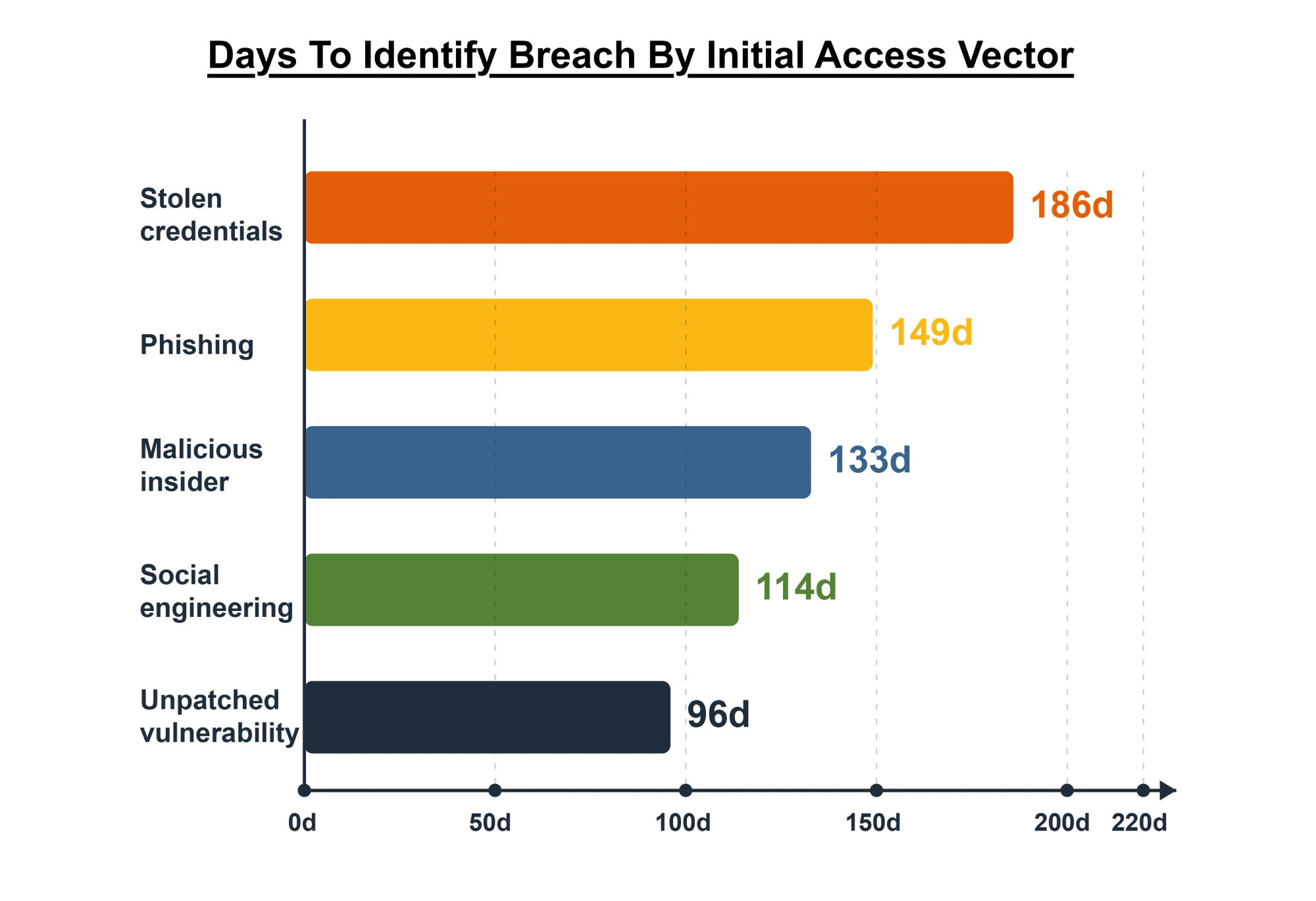
IBM’s Cost of a Data Breach Report 2025 puts the median time to identify a credential breach at 186 days[3]. Six months. During that window an attacker completes reconnaissance, escalates to domain admin, reaches critical systems, and in ransomware scenarios usually exfiltrates data well before triggering encryption. Signature-based detection tools have nothing to match against. Behavioral tools have no anomaly to flag. Both are structurally unsuited to an attacker who authenticates with valid credentials and works carefully inside normal access patterns.
What are credential harvesting traps and how do they catch attackers?
Honey credentials seeded into LSASS memory, registry keys, and local credential stores get collected by any tool that dumps credentials indiscriminately: the attacker cannot separate real credentials from fake ones at harvest time. Honey accounts in on-premises AD and Azure AD are configured to look like real service or admin accounts, complete with realistic naming conventions and plausible attributes.
Breadcrumb files dropped on real endpoints reference these fake accounts and point toward decoy servers, giving the attacker a realistic-looking trail to follow away from production systems. Canary tokens in S3 buckets, Azure Blob containers, and Kubernetes secrets catch attackers scanning cloud storage for exposed credentials. None of these objects serves any legitimate operational purpose. Any access to any of them is unauthorized, which means every alert they generate is a confirmed intrusion signal with no ambiguity.
Each layer maps to a specific phase of attacker activity:
Endpoint honey credentials
Fake credentials planted in LSASS memory space, registry keys, and local credential stores. Credential dumping tools extract them alongside real ones. When an attacker later authenticates with a honey credential, the alert fires with the source host, target system, and timestamp.
Active Directory honey accounts
Fake user and service accounts in on-premises AD and Azure AD that mirror naming conventions of real accounts. Any Kerberos ticket request, directory enumeration, or authentication attempt involving these accounts triggers an immediate, confirmed alert.
Breadcrumb trails on real endpoints
Shortcut files, cached credential references, and network share pointers deployed to real user machines. Attackers following what looks like an admin's saved credentials get funneled toward decoy infrastructure instead of production systems.
Cloud canary credentials
Honey tokens placed in S3 buckets, Azure Blob storage, Kubernetes secrets, and secrets managers. Cloud-scanning attackers who find and attempt to use these credentials trigger alerts with the exact API call, origin IP, and target service.
Correlated across a single incident: credential dump event on host A at 14:32, honey credential authentication attempt originating from host B at 14:47, access to decoy file server C at 14:51. Source host, pivot host, target asset class, all timestamped. The attacker’s reconnaissance path is documented in full before any production system is touched, giving defenders a precise forensic record alongside the initial alert.
Which credential attack techniques do traps detect, and how?
| Technique | ATT&CK ID | What the attacker does | Trap detection signal | Confidence |
|---|---|---|---|---|
| OS Credential Dumping | T1003 | Extracts hashes, Kerberos tickets, or plaintext passwords from LSASS, SAM, or AD using credential dumping tools | Honey credentials harvested from memory, then used in an authentication or lateral movement attempt | Very high |
| Credential Stuffing | T1110.004 | Automated tools replay username and password pairs from prior data breaches against enterprise login portals | Any login attempt against a honey account is confirmed unauthorized access, regardless of success | Very high |
| Password Spraying | T1110.003 | Commonly used passwords tested across many user accounts to avoid per-account lockout thresholds | Spray campaign reaching honey accounts confirms the attacker's presence and scope | High |
| Kerberoasting | T1558.003 | Service ticket hashes requested from AD for service accounts, then cracked offline to recover passwords | Honey service accounts with realistic names attract ticket requests; subsequent use fires an alert | High |
| Valid Accounts | T1078 | Compromised credentials used to gain access and escalate privileges while appearing as a legitimate user | Honey account authentication attempts expose AD enumeration, credential reuse, and lateral movement | Very high |
| DCSync | T1003.006 | AD replication permissions abused from a non-domain controller to extract credential material at scale | Replication requests from non-DC systems that include honey account data trigger immediate alerts | Very high |
Why privilege escalation is the inflection point
Getting to a domain admin account changes the incident scope entirely. Before that point, a credential theft is a contained problem: one account revoked, one host forensicated, limited blast radius. After it, every credential in the domain is suspect, every DC needs review, and remediation is measured in weeks. The entire value of catching an attacker with credential traps is that it happens before they cross that line.
Is Fidelis Deception® the right solution for credential harvesting detection?
Yes. Every mechanism described in this article, including honey credentials in memory, fake AD and Azure AD accounts, endpoint breadcrumbs, and cloud decoys, is a documented Fidelis Deception® capability. The capabilities listed below come directly from official Fidelis product documentation. Nothing here is extrapolated.
Fidelis Deception® uses machine learning to map your cyber terrain continuously, calculate which assets are highest-risk, and deploy decoys and breadcrumbs at the locations attackers are statistically most likely to target. Decoy coverage spans on-premises operating systems, cloud assets, IoT, and containerized environments. Breadcrumbs deployed to real endpoints include memory credentials, registry keys, canary files, and network activity lures. Fake AD accounts, including Azure AD, mirror the naming conventions and attributes of real accounts so an attacker enumerating the directory finds nothing to distinguish them. No legitimate user ever has a reason to touch a deceptive object, so each alert requires no triage decision. It is a confirmed intrusion signal.
-
Exposes stolen credential use
Documented capability. Honey credentials surface attacker activity at the moment of attempted reuse, before lateral movement completes. -
Active Directory and Azure AD deception
Fake accounts placed in on-premises AD and Azure AD catch directory enumeration and credential-based privilege escalation attempts. -
Endpoint breadcrumbs
Memory credentials, registry keys, canary files, and network lures deployed to real assets pull attackers away from production infrastructure. -
Zero-noise alerts
No legitimate user touches a deceptive object. Every alert is actionable. Alert fatigue is structurally impossible. -
ML-driven deployment
Machine learning automates and continuously updates decoy and breadcrumb placement based on real asset risk profiles. -
Fidelis Elevate® XDR integration
Deception telemetry correlates with network, endpoint, and sandbox data for full attack chain visibility from credential theft through lateral movement.
How do you prevent credential theft and build a detection program around traps?
MFA stops the attacker who stole a password but not the second factor. Strong password policies and password managers cut the reuse problem that makes credential stuffing profitable. Least-privilege access limits what a compromised account can actually do. Each of these reduces the probability or impact of credential theft. None of them guarantees the attacker never gets in. Traps cover the scenario where credentials are already compromised and the attacker is already inside.
1. Enable multi factor authentication, starting with privileged accounts
FIDO2-based authenticators bind authentication to a physical device and a specific origin, making them immune to credential replay and MFA fatigue attacks. CISA guidance recommends phishing-resistant MFA for privileged access specifically because SMS and push-based alternatives are regularly bypassed by real-time phishing proxies and push fatigue techniques[4]. Start with privileged and administrative accounts, then extend coverage across all user accounts.
2. Enforce strong password policies and deploy password managers
49% is the median share of passwords that are actually unique across a given user’s accounts, per the 2025 DBIR[1]. The other 51% are reused somewhere. Credential stuffing is profitable precisely because of that reuse. Password managers eliminate the problem by generating and storing a unique credential per service. Complexity policies applied to all account passwords, including service accounts, remove the weak password population that brute force and spraying target.
3. Apply least-privilege access controls across all user and service accounts
Every account, including service accounts, should hold only the permissions required for its specific function. A credential theft event on an account scoped to read-only access on two systems is a contained problem. The same event on an over-permissioned service account with domain-wide access is a domain-wide breach. Privileged access management enforces that boundary systematically rather than relying on individual configuration decisions.
4. Monitor for unusual login behavior at the identity layer
Authentication telemetry catches what endpoint and network monitoring cannot see: off-hours logins, impossible travel between geolocations, access to systems outside the account’s normal scope. Correlated with deception trap telemetry, this layer closes the interpretation gap. An unusual authentication event plus a honey account interaction from the same source host is a confirmed compromise. An unusual authentication event with no trap interaction requires deeper investigation rather than immediate containment.
5. Educate users on social engineering tactics and phishing
Spear-phishing and MFA fatigue attacks consistently outperform technical exploits for credential acquisition because they target people rather than systems. Staff who can recognize a spoofed login portal, a suspicious link in an urgent IT request, or an unexpected MFA push they did not initiate represent a genuine reduction in credential compromise rate. Personal accounts are a relevant target: 46% of unmanaged devices in infostealer logs carry corporate credentials[1], which means personal device hygiene is a corporate security issue.
6. Deploy credential harvesting traps as the last line of detection
Every prevention control has a failure mode. Phishing-resistant MFA gets bypassed via real-time proxies. Password managers get compromised at the device level by infostealers. Least-privilege policies have gaps in legacy environments. Traps fire at the moment post-compromise reconnaissance begins, regardless of how the attacker got in, and provide a high-confidence alert at the one point in the kill chain where stopping the attacker is still cheap.
What does early credential theft detection actually change for security teams?
A trap alert during credential dumping means the attacker is at Phase 3 of the kill chain. No domain controller reached. No persistence established. No sensitive data touched. Revoke the compromised account, forensic the source host, follow the alert chain. Two hours of work. Compare that to detecting the same attacker after they have reached domain admin: every credential in the domain is now suspect, every system that admin account touched needs review, and you are looking at weeks of remediation plus a breach notification process.
What makes traps specifically effective here is that they do not depend on the attacker making a mistake relative to normal behavior. Using a honey credential is not a behavioral anomaly. It looks like a normal authentication attempt from the SIEM’s perspective. It looks like a normal lateral movement attempt from the network’s perspective. From the deception platform’s perspective, it is a confirmed intrusion event with full forensic context, delivered within minutes. That gap, between what conventional tools see and what traps surface, is where credential-based attacks have operated undetected for years.
Key takeaways
Stolen credentials fuel 22% of confirmed breaches and take 186 days to detect on median with conventional tools. Credential traps fire the moment a honey credential is used or a fake AD account is queried. No behavioral baseline required. No false positives. Fidelis Deception® covers this directly: documented capabilities include honey AD and Azure AD accounts, endpoint memory credential breadcrumbs, canary files, cloud canary tokens, and ML-driven auto-deployment based on real asset risk. Layer traps with phishing-resistant MFA, strong password policies, least-privilege access controls, and identity-layer authentication monitoring for a program with no single point of failure.
Citations:
- ^https://www.verizon.com/business/resources/reports/dbir/
- ^https://attack.mitre.org/techniques/T1003/
- ^https://www.ibm.com/think/x-force/2025-cost-of-a-data-breach-navigating-ai
- ^https://www.cisa.gov/news-events/alerts/2025/04/16/cisa-releases-guidance-credential-risks-associated-potential-legacy-oracle-cloud-compromise
- ^https://attack.mitre.org/techniques/T1078/