
Summary
CVE-2025-21333 is a highseverity elevation of privilege vulnerability in the Windows HyperV NT Kernel Integration VSP caused by a heapbased buffer overflow, which allows a local attacker with low privileges to obtain SYSTEMlevel access on affected Windows systems; the vulnerability is actively exploited in the wild and has been addressed through Microsoft security updates released in January 2025.
Urgent Actions Required
- Install Microsoft patches immediately.
- Update all affected Windows systems to fixed versions.
- Apply HyperV hotfixes if available.
- Apply vendor mitigations if patching is delayed.
- Watch Hyper-V hosts for suspicious activity.
Which Systems Are Vulnerable to CVE-2025-21333?
Technical Overview
- Vulnerability Type: Heap-based Buffer Overflow (CWE‑122) leading to Elevation of Privilege
-
Affected Software/Versions:
- Windows 10 (21H2, 22H2)
- Windows 11 (22H2, 23H2, 24H2)
- Windows Server 2022 (23H2)
- Windows Server 23H2
- Windows Server 2025
- CVSS Score: 7.8
-
CVSS Vector: v3.1
- Attack Vector: Local
- Attack Complexity: Low
- Privileges Required: Low
- User Interaction: None
- Scope: Unchanged
- Confidentiality Impact: High
- Integrity Impact: High
- Availability Impact: High
-
Patch Availability: Yes, available
CVE-2025-21333 - Security Update Guide - Microsoft - Windows Hyper-V NT Kernel Integration VSP Elevation of Privilege Vulnerability
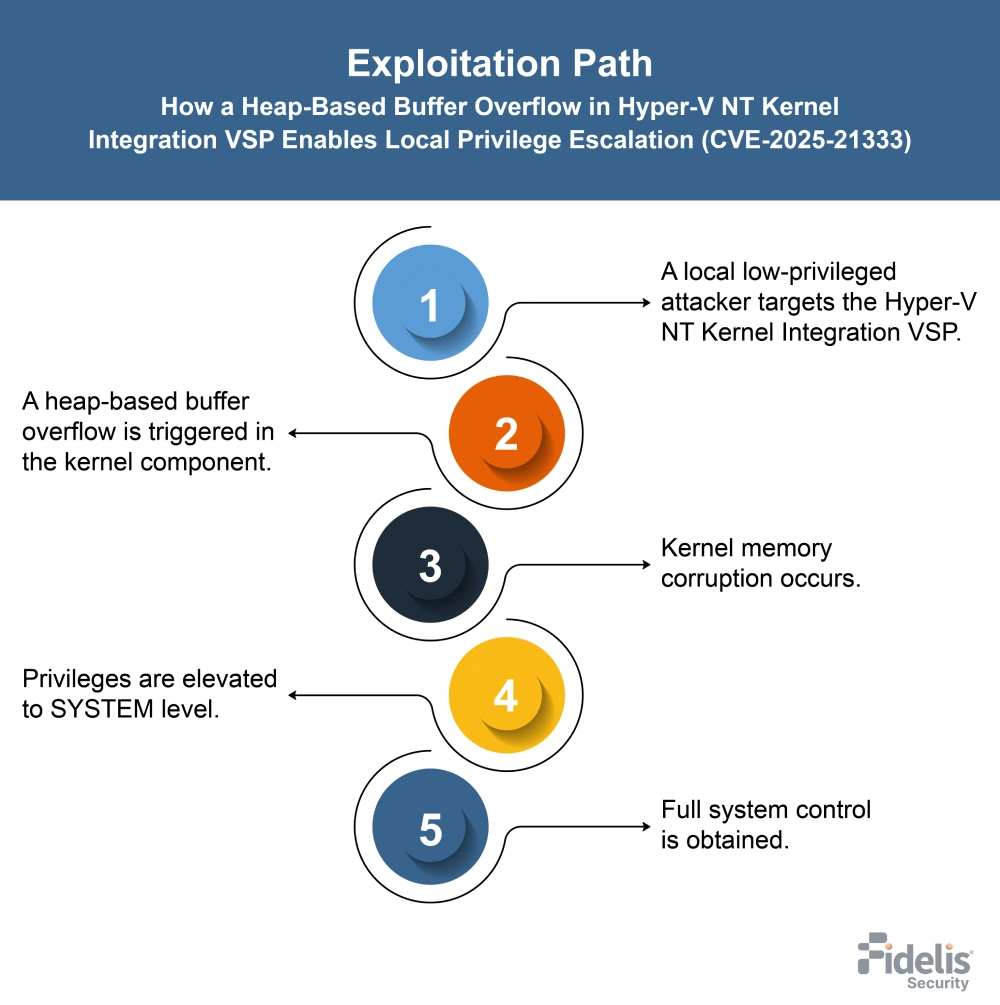
How Does the CVE-2025-21333 Exploit Work?
The attack typically follows these steps:
What Causes CVE-2025-21333?
Vulnerability Root Cause:
CVE-2025-21333 is a heap-based buffer overflow in Windows Hyper-V’s NT Kernel Integration VSP. Poor memory handling lets a local attacker gain SYSTEM-level privileges on the host.
How Can You Mitigate CVE-2025-21333?
If immediate patching is delayed or not possible:
- Apply Microsoft-recommended mitigations or Hyper-V–specific hotfixes where available.
- Update affected Windows and Windows Server systems to the latest security builds as soon as possible.
- Review and validate Hyper-V configuration settings to reduce exposure.
- Monitor systems for suspicious activity.
- Stop using affected Hyper-V components if unpatched.
Which Assets and Systems Are at Risk?
Asset Types Affected:
- Email Communication Systems – Risk of remote code execution and data compromise.
- Collaboration Platforms – Potential unauthorized access or disruption of hosted mail services.
Business-Critical Systems at Risk:
- Virtualization Hosts – Hyper-V hosts managing multiple virtual machines
- Enterprise IT Environments – Organizations relying on Hyper-V for internal infrastructure
- Data Centers and Cloud Providers – Environments using Hyper-V at scale for VM isolation and management
Exposure Level:
- Local Systems – Exploitation requires authenticated local access
- Unpatched Hosts – Systems not updated with the January 2025 Microsoft security fixes remain vulnerable
Will Patching CVE-2025-21333 Cause Downtime?
Patch application impact: Patching follows normal Windows update procedures and may require a system reboot, causing short, planned downtime on affected Hyper-V hosts.
Mitigation (if immediate patching is not possible): If updates are delayed, apply Microsoft mitigations, check Hyper-V settings, and monitor systems. These reduce risk but don’t replace patching.
How Can You Detect CVE-2025-21333 Exploitation?
-
Exploitation Signatures:
- Attempts to exploit a known heap-based buffer overflow in the Hyper-V NT Kernel Integration VSP.
- Use of publicly available proof-of-concept exploits targeting vkrnlintvsp.sys.
-
Indicators of Compromise (IOCs/IOAs):
- Unexpected elevation of privileges to SYSTEM on Hyper-V hosts.
- Abnormal behavior involving Hyper-V–related kernel components.
- Signs of local exploitation activity on systems with authenticated user access.
-
Behavioral Indicators:
- Privilege escalation occurring without administrative approval.
- Unusual interactions between guest virtual machines and the host OS.
-
Alerting Strategy:
- Priority: High
- Trigger alerts for:
- Local privilege escalation events reaching SYSTEM level.
- Suspicious activity involving Hyper-V kernel drivers on unpatched systems.
Remediation & Response
-
Remediation Timeline:
- Immediate: Apply Microsoft security updates released in the January 2025 Patch Tuesday.
- By Feb 04, 2025 (CISA KEV due date): Make sure all affected Windows systems are fully patched or mitigated
-
Rollback Plan:
- If problems arise, revert to the previous stable state and reapply patches.
- Log rollback actions, systems, and patch versions for auditing.
-
Incident Response Considerations:
- Isolate Hyper-V hosts if suspicious activity occurs.
- Watch for unusual Hyper-V kernel behavior.
- Continue monitoring after patching to ensure the issue is fixed.
CVSS Breakdown Table
| Metric | Value | Description |
|---|---|---|
| Base Score | 7.8 | High-severity vulnerability with significant security impact |
| Attack Vector | Local | Exploitation requires local system access |
| Attack Complexity | Low | No special conditions are needed to carry out the attack |
| Privileges Required | Low | Attacker must have basic local access |
| User Interaction | None | No user action is required |
| Scope | None | Impact remains within the affected system boundary |
| Confidentiality Impact | High | Allows access to sensitive system data |
| Integrity Impact | High | Enables unauthorized modification of system state |
| Availability Impact | High | Can disrupt system stability or functionality |
Keep Exploring
Detailed insights into critical and emerging CVEs