
Key Takeaways
- Retrospective detection uncovers threats that were missed during initial security inspections by analyzing historical data.
- Advanced threats often evade real-time defenses, making retrospective analysis an important layer of cybersecurity.
- SIEM platforms, threat intelligence, machine learning, and behavioral analytics help automate retrospective threat detection.
- Retrospective analysis improves incident investigations, supports proactive threat hunting, and strengthens future defenses.
- Organizations can continuously improve their security posture by identifying detection gaps, refining rules, and learning from past threats.
Retrospective detection helps security teams spot threats that slipped past earlier defenses.
In simple terms, what does a retrospective detection mean?
It refers to the process of analyzing historical security data to identify malicious activity that was not recognized during initial inspections.
Instead of catching them in real-time, this approach takes a closer look at past network activity to uncover what was missed. In this article, we’ll explain how retrospective detection works, why some threats go unnoticed at first, and what security solutions can help security professionals stay ahead.
Understanding Retrospective Detection - The Digital Detective Work
It works by looking for clues in collected data. Verification techniques focus on pinpointing artifacts generated during malware execution. Checking carefully can show how bad a breach really is and help make better defenses.
Working with historical network data isn’t always straightforward, though. In today’s rapidly evolving threat landscape, ensuring findings remain accurate and relevant can be challenging. Still, retrospective detection proves essential as advanced persistent threats become increasingly sophisticated.
- Sandbox Detection Methods
- Sandbox Data Analysis
- Fidelis Sandbox Appliance

Why Sophisticated Threats Initially Slip Past Defenses
You may ask why some threats get missed initially. Most defense security tools miss malware at first because of how they’re designed. These systems typically analyze traffic at specific moments, making them vulnerable to new malware variants.
That’s why clever attackers often sneak by. While hiding in your organization’s systems, malware can steal credentials, spy on users, and establish persistent access to critical data.
Knowing why helps security teams build better detection methods. It’s not just about catching threats – it’s about understanding how they exploit vulnerabilities in the first place.
How Long Can Malware Go Undetected - The Hidden Truth
Here’s something that’ll shock you: back in 2019, it took companies an average of over 200 days to detect an advanced persistent threat attack. That’s more than six months of threats hiding in plain sight!
Essential Security Tools for Automated Retrospective Detection
SIEM tools are key players in retrospective detection. These platforms correlate historical data with current alerts, giving security professionals the context they need for effective threat detection and response.
Network traffic analysis software and specialized platforms enhance automated and continuous retrospective threat detection capabilities significantly. Machine learning boosts threat detection power by processing massive amounts of network data quickly, spotting malware that mimics legitimate software behavior.
Threat intelligence platforms provide real-time updates on emerging threats, enhancing the overall retrospective analysis process. However, the constant evolution of new malware strains challenges systems that rely solely on known signatures – that’s where artificial intelligence and behavioral analytics come into play.
Benefits of Retrospective Detection
After a security monitoring tool identifies a malware attachment entering the network, what is the benefit of performing a retrospective analysis? The benefits fall into three key areas:
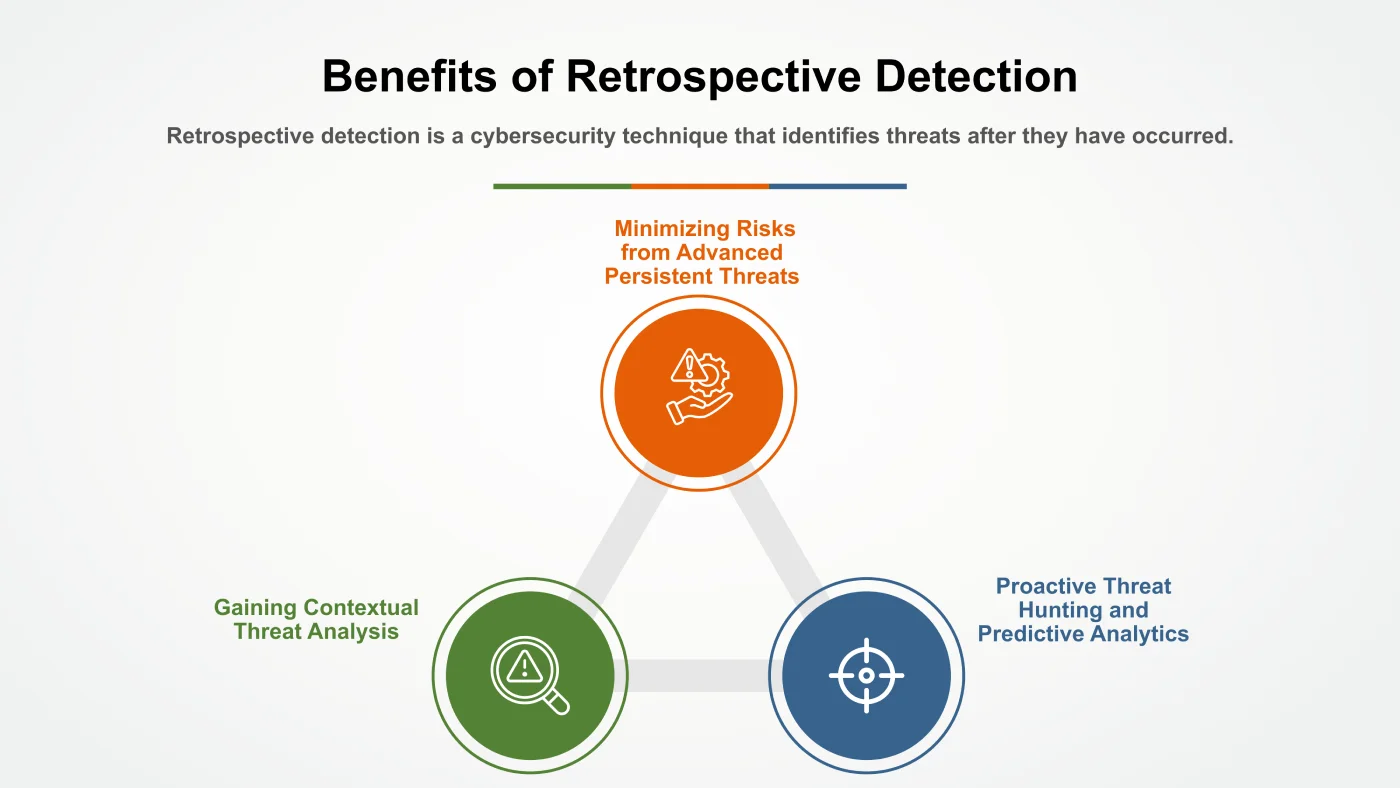
Mitigate Security Incidents and Advanced Persistent Threats
- Supports retrospective malware detection by identifying malicious files, processes, and behaviors that bypassed initial security controls.
- Helps security teams understand potential threats lurking in their environment and strengthens the organization's security posture against future attacks.
Deep Investigation and Contextual Analysis
- Enables teams to determine impact and origins of detected threats
- Assesses delivery methods, attack vectors, and threat severity
- Facilitates development of more effective threat response strategies
Proactive Threat Hunting and Predictive Analytics
- Empowers organizations to actively seek out potential threats before they escalate
- Uses predictive analytics to anticipate emerging threats and cybersecurity risks
- Transforms security from reactive to proactive by enabling organizations to take pre-emptive action
Retrospective findings often serve as the starting point for proactive threat hunting. By analyzing previously missed indicators of compromise, security teams can develop new hypotheses, search for related attacker behaviors across the environment, and identify risks before they trigger security alerts. This shifts security operations from simply responding to incidents toward actively seeking out hidden threats.
Decoding Retrospective Security Analysis - The Three-Step Process
Retrospective security analysis means going back through logs and network activity to spot malware behavior missed at first. This deep investigation process proves crucial for uncovering signs of compromise that slipped through during initial detection.
The methodology includes three key steps: collecting historical data, verifying threat presence, and reviewing the context of detected threats. Each step ensures comprehensive understanding of malware behavior and its impact on compromised systems.
Data Collection for Forensic Analysis
Gathering good data is the key to successful retrospective detection. However, incomplete or corrupted logs can seriously hinder these efforts. Threat intelligence platforms provide crucial updates on emerging threats, enhancing the overall analysis process.
Security professionals dealing with massive amounts of data must ensure information accuracy and relevance. This careful approach helps in identifying insider threats, unknown threats, and other cybersecurity threats that might otherwise slip by unnoticed.
Verification Process and Detection Rules
Verification checks past data against alerts to confirm malware. This approach is particularly useful when a threat detected in network file transfer retrospective analysis reveals malicious content that appeared harmless during the original inspection. SIEM solutions play a critical role here, allowing security operations teams to validate findings and reduce false positives.
Forensic analysis tools help teams determine the accuracy of their detection efforts and develop stronger countermeasures against future attacks. This process ensures that security incidents are properly documented and addressed.
Contextual Review for Effective Threat Response
The value of retrospective detection extends beyond identifying a single threat. Once an investigation is complete, security teams typically update detection rules, refine threat intelligence feeds, improve incident response playbooks, and close visibility gaps uncovered during the analysis. These improvements help prevent similar attacks from going undetected in the future.
Context matters when figuring out how bad a threat is and where it came from. However, interpreting data from multiple sources can complicate incident understanding.
Accurate contextual analysis proves essential for effective threat mitigation and improving overall security measures. This helps organizations quickly identify the true nature and intent of threats, enabling organizations to take appropriate protective actions for their sensitive data and critical assets.
- Going Beyond Alters
- Finding Hidden Patterns
- Crafting a Hypothesis-Drive Approach

Real-World Success Stories in Threat Detection and Response
Several organizations have successfully implemented this method, significantly improving their overall security posture. Companies adopting retrospective detection methods are better equipped to identify and mitigate threats based on newly available intelligence.
In 2019, it took companies an average of over 200 days to detect an advanced persistent threat (APT) attack. Implementing retrospective detection is essential for organizations aiming to refine their security posture against such persistent threats.
Overcoming Challenges in Retrospective Detection
Handling all the data from retrospective detection can be overwhelming, making it tough to spot threats fast. This makes it challenging to identify threats efficiently while maintaining accuracy across mobile devices, cloud environments, and traditional network infrastructure.
The constant generation of new malicious software poses ongoing challenges for security systems. Additionally, it’s tricky to tell normal activity from potential threats, which can cause false alarms during analysis.
These obstacles highlight the need for continuous improvement and innovation in detection techniques, especially as attackers develop new methods to disrupt systems and gain access to sensitive information.
Best Practices for Security Operations Teams
To maximize effective threat detection and response capabilities:
- Boost retrospective detection skills to spot threats better across all network segments
- Use new security solutions that quickly build and check detection rules with help from the security community
- Regularly evaluate and update incident response procedures.
- Run drills to get ready for various security incidents scenarios
- Encourage teamwork between security and operational teams through security orchestration
- Set up clear contacts for smooth communication during security events
Future of Retrospective Security and Extended Detection
As ransomware threats escalate, organizations are prioritizing comprehensive mitigation strategies to protect critical data. Supply chain attacks represent a growing risk, prompting companies to implement stringent security measures against third-party vulnerabilities.
Quantum computing could revolutionize cybersecurity, requiring new encryption methods to withstand potential quantum threats. The Internet of Things (IoT) continues expanding the attack surface, creating fresh security challenges that demand enhanced authentication and monitoring to protect sensitive data.
Retrospective analysis enables organizations to improve regulatory compliance by ensuring all potential threats are properly documented and addressed. Extended detection and response solutions will continue evolving to address these emerging threats.
Conclusion
Retrospective detection plays a big role in today’s cybersecurity. It helps identify threats that slip past real-time detection systems, providing a comprehensive understanding of vulnerabilities in your environment and helping remediate threats effectively.
By looking back at historical activity, security teams can learn how threats entered the environment, what indicators were missed, and where detection gaps exist. These insights support more effective threat hunting efforts, helping teams proactively search for similar threats before they escalate into major incidents.
Organizations can then use these findings to refine detection rules, strengthen incident response processes, and build stronger defenses against future attacks. As new threats emerge, repeating this cycle of analysis, learning, and improvement enables a more resilient and proactive security posture.
Remember: effective threat detection isn’t just about having the right security tools – it’s about combining technology with experienced analyst judgment to continuously identify, investigate, and reduce cybersecurity risks.
See why security teams trust Fidelis to:
- Cut threat detection time by 9x
- Simplify security operations
- Provide unmatched visibility and control
Frequently Asked Questions
What is retrospective detection?
Retrospective detection is crucial for enhancing security, as it involves analyzing historical data to identify previously overlooked security threats. By doing so, organizations can improve their defenses against future attacks.
Why do threats go undetected initially?
Threats frequently remain undetected initially because defensive systems have design limitations that only analyze traffic at specific moments, often overlooking new signatures or variations of malware. This underscores the importance of continuously updating and enhancing security measures.
What tools are used for retrospective detection?
Retrospective detection commonly utilizes Security Information and Event Management (SIEM) solutions, network traffic analysis software, and platforms like ANY.RUN, with AI and machine learning enhancing these detection capabilities.
What are the benefits of retrospective detection?
Retrospective detection significantly enhances security by minimizing risks from advanced threats and hidden malware while providing valuable context for security incidents. This proactive approach aids in effective threat hunting and predictive analytics.
What challenges are faced in retrospective detection?
Retrospective detection faces challenges such as managing large data volumes, distinguishing between normal behaviors and potential threats, and staying ahead of the continuous emergence of new malicious software.